



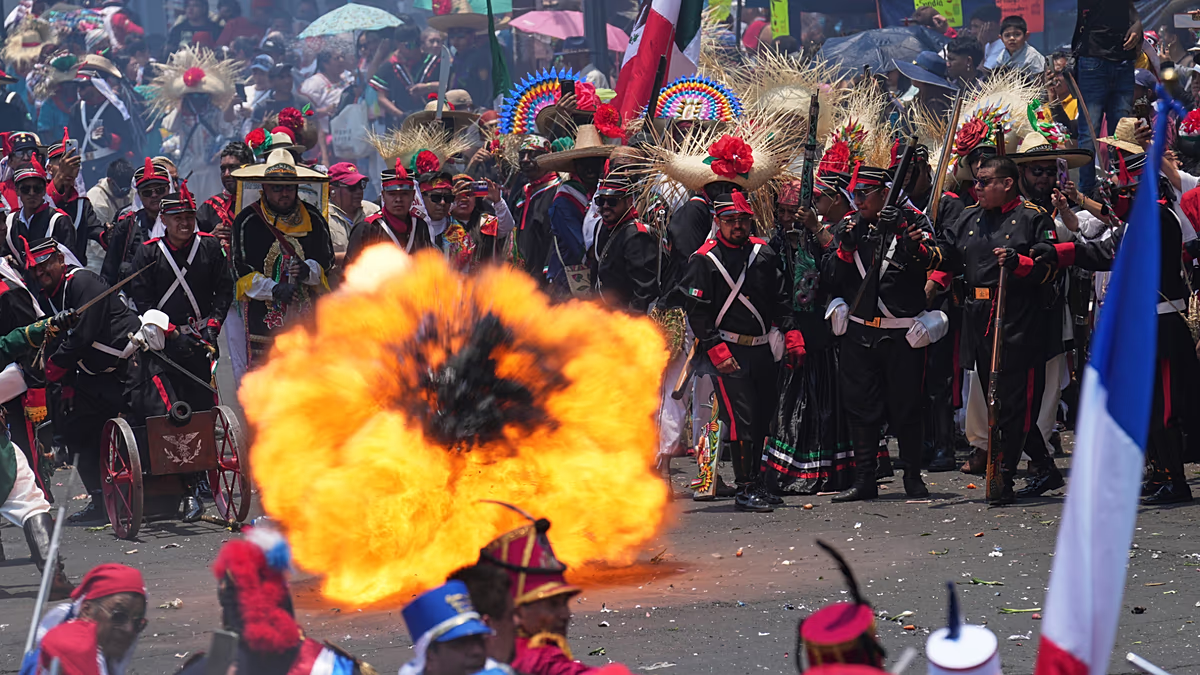
Of the many threads that weave together the tapestry of Mexican history, the Battle of Puebla stands as a particularly vibrant and defiant strand. Each year on the fifth of May, this thread is pulled back into the present, not merely through textbooks or speeches, but through living, breathing spectacle. In the state of Puebla, on the very grounds where history unfolded, participants dressed in meticulously recreated period uniforms take up arms once more. Mexican reenactors, embodying the spirit of General Ignacio Zaragoza’s ragged but determined army, face off against those portraying the formidable French expeditionary forces. The crack of mock musketry and the swirl of uniformed lines are more than a performance; they are a physical bridge to 1862. This annual restaging for the 164th anniversary is a profound act of communal memory, directly connecting modern citizens to the resilience of their forebears who secured an unlikely victory against a world power.
The historical victory commemorated is significant precisely because of its context. In 1862, a powerful French army, sent by Emperor Napoleon III to carve out a colonial foothold in the Americas and install a puppet monarchy, marched confidently toward Mexico City. They were intercepted at Puebla by a smaller, less experienced, and poorly equipped Mexican force under General Zaragoza. Against staggering odds, the Mexican defenders repelled the elite French troops on May 5th. It is crucial to understand, as historians note, that this battle did not end the French Intervention; the war would continue, and France would ultimately occupy Mexico for several years. Yet, the triumph at Puebla immediately became—and remains—a powerful symbol. It represents a moment when national unity and courage triumphed over overwhelming force, a foundational story of resistance that fuels national pride and identity. The reenactment, therefore, is not a celebration of a finished war, but a homage to the spirit that refused to be easily conquered.
This deep cultural reverence has led to formal recognition of the tradition’s importance. While the heart of the commemoration beats strongest in Puebla, its significance resonates nationwide. In Mexico City, the capital’s own ceremonies and observances surrounding Cinco de Mayo were officially inscribed as Intangible Cultural Heritage in 2023. This designation is far from ceremonial paperwork; it is a conscious commitment to safeguarding a living historical practice. It acknowledges that the value of Cinco de Mayo lies not in a forgotten date, but in the active, participatory rituals—the parades, the school performances, the reenactments—that keep its meaning alive. This status helps ensure funding, promotion, and continuity, framing the anniversary as a vital dialogue between past and present that must be actively maintained for future generations.
Interestingly, the journey of Cinco de Mayo from a regional historical anniversary to a day of widespread recognition is a story with two distinct paths. Within Mexico, its observance remains most fervent in Puebla, a point of local and national pride. However, across the border in the United States, the date has taken on a much broader, though often misunderstood, cultural life. Adopted initially by Mexican-American communities in the 19th century as a celebration of resistance and democracy during the U.S. Civil War, it has evolved into a widespread festival of Mexican heritage and culture. While this has sometimes led to commercialization and a loss of historical nuance, it also speaks to the day’s power as a symbol of identity and resilience for the diaspora. This trans-national visibility creates a unique dynamic, where the day simultaneously serves as a solemn historical lesson at home and a vibrant, public celebration of mexicanidad abroad.
Ultimately, for Mexican officials, historians, and educators, the core mission of these annual commemorations is one of transmission. The goal is to preserve a concrete historical memory and pass its essence to the young. In an age where history can feel distant or abstract, the sight of a parent in a Zaragoza uniform, the sound of a cannon salute, or the participation in a school pageant makes the past tangible. It transforms the Battle of Puebla from a chapter in a book into a story felt in the heart and seen with the eyes. This active remembrance fights the erosion of time, ensuring that the values of unity, defense of sovereignty, and courage against odds are not abstract concepts, but are inherited as part of a living legacy.
Therefore, the reenactments on the hills of Puebla are far more than a simple historical hobby. They are a profound civic and cultural ritual. They bind communities together through shared action, honor the sacrifices of ancestors, and instill a sense of historical continuity. From the officially recognized ceremonies in Mexico City to the local schoolyards where children learn of Zaragoza’s victory, Cinco de Mayo serves as an annual testament to a nation’s character. It reminds Mexicans and the world that their history is not just a record of events, but a continuing source of strength, identity, and inspiration, faithfully restaged not to relive a war, but to renew a promise of resilience for every generation that follows.