


Paragraph 1: A Gathering of Unlikely Guests
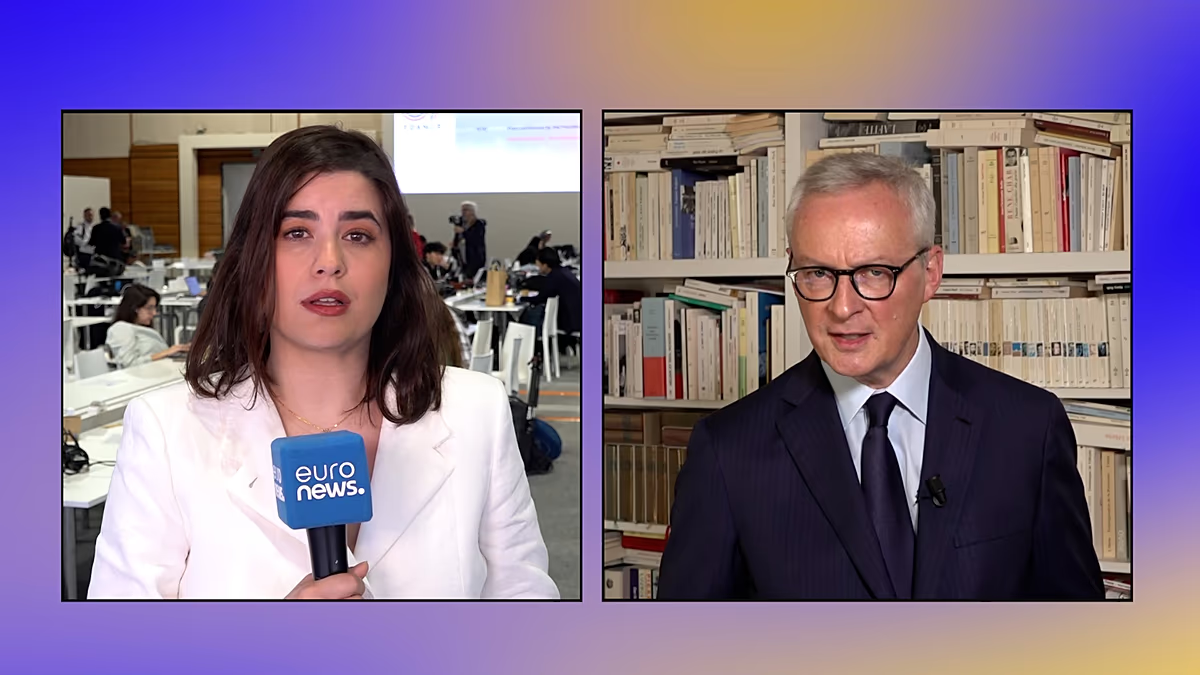
A scene that would have been unthinkable just a few years ago unfolded in Yerevan, Armenia. The nation, long viewed as Russia’s closest and most dependent ally in the South Caucasus, found itself hosting a remarkable assembly of Western leaders. The summit of the European Political Community and a separate EU-Armenia meeting brought together European heads of state, the Prime Minister of Canada, the Secretary General of NATO, and, most strikingly, Ukraine’s President Volodymyr Zelenskyy. This congregation was not merely a diplomatic event; it was a powerful visual symbol of a profound and deliberate geopolitical shift. For Armenia, a country traditionally within Moscow’s sphere of influence, this was a bold statement of reorientation, signaling a conscious turn toward Europe and a reevaluation of its century-long strategic partnership with Russia.
Paragraph疇: The Velvet Revolution’s Geopolitical Aftermath
The architect of this shift, as acknowledged by French President Emmanuel Macron at the summit, is Armenian Prime Minister Nikol Pashinyan. Macron noted the stark contrast, stating, “Eight years ago, nobody would come here… this country was seen… as a sort of de facto satellite of Russia.” He credited Pashinyan’s 2018 “Velvet Revolution” for “de-risking this country from Russia.” This process of emancipation has been painful. The deterioration of the Russo-Armenian alliance accelerated dramatically following Azerbaijan’s 2023 military operation, which resulted in the total dissolution of the separatist regime in Nagorno-Karabakh—a region over which Armenia and Azerbaijan had fought for decades. Yerevan felt profoundly betrayed by Moscow, which it viewed as a security guarantor, for its inaction and perceived complicity. This betrayal culminated in 2024 with Armenia suspending its membership in the Russia-led Collective Security Treaty Organization (CSTO), a military alliance analogous to NATO for the post-Soviet space.
Paragraph 3: Putin’s Ultimatum and Pashinyan’s Choice
The rift widened into a chasm in early 2025 when Pashinyan publicly declared Armenia’s future intention to join the European Union. Moscow’s response was swift and severe. During a tense Kremlin meeting in April, President Vladimir Putin delivered a not-so-veiled ultimatum. While claiming calmness about Yerevan’s EU flirtation, he explicitly ruled out any possibility of Armenia enjoying a dual economic relationship, stating membership in both the EU and Russia’s Eurasian Economic Union was “impossible.” The threat, connected to discussions of Russian gas supplies, was clear: choose your economic and political bloc. Just one month later, by hosting the European summit, Pashinyan made his choice unmistakable. He was steering his nation toward Europe, accepting the immense risks that came with defying Moscow.
Paragraph 4: The Provocation of Zelenskyy’s Visit
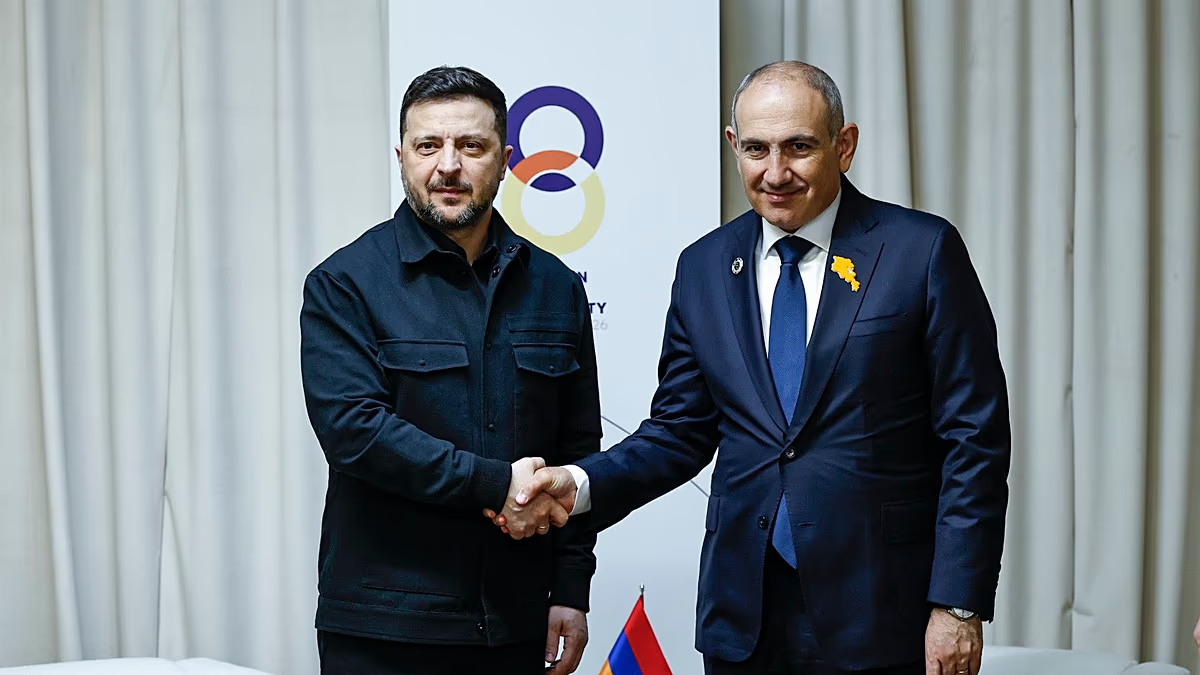
If the European summit was a defiance, the presence of President Zelenskyy was, in Moscow’s eyes, a profound provocation. His visit was historic—the first by a Ukrainian head of state to Armenia in 24 years. The talks between Zelenskyy and Pashinyan covered economic cooperation and, critically, security. Zelenskyy briefed Pashinyan on Ukraine’s peace diplomacy, a topic of extreme sensitivity for Russia. This engagement suggested Armenia was not only distancing itself from Moscow but actively engaging with its most bitter enemy, potentially even positioning itself as a neutral venue for future peace discussions. For the Kremlin, this was a step too far, a symbolic humiliation that crossed a red line.
Paragraph 5: The Kremlin’s Rhetorical Fury
While Russian officials maintained a stiff public silence, the state-controlled media and influential military bloggers unleashed a torrent of fury. The visit was labeled a “humiliation” and a “gut punch from Russia’s strategic partner.” Prominent propagandists like RT’s Margarita Simonyan expressed shock at Armenia’s “ungrateful” move, suggesting it was “high time we considered how to protect the Russian population and our interests in that country.” This specific wording is a notorious rhetorical precursor Russia has used to justify military interventions in Georgia, Ukraine, and Moldova. Meanwhile, radical military bloggers lambasted their own defense ministry for not intercepting Zelenskyy’s plane, with one calling the episode “the most shameful page in history.” This outrage revealed a deep-seated perception of betrayal and a loss of imperial control.
Paragraph 6: A Precarious Path Toward a New Future
Armenia now stands at a perilous crossroads. Its westward turn, celebrated in European capitals, has come at a severe cost. It has traded the flawed but familiar security umbrella of Russia for a promised but undefined European future, all while its historical adversary, Azerbaijan, watches closely. Russia maintains a tangible military presence—around 3,000 troops at its base in Gyumri under an existing pact—making the threat more than just rhetorical. Pashinyan’s gamble is monumental: he is betting that the political and economic integration offered by Europe, and the potential for new security partnerships, will provide a more stable and sovereign future than subordination to a resentful and unpredictable Kremlin. The summit in Yerevan was not just a meeting; it was a declaration of independence, a plea for new allies, and a step onto a high-wire act with no safety net, as Armenia seeks to redefine its destiny in a fractured world.