
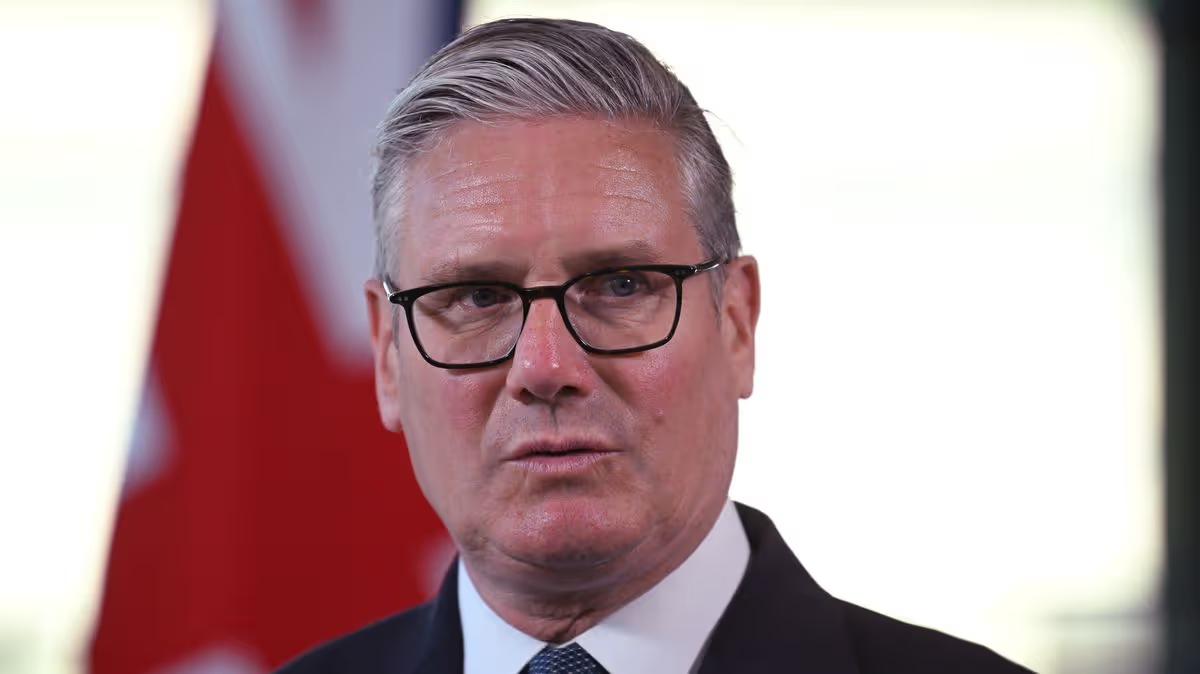


In a sobering national address, Canadian Prime Minister Mark Carney delivered a fundamental reassessment of Canada’s most important relationship, declaring that the country’s deep economic integration with the United States has shifted from a historic strength to a present vulnerability. Speaking against a backdrop of global instability, Carney articulated a clear-eyed vision that moves beyond wishful thinking, stating that the world has grown more dangerous and divided. He pointed directly to a transformative shift in U.S. trade policy under President Donald Trump, whose administration has raised tariffs to levels not seen since the Great Depression. This protectionist turn, Carney argued, has exposed the fragility of a Canadian economy that has long relied on seamless access to its southern neighbour, compelling a national strategy of economic diversification to correct this newfound weakness.
The tangible impacts of this shift are already being felt across key Canadian industries. Carney highlighted the acute pressures on auto and steel sector workers, who are caught in the crossfire of rising trade barriers. Beyond specific tariffs, he identified a broader, more insidious problem: a pervasive “pall of uncertainty” that is causing businesses to hesitate and withhold critical investments for the future. This climate of unpredictability, stemming from the volatile U.S. trade stance, stifles growth and innovation. In response, Carney promised Canadians a policy of transparent and regular updates, vowing never to “sugarcoat” the challenges ahead. His message was one of sober realism, emphasizing that true national security requires acknowledging these threats rather than ignoring them.
This perspective is not a sudden development for Carney, a former governor of both the Bank of Canada and the Bank of England, who has long observed the shifting tectonics of global power. Earlier in the year, at the World Economic Forum in Davos, he earned international acclaim for condemning the economic coercion of smaller nations by larger powers—a speech that drew a sharp personal rebuke from President Trump. Trump’s retort, “Canada lives because of the United States,” underscored the very dynamic Carney now seeks to alter: a relationship perceived in Washington as fundamentally asymmetrical. The Prime Minister’s latest address, delivered without immediate White House reaction, thus represents a deliberate and calculated next step in a carefully articulated foreign economic policy.
The timing of this declaration is politically significant, coming shortly after Carney’s government secured a strengthened mandate through special election wins. He is now under pressure from the opposition Conservatives to deliver on a promised trade deal with the U.S., a key election pledge. Yet, his address suggests a strategic pivot, broadening the focus from securing a single agreement to fundamentally restructuring Canada’s economic foundations. His plan is ambitious and domestic in its focus: attracting new foreign investment, doubling clean energy capacity, reducing internal trade barriers, and following through on commitments to increase defence spending, cut taxes, and improve housing affordability. This suite of policies is framed as building internal resilience.
At the heart of Carney’s philosophy is a call for self-reliance and proactive sovereignty. He argued that Canada cannot control the disruptive actions of its neighbour, nor can it stake its future on the hope that such disruptions will “suddenly stop.” Instead, he urged a focus on what Canadians can control within their own borders. “Hope isn’t a plan and nostalgia is not a strategy,” he stated pointedly, dismissing the idea of simply waiting for a return to a bygone era of U.S. partnership. He reminded listeners that Canada has been a steadfast ally, supporting American military endeavours from the World Wars to Afghanistan, implying that the relationship should be one of mutual respect, not dependency.
Concluding with a powerful call to action, Carney framed this economic diversification not as a rejection of the United States, but as a necessary evolution for Canadian prosperity and security. “The US has changed and we must respond,” he asserted. The mission, as he defines it, is ultimately about “taking back control of our security, our borders and our future.” This represents a defining moment for his premiership, setting a course to weave Canada’s economic fabric with a more diverse set of global threads. The goal is to construct a nation robust enough to withstand external shocks, ensuring that its destiny is shaped in Ottawa and in Canadian boardrooms, not solely in reaction to the political winds of Washington.