

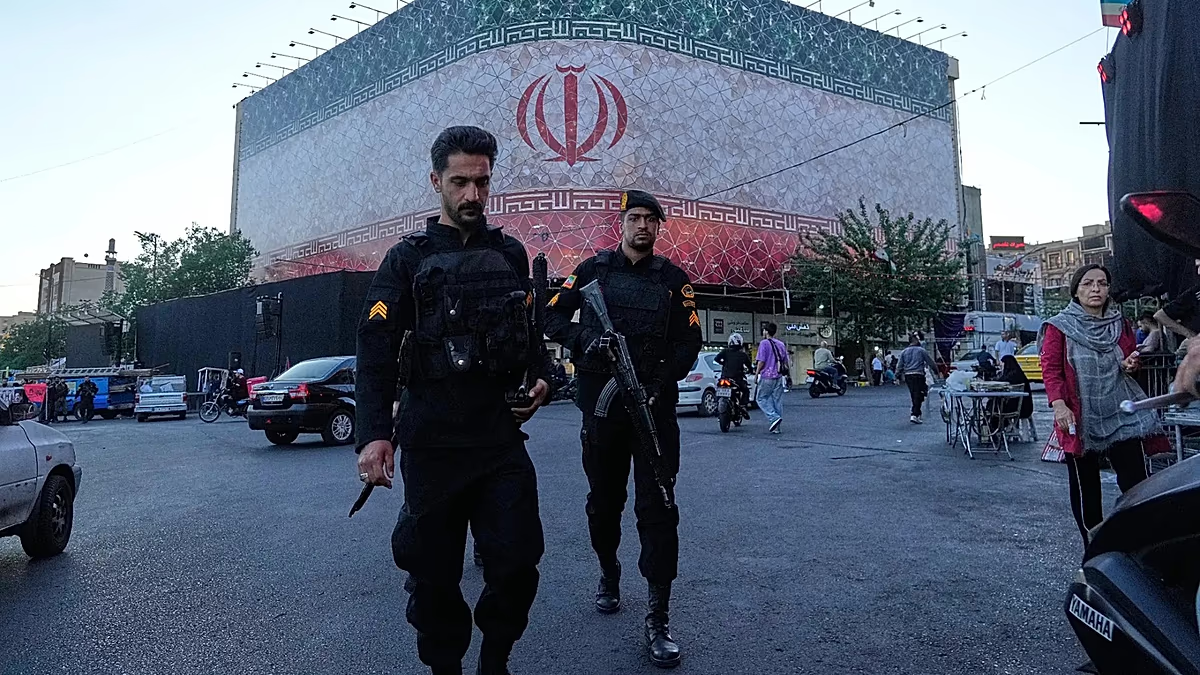
The recent framework agreement between the United States and Iran, aimed at bringing an immediate halt to open hostilities, has been immediately clouded by triumphant claims from Tehran and stark reservations from Israel. The deal, confirmed by Iranian Deputy Foreign Minister Kazem Gharibabadi, ostensibly establishes a ceasefire and paves the way for a final agreement after sixty days of further talks. However, the Iranian presentation has been one of unambiguous victory. State media banners declared the U.S. was “forced to sign,” while military officials proclaimed the “humiliated enemies” had no choice but to accept defeat. This narrative extends beyond rhetoric into tangible geopolitical claims, particularly regarding the strategically vital Strait of Hormuz, through which a significant portion of the world’s oil flows. Iran has announced plans, in cooperation with Oman, to establish a legal framework governing navigation, implying a future where it could levy tolls—a move swiftly rejected by Oman and viewed with deep suspicion by neighboring Gulf states. This immediate posturing underscores the fragility of the accord and the divergent interpretations each side brings to the table.
While Iran frames the deal as a capitulation by Washington, the United States’ position, as articulated by President Donald Trump, appears more measured and conditional. Trump initially announced the reopening of the Strait and the lifting of the U.S. naval blockade, only to later clarify these actions were pending the formal signing of the agreement in Switzerland. The details emerging from Iranian media, such as the release of billions in frozen assets, have not been confirmed by the U.S. and remain a point of potential contention. The core of the ongoing negotiation, as hinted by Trump himself, revolves around the critical issue of Iran’s nuclear program and the duration for which it would suspend uranium enrichment. This ambiguity around the specifics—what Iran gets, what concessions it makes, and the exact sequence of events—leaves the agreement on shaky ground, vulnerable to spoilers and misinterpretation from all sides.
One of the most significant and immediate challenges to the deal’s viability comes from Israel, a key U.S. ally and Iran’s primary regional adversary. Israeli officials have made it clear they do not consider the ceasefire to apply to their ongoing military operations against Hezbollah in Lebanon. Defense Minister Israel Katz stated a policy of maintaining Israeli Defense Forces in security zones in Lebanon, Syria, and Gaza indefinitely. Finance Minister Bezalel Smotrich dismissed the framework as “bad for Israel and for the entire free world,” vowing to continue campaigns to counter Iran. This stance directly contradicts a central Iranian precondition, which has consistently demanded an end to hostilities in Lebanon as non-negotiable for a broader peace. Iran’s Foreign Minister actively lobbied regional powers to pressure Israel to halt its campaign, placing the onus for enforcement on the United States. This stark disconnect threatens to unravel the fragile truce before the final negotiations even begin.
The heart of this tension lies in the role of Hezbollah and the broader “Axis of Resistance.” This network of proxy forces, built and funded by Iran’s Islamic Revolutionary Guard Corps, represents Tehran’s primary tool for projecting power across the Middle East. The current conflict itself was triggered by Hezbollah’s missile attacks on Israel, launched in retaliation for the killing of Iran’s Supreme Leader in initial U.S.-Israeli strikes. The subsequent Israeli intervention in Lebanon has, according to Lebanese officials, resulted in thousands of casualties and massive displacement. For Iran, Hezbollah is not merely an ally but a strategic asset; for Israel, it is an existential threat on its northern border. Any agreement that does not definitively address the status and activities of these Iranian-backed militias, particularly Hezbollah, is inherently unstable. The framework deal, by leaving this core conflict simmering, fails to address the fundamental regional rivalry that fuels the violence.
The path forward is fraught with obstacles. The promised sixty-day negotiation window will be a period of intense diplomatic maneuvering, where the unresolved details—nuclear limits, financial transactions, and the future of Iran’s regional proxies—must be hammered out. The Trump administration will face the difficult task of reconciling Israel’s security concerns with the terms of a deal that Iran already celebrates as a triumph. Meanwhile, Gulf Arab states watch nervously as Iran asserts control over shared waterways, threatening to create new fissures in an already unstable region. The initial fanfare from Tehran and the immediate pushback from Jerusalem reveal the agreement for what it is: a precarious pause, not a peace. Its success hinges on the parties’ willingness to compromise on issues they have thus far presented in absolutist, victory-or-defeat terms.
Ultimately, the framework agreement is a testament to the exhaustion of all sides with open warfare, but not necessarily a commitment to a shared vision for stability. It is a temporary bridge built over a canyon of deep-seated mistrust, conflicting interests, and unresolved grievances. The Iranian victory narrative, the Israeli rejection of its scope, and the vague American conditions all point to a rocky implementation at best. The coming weeks will test whether diplomacy can forge a lasting peace from a ceasefire each side interprets so differently, or whether this pause merely becomes an intermission before the next, potentially more devastating, chapter of conflict. The world, reliant on the stability of the Persian Gulf, holds its breath.