


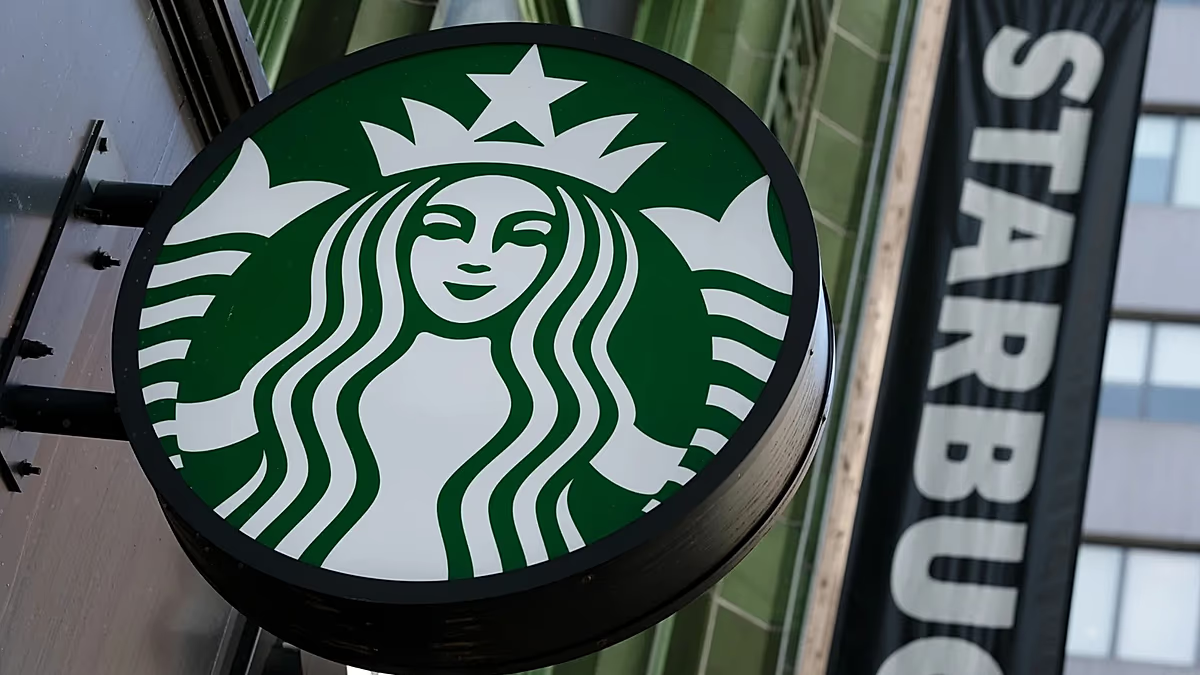
In a move of profound corporate contrition, Starbucks stores across South Korea will close for half a day next week. This unprecedented nationwide shutdown, the first since the brand entered the market in 1999, is not for maintenance or a corporate celebration, but for a mandatory history lesson. The directive comes from Shinsegae Group, the local licensee, in direct response to a catastrophic promotional campaign that inadvertently evoked one of the nation’s most painful and politically charged historical events. The campaign, bluntly named “Tank Day,” was scheduled for May 18th—the precise date marking the 46th anniversary of the 1980 Gwangju Uprising, a pro-democracy movement violently suppressed by military forces. The mere suggestion of a celebratory “tank” promotion on this somber anniversary ignited immediate and fierce public outrage, highlighting a deep and damaging failure of cultural sensitivity.
The Gwangju Uprising holds a sacred and tragic place in South Korea’s modern identity, seen as a pivotal struggle for democracy against authoritarian rule. The official death toll stands at 165 civilians, though many citizens and historians believe the true number is significantly higher. For a global brand like Starbucks to appear to commercialize this memory with a promotional gimmick was perceived not merely as a marketing misstep, but as a profound act of disrespect toward the victims, their families, and the nation’s democratic journey. The backlash was swift and severe, manifesting in public protests in Seoul and Gwangju, a torrent of criticism on social media, and even a statement from opposition leader Lee Jae Myung, who condemned the “inhumane and disgraceful conduct.” The emotional public response underscores how historical memory in South Korea is not a distant academic subject, but a living, deeply felt part of the social fabric.
Confronted with this firestorm, Shinsegae Group acted with decisive, sweeping measures intended to signal accountability from the very top of the organization to every frontline barista. On the very day the scandal erupted, the company fired the CEO of Starbucks Korea. The announced training plan extends this accountability upward: while all store employees will attend their session next Monday afternoon, shutting down over 2,000 outlets at 3 p.m. for three hours, the chairman of Shinsegae Group, Chung Yong-jin, along with the CEOs of all affiliate companies, will themselves undergo a separate, similar training session two days later. This structure sends a clear message—the failure was systemic, and the responsibility is shared by all levels of leadership, not just the marketing team that conceived the ill-fated campaign.
The internal investigation revealed a staggering series of procedural breakdowns that allowed such a tone-deaf promotion to proceed unchallenged. According to the company, officials had signed off on the campaign design without even opening the file to review its content. Furthermore, the promotion underwent no legal or compliance review, a standard check that might have flagged the obvious historical implications. This points to a dangerous corporate culture where routine checks and balances were ignored, and social sensitivity was completely divorced from marketing strategy. The planned training, to be led in part by Professor Koo Jeong-woo of Sungkyunkwan University, will therefore aim to rebuild this essential awareness, focusing on the “meaning of social sensitivity” and the specific historical context that was so grievously overlooked.
The financial and reputational consequences for Starbucks in South Korea, its third-largest global market after the U.S. and China, have been immediate and severe. Shinsegae Group acknowledged a “sharp decline in sales” in the immediate aftermath of the scandal. In a market with intense competition from both global chains and local coffee brands, consumer loyalty is fragile. The closure itself, while a necessary step in rebuilding trust, also represents a significant loss of revenue and disrupts customer routines. However, the greater cost lies in the long-term brand damage. The episode has exposed a jarring disconnect between the corporation and the society it serves, threatening its hard-earned position as a ubiquitous and welcome part of daily Korean life.
Ultimately, this incident serves as a stark, textbook case study in the absolute necessity of local historical and cultural literacy for global corporations. For foreign brands operating in any market with a complex historical narrative, understanding local trauma is not an optional element of corporate social responsibility; it is a fundamental prerequisite for doing business. Starbucks Korea’s response, through widespread closures and top-to-bottom retraining, is an attempt to publicly atone and relearn this lesson. It is a dramatic acknowledgment that in our interconnected world, a failure of memory and empathy is not just a public relations problem, but a direct threat to a company’s very license to operate. The true test will be whether this painful episode fosters a genuine, enduring change in corporate consciousness, ensuring that such a grievous oversight never happens again.