



Paragraph 1
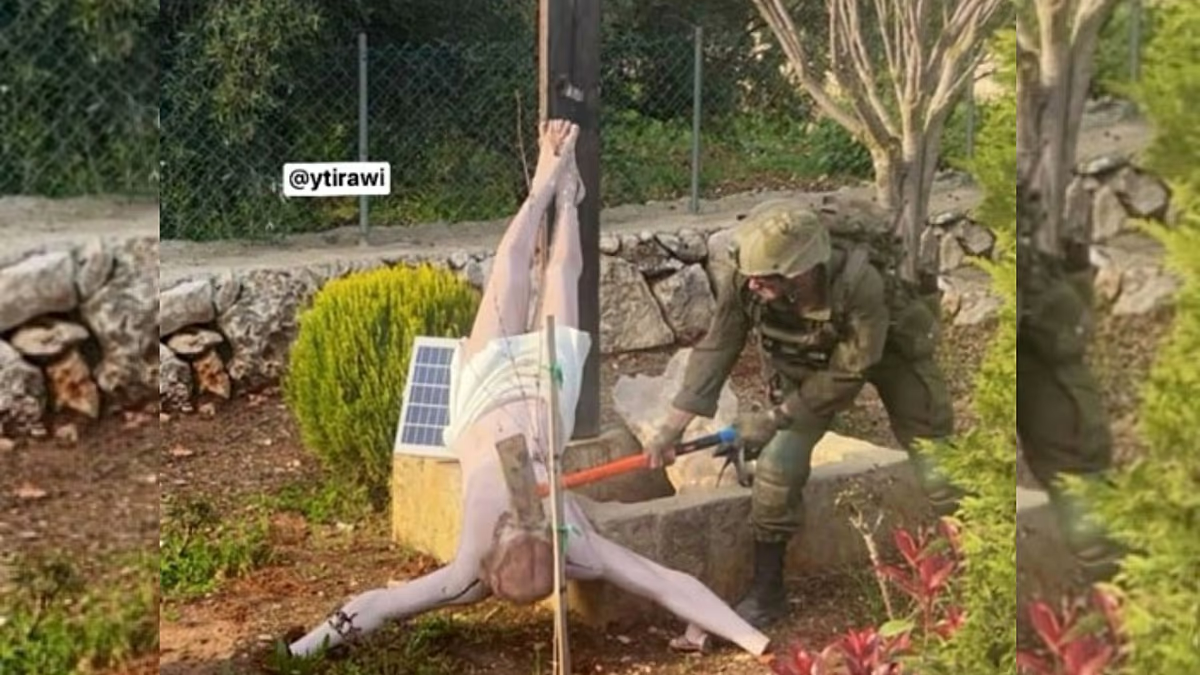
A deeply troubling image emerged from the conflict-scarred landscape of southern Lebanon this week, provoking international condemnation and highlighting the fragile state of interfaith relations in the region. The photograph, verified as authentic by Israeli authorities, shows an Israeli Defense Forces (IDF) soldier using a sledgehammer or axe to smash the face of a statue depicting the crucified Jesus. The act of desecration occurred in Debel, a Christian village near the Lebanese-Israeli border, and its rapid circulation on social media ignited immediate outrage. In response, Israeli Prime Minister Benjamin Netanyahu moved swiftly to condemn the incident “in the strongest terms,” expressing that he, “like the overwhelming majority of Israelis,” was “stunned and saddened.” He announced a criminal probe and promised “harsh disciplinary action” for the soldier involved, framing the act as a violation of core Israeli values. Netanyahu emphasized that Israel, “as a Jewish state, cherishes values based on tolerance and mutual respect among followers of all religions,” and contrasted the situation with the persecution of Christians elsewhere in the Middle East.
Paragraph 2
The incident quickly transcended its local context, sparking a sharp diplomatic exchange that laid bare wider geopolitical tensions. The initial apology from Israeli Foreign Minister Gideon Sa’ar, who called the damage “grave and disgraceful” and apologized to every offended Christian, was met with a pointed response from Poland’s Deputy Prime Minister, Radosław Sikorski. While Sikorski commended Sa’ar’s quick apology, he used the moment to levy much broader criticisms against the Israeli military campaign in Gaza, referencing soldier admissions of war crimes and the high Palestinian civilian death toll. Sa’ar fired back, rejecting Sikorski’s comments as “grave, baseless, and slanderous,” and vigorously defending the IDF as a “professional and ethical army.” This heated exchange illustrated how a single act of vandalism could become a flashpoint for entrenched international disagreements over the conduct of the wider conflict, pulling the focus from Lebanon to Gaza. The condemnation was not limited to European officials; U.S. Ambassador to Israel Mike Huckabee also called for “swift, severe, and public consequences” for the soldier involved.
Paragraph 3
For Lebanon’s Christian community, which makes up roughly 30% of the population and is the only significant Christian power-sharing bloc in the Middle East, the vandalism felt like a targeted blow. This diverse community, encompassing Maronite Catholics, Greek Orthodox, and other denominations, has long navigated a precarious existence amidst regional strife. Already caught in the crossfire of the ongoing hostilities between Israel and Hezbollah, with thousands displaced from their homes in southern villages, the desecration of a potent religious symbol in a Christian village struck a profound nerve. It was perceived not as an isolated act of a rogue soldier, but as part of a pattern of erosion and threat to their presence and heritage. The incident risks further poisoning the atmosphere at a critically fragile moment, undermining the tentative ceasefire between Israel and Hezbollah and deepening the sense of vulnerability among Lebanese Christians who feel their stability and holy sites are under threat from multiple sides.
Paragraph 4
Distressingly, this act of vandalism is not an isolated episode in recent months but part of a series of incidents straining relations between Israeli authorities and Christian communities in the Holy Land. Just days earlier, on March 9, a Maronite priest, Father Pierre Al-Rahi, was killed in an Israeli tank strike on a house in the border village of Qlayaa, an event that drew an expression of “profound sorrow” from the Pope. Furthermore, on Palm Sunday, Israeli authorities initially prevented the Latin Patriarch of Jerusalem, Cardinal Pierbattista Pizzaballa, from entering the Church of the Holy Sepulchre to celebrate Mass—a move condemned by Western leaders like Italy’s Giorgia Meloni and France’s Emmanuel Macron as an assault on religious freedom. While Netanyahu later reversed the decision, explaining it was made over specific safety concerns due to Iranian missile threats near holy sites, the cumulative effect of these events has been to create a palpable sense of grievance and anxiety among Christian leaders and congregations, who see a worrying pattern of disrespect and endangerment.
Paragraph 5
The context of this tension is the renewed and devastating conflict along the Lebanon-Israel border, a front that has been active alongside the war in Gaza. Hostilities, triggered by Hezbollah rocket fire in solidarity with Hamas and in response to the killing of an Iranian general, have resulted in over 2,000 deaths in Lebanon and widespread displacement. Despite a recent ceasefire, skirmishes continue in a buffer zone, and the IDF has warned residents, including Christians, not to return to certain border villages. Into this tinderbox of fear, displacement, and ongoing military activity, the image of a soldier destroying a central icon of Christian faith landed with explosive force. It transformed an abstract geopolitical conflict into a visceral, personal insult for many Lebanese Christians, symbolizing a deeper violation of their community’s space and sanctity during a time of profound insecurity.
Paragraph 6
In conclusion, the desecration of the statue in Debel, while officially condemned and under investigation by Israel, has reverberated far beyond the shattered plaster or stone. It has exposed raw interfaith nerves, fueled diplomatic strife, and compounded the fears of an already vulnerable Christian minority in Lebanon. The incident sits within a troubling sequence of events that have placed Christian sites and figures in the crosshairs of a wider regional war, both literally and figuratively. For the Christian communities of the Levant, these actions are not merely military or political missteps but are felt as assaults on their very identity and continuity in a region they have called home for millennia. As fragile ceasefires hold, addressing the profound sense of disrespect embodied in this act will be crucial, not just for military discipline, but for any future hope of reconciliation and stable coexistence in a tragically divided land.