


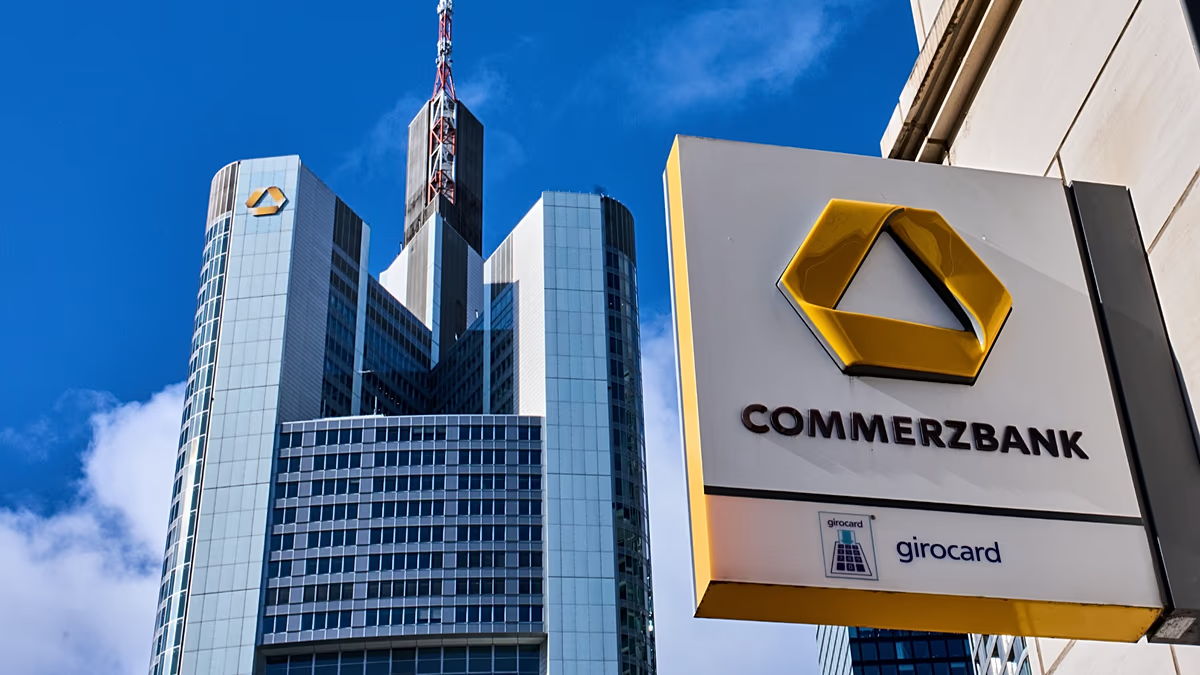
In a bold and defiant move, Commerzbank has laid out an aggressive new roadmap for its future, one that serves as both a declaration of independence and a direct counterpoint to the takeover ambitions of Italy’s UniCredit. Announced in early May 2026, the Frankfurt-based lender unveiled sharply upgraded financial targets, pledging to boost revenues to €16.8 billion and net profit to a staggering €5.9 billion by the year 2030. Alongside this vision of ambitious growth, however, came a sobering human cost: a plan to cut an additional 3,000 jobs, affecting roughly 8% of its current workforce. Chief Executive Bettina Orlopp framed the strategy as “ambitious and at the same time reliable,” adding a pointed warning that “any alternative must be measured against this.” The message was unequivocal: Commerzbank believes it can—and should—forge its own path to prosperity.
This strategic gambit is a direct response to the high-stakes corporate drama unfolding around it. Just days before, UniCredit formalized a voluntary share exchange offer for all outstanding Commerzbank shares, valuing the German institution at nearly €35 billion. This was not a sudden move, but the culmination of a calculated campaign. Since first acquiring a large stake from the German government in 2024, UniCredit has steadily increased its holdings through market purchases. Under German takeover law, once its stake crossed a certain threshold, it was legally compelled to make a formal offer. It now directly controls about 26% of Commerzbank, with another 4% held via financial instruments. For Commerzbank’s leadership and its political supporters, this bid is viewed not as an opportunity, but as an existential threat that has set “alarm bells ringing in Frankfurt and Berlin.”
The profound anxiety stems from Commerzbank’s unique and deeply embedded role in the German economic ecosystem. As the country’s second-largest private lender, it is far more than just a bank; it is a pivotal financial lifeline for the famed Mittelstand—the small and medium-sized family businesses that form the backbone of Germany’s industrial might. A takeover by a foreign entity, particularly one with a reputation for aggressive restructuring, raises fears that this focus could be gutted in favor of a more centralized, pan-European model. Commerzbank executives have been quick to label UniCredit’s plans as “vague” and laden with “considerable implementation risks.” They warn that UniCredit’s own projections suggest around 7,000 total job cuts could be on the horizon, a far deeper and more disruptive reduction than the bank’s own painful but controlled restructuring.
Yet, Commerzbank’s defensive strategy is not merely rhetorical. Its own plan involves a significant €450 million restructuring charge, acknowledging that achieving its lofty profit goals requires difficult efficiency measures now. A key part of this transformation, the bank notes, will be the increased use of artificial intelligence to streamline processes. This context adds a layer of complexity to the job cuts: they are framed as a necessary, if painful, step to modernize and fortify the bank from within, rather than cuts imposed from outside. The bank is keen to demonstrate that it is proactively shaping its destiny, pointing to a net profit of €913 million in the first quarter of 2026—its best quarterly result since 2011—as evidence that its current trajectory is already bearing fruit.
The political dimension of this battle cannot be overstated. The German state retains a stake of around 12% in Commerzbank, a legacy of its bailout during the financial crisis, and reports suggest the government is even exploring options to increase its holding to fend off the Italian suitor. Chancellor Friedrich Merz has thrown his weight firmly behind Commerzbank, stating that while Germany needs strong banks, “not every type of takeover” is welcome. His declaration, “We firmly reject hostile and aggressive behaviour,” elevates the affair from a corporate tussle to a matter of national economic interest. This political backing provides Commerzbank with a powerful shield as it makes its stand, framing resistance not as corporate stubbornness, but as a defense of a vital national institution.
Despite the firm stance, Commerzbank has left a narrow door open for dialogue. The bank states it remains open to talks in principle, but under strict conditions: shareholders must be offered an “attractive premium,” and, crucially, key elements of its strategy—presumably its commitment to the Mittelstand and its German retail base—must be retained. In essence, it has drawn its line in the sand. The coming months will determine whether UniCredit’s offer can be sweetened or shaped to meet these conditions, or if Commerzbank’s dramatic plan of deep cuts and high profits will convince shareholders that independence is the more valuable course. The outcome will resonate far beyond boardrooms, impacting tens of thousands of employees and the very fabric of German industrial finance.