

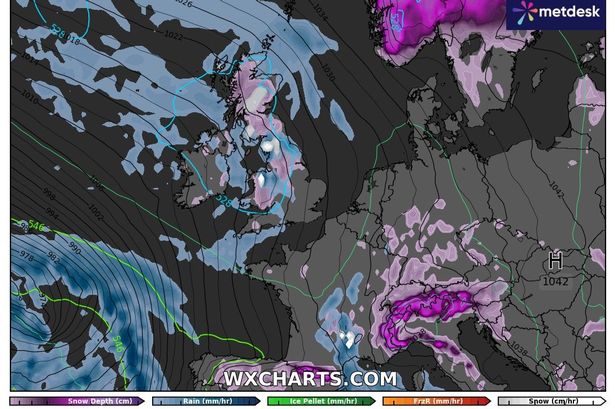
The term “polar vortex dislocation” recently splashed across headlines, stoking fears of an impending “winter hell.” While this phrasing evokes dramatic imagery of a sudden, catastrophic shift in weather patterns, the reality is more nuanced. Meteorologists, including experts at the Met Office (the United Kingdom’s national weather service), offer a more measured perspective on this phenomenon, explaining its mechanics, potential impacts, and the uncertainties inherent in long-range forecasting. To understand the potential implications, we must first clarify what the polar vortex is and how its behavior can influence winter weather.
The polar vortex isn’t a single, monolithic storm, but rather a large-scale, persistent area of low pressure and cold air that swirls around the Earth’s poles in the stratosphere, the layer of the atmosphere above where most weather occurs. This swirling mass of air is typically confined to the polar regions by strong winds known as the polar jet stream. The strength and position of the polar vortex and the jet stream naturally fluctuate throughout the year. During winter, the vortex strengthens and the jet stream generally flows in a relatively straight path from west to east. However, under certain conditions, the vortex can weaken and become distorted, leading to what’s popularly termed a “dislocation” or “split.” This weakening allows the jet stream to meander southward, bringing frigid air and potentially severe winter weather to lower latitudes.
Several factors can influence the stability of the polar vortex. One key player is sudden stratospheric warming (SSW), a rapid increase in temperature in the stratosphere over the poles. SSW can disrupt the polar vortex, weakening its winds and causing the jet stream to buckle. Another contributing factor is the Arctic Oscillation (AO), a climate pattern characterized by changes in atmospheric pressure between the Arctic and mid-latitudes. A negative AO phase is associated with a weaker polar vortex and a greater likelihood of cold air outbreaks in mid-latitudes. While these factors can increase the probability of disruptions to the polar vortex, they don’t guarantee a particular outcome in terms of weather. The interaction of these large-scale atmospheric patterns with other meteorological factors creates a complex and often unpredictable picture.
Forecasting the impacts of a polar vortex disruption is challenging, particularly on longer timescales. While a weakened vortex can increase the likelihood of cold air outbreaks, it doesn’t dictate precisely where or when the coldest air will strike. The meandering jet stream can steer individual weather systems, bringing snow, ice, and frigid temperatures to some regions while others experience relatively mild conditions. Furthermore, the impact of a weakened vortex can vary depending on the specific region and its prevailing climate. A southward dip in the jet stream might bring unusually cold weather to one area but merely average winter conditions to another. The timing of the disruption also plays a role. A late-season weakening might have a less pronounced impact as the sun’s angle becomes higher and overall temperatures begin to rise.
The term “winter hell” used in some media reports is often hyperbole designed to capture attention rather than a scientifically accurate description of potential weather conditions. While a disrupted polar vortex can lead to periods of harsh winter weather, it doesn’t necessarily imply widespread, catastrophic conditions. Meteorologists prefer to use more measured language, focusing on probabilities and potential scenarios rather than making definitive pronouncements of extreme weather. They emphasize the uncertainty inherent in long-range forecasting and caution against interpreting a weakened polar vortex as a guarantee of severe winter weather everywhere. Instead, they focus on providing probabilistic forecasts that reflect the range of possible outcomes.
It’s essential to distinguish between weather and climate when discussing the polar vortex. While a disrupted vortex can influence short-term weather patterns, it’s not directly linked to long-term climate change trends. Climate change is primarily driven by increasing concentrations of greenhouse gases in the atmosphere, which lead to a gradual warming of the planet. While some research suggests a potential connection between Arctic warming and changes in the polar vortex, the relationship is complex and still under investigation. It’s important not to conflate short-term weather events, even extreme ones, with the long-term trends of a changing climate. Responsible reporting on the polar vortex requires careful consideration of the scientific nuances and avoiding sensationalist language that can misrepresent the potential impacts. The Met Office and other meteorological agencies carefully monitor the polar vortex and other atmospheric patterns to provide the most accurate and reliable forecasts possible, recognizing the inherent uncertainties in predicting the complexities of weather.