


Paragraph 1: A Diplomatic Standoff Emerges
A significant diplomatic rift is unfolding within the European Union, centered on Spain’s call to fundamentally reassess the bloc’s relationship with Israel. During a meeting of EU Foreign Ministers in Brussels, member states are poised to reject a Spanish proposal to suspend the EU-Israel Association Agreement. This agreement forms the bedrock of economic and political ties between the EU and Israel, facilitating trade, dialogue, and cooperation. Spanish Prime Minister Pedro Sánchez ignited this debate by publicly urging the agreement’s termination, arguing that Israel’s conduct in Gaza and the West Bank constitutes violations of international humanitarian law, thereby breaching the accord’s essential principles. However, Sánchez’s bold stance faces immediate resistance, highlighting a deep and persistent division among the 27 member states on how to respond to the ongoing conflict.
Paragraph 2: The Coalition for Action and the Wall of Consensus
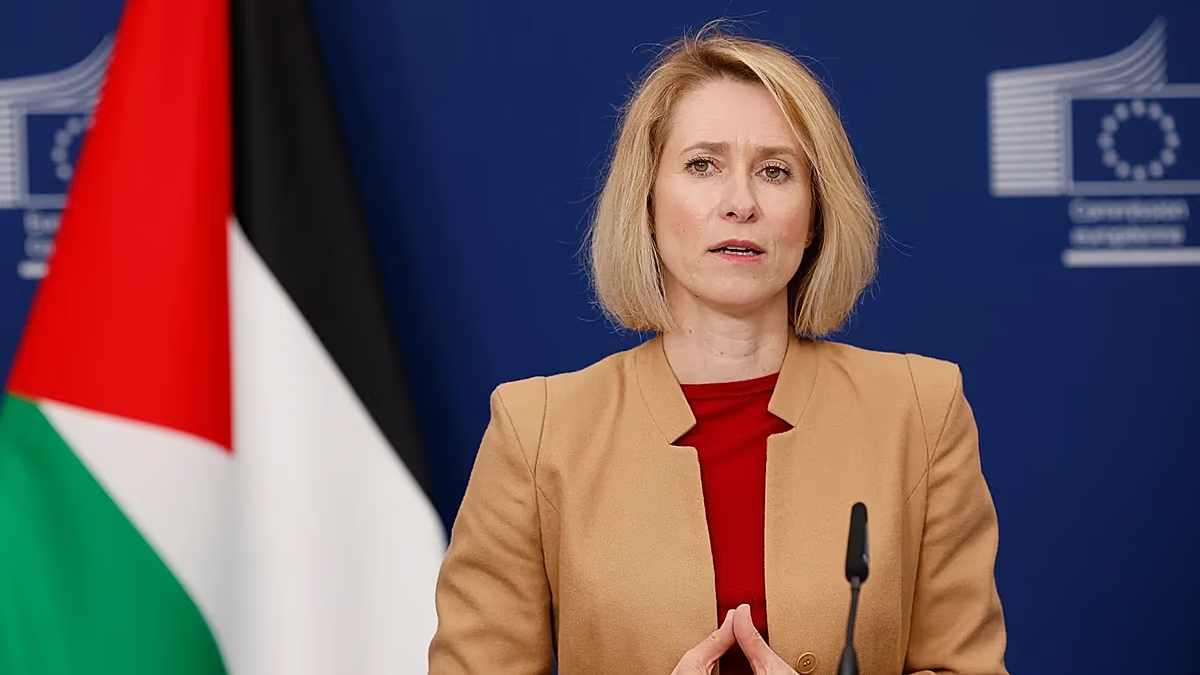
Spain is not alone in its demand for a tougher stance. Ireland and Slovenia have previously aligned with Madrid, contending that Israel’s actions—including the escalation of violence in the West Bank, attacks on Lebanese civilians, and parliamentary moves toward approving the death penalty—represent a breach of its human rights obligations under the agreement. Yet, despite this growing coalition, the path to actual suspension is legally and politically narrow. EU Foreign Affairs Chief Kaja Kallas emphasized that a “unified position” among member states is necessary, a formidable requirement given the current landscape. Diplomats confirm that broad consensus is absent. Key EU powers, including Germany and Italy, remain opposed. Italy’s government, led by Giorgia Meloni, has stated it will pursue a “serious and balanced approach,” cautioning against measures that could harm Israeli civilians, reflecting a widespread concern about the unintended humanitarian consequences of severing ties.
Paragraph 3: Stalled Measures and Citizen Pressure
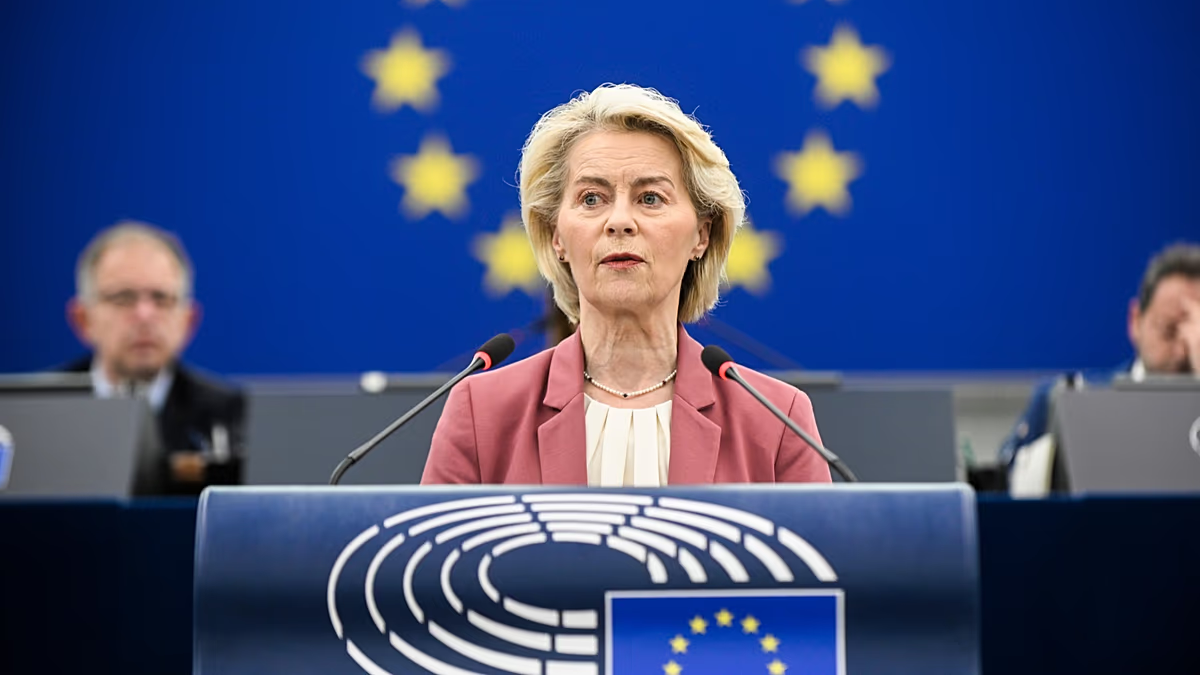
The debate is not limited to a full suspension; lesser measures have also encountered roadblocks. Last September, as the war in Gaza continued, European Commission President Ursula von der Leyen proposed a partial suspension targeting the trade provisions of the agreement. This more limited step met similar resistance from a cluster of member states. Furthermore, over a million European citizens have lent their voice to the cause, signing a cross-border petition demanding the agreement’s suspension, illustrating significant public pressure for action. Kallas herself has suggested exploring partial measures to exert pressure, following discussions with Palestinian Prime Minister Mohammad Mustafa on advancing a two-state solution. However, these proposals remain stalled. Countries like Germany, Hungary, and the Czech Republic form a blocking minority, preventing the formation of the qualified majority needed to enact any trade restrictions, leaving the EU’s substantive economic relationship with Israel unchanged.
Paragraph 4: A Glimmer of Progress on Settler Sanctions
In contrast to the deadlock over the association agreement, another EU initiative shows potential for progress. The European Commission has proposed a set of sanctions specifically targeting violent Israeli settlers in the West Bank. This measure, designed to punish individuals committing acts of violence against Palestinians and to support the EU’s commitment under the New York Declaration to target entities supporting illegal settlements, has secured agreement from all member states except one: Hungary. To date, the EU has sanctioned nine individuals and five entities under its human rights regime for extremist violence and for blocking aid to Gaza. The Hungarian opposition has been the sole obstacle to a broader, dedicated sanctions framework. However, a recent change in Hungary’s political landscape—following elections that are expected to bring a new government to power—has injected hope. Kallas noted that with a new administration in Budapest, the EU can re-examine the policy, suggesting a possible breakthrough on this more targeted form of pressure.
Paragraph 5: The Core Challenge: Strategic Divisions and Legal Complexities
The impasse reflects more than a simple disagreement; it underscores profound strategic and moral divisions within the EU regarding the Israeli-Palestinian conflict. Some member states view strong economic and political leverage as a necessary tool to compel compliance with international law and protect Palestinian rights. Others, concerned with stability, dialogue, and Israel’s security, argue that cutting ties would be counterproductive, alienating a key partner and potentially exacerbating the crisis. Furthermore, the legal process itself is contentious. While Kallas insists a unified position is needed, the treaties do not explicitly mandate unanimity for such a suspension, leading to debates over procedure alongside principle. This ambiguity allows dissenting nations to argue that any drastic action lacks the requisite collective will, effectively vetoing initiatives through political weight rather than strict legal rule.
Paragraph 6: The Path Forward: Incremental Steps or Continued Stalemate?
As the EU Foreign Ministers convene, the outcome seems predetermined: no suspension of the association agreement will occur. The immediate future points toward continued stalemate on the grand economic question. However, the focus may shift to more incremental, symbolic measures. The possible advancement of settler sanctions, pending Hungary’s new government’s stance, offers a narrower path for the EU to express its condemnation and uphold its human rights commitments. This compartmentalized approach—targeting specific offenders while maintaining the overarching bilateral framework—may be the only viable compromise in a union deeply split. The EU thus finds itself in a delicate balancing act: striving to uphold its declared principles on international law and human rights while navigating internal fractures and the complex realities of a protracted and devastating conflict. The unity required for transformative action remains elusive, leaving the bloc to operate within the confines of its lowest common denominator.