



For weeks, the plight of a solitary humpback whale trapped in the shallow, brackish waters of Germany’s Baltic Sea has transfixed the nation. The giant, measuring 13.5 meters, became an unlikely and poignant national figure, dubbed “Timmy” by an empathetic press. His story is one of bewildering disorientation and profound struggle, beginning when he was first observed stranded on a sandbank near Lübeck on March 23rd. The Baltic Sea is an unnatural and perilous environment for a humpback whale, which typically navigates the deep, salt-rich currents of the North Atlantic. His presence there suggested a tragic navigational error, leaving him starving, exhausted, and increasingly injured from the relentless chafing of the sandy seabed. By April 1st, the situation appeared hopeless; regional authorities, witnessing his deteriorating condition and profound distress, concluded that he could no longer be saved and that death was imminent.
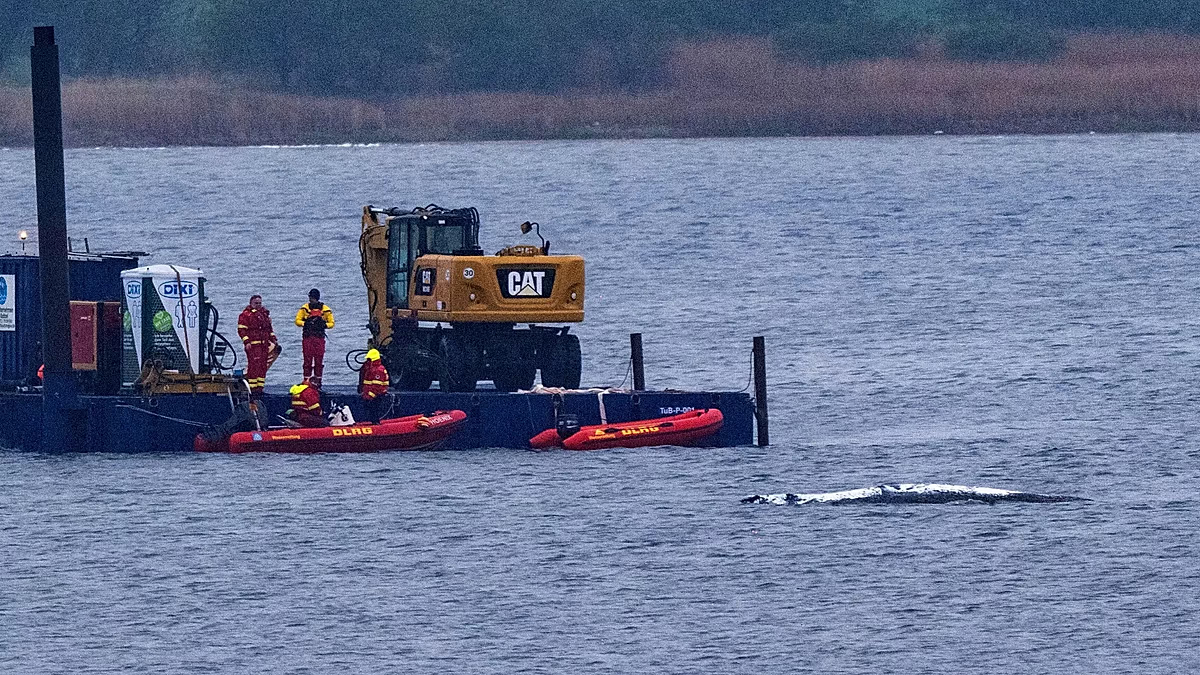
Yet, in a twist fueled by public compassion and human ingenuity, a glimmer of hope emerged. Last week, local officials approved a daring, last-ditch rescue plan proposed by two entrepreneurs, one of whom was the founder of the major electronics retailer MediaMarkt. The ambitious strategy involved a complex marine operation near the island of Poel. Rescuers worked to clear sand from around the beleaguered whale, preparing to use inflatable cushions to gently lift his immense body from the seabed. The plan was to then secure him within a framework of pontoons and, with the aid of a tugboat, undertake an unprecedented journey to transport him hundreds of kilometers back to his rightful home in the North Sea, or even the Atlantic Ocean. It was a Herculean effort, born of a collective refusal to abandon Timmy to his fate.
The emotional saga took another dramatic turn on Monday. Before the elaborate rescue machinery could be fully deployed, Timmy, in a sudden surge of strength, freed himself from the sandbank and swam away. For a moment, hearts soared with the hope that he had finally mustered the strength to guide himself to safety. However, this hope was short-lived. The whale’s newfound mobility only led him to another nearby sandbank, where he came to a halt once again. Till Backhaus, the environment minister for the state of Mecklenburg-Western Pomerania who was present at the scene, sought to frame this development positively, suggesting the whale was not fully stranded but merely “resting.” This interpretation highlighted the delicate balance between cautious optimism and the harsh realities of the situation.
Despite the setback, Timmy’s autonomous escape attempt delivered a crucial and encouraging message: it was a definitive sign of life and lingering vitality. As reported by Bild newspaper, rescuers interpreted this burst of movement as proof that the whale, though undoubtedly weakened and wounded, still possessed a fighting spirit and a reserve of physical strength. This assessment revitalized the rescue team’s determination, transforming the mission from a faint possibility into a renewed imperative. The failed attempt did not mark an end, but rather a new chapter in the operation, proving that Timmy was an active participant in his own survival, not just a passive victim. It underscored that the goal—to return this lost leviathan to the open ocean—was still worth pursuing.
The challenges, however, remain immense and fraught with risk. The whale’s injuries are severe, and his prolonged time without proper nourishment in the unsuitably fresh Baltic water has taken a grave physiological toll. Every movement in the shallow waters risks further abrasions and exhaustion. The rescue operation itself is inherently perilous; manipulating an animal of such size and fragility, even with the best intentions and technology, carries significant danger. The team is now tasked with adapting their strategy to the whale’s new location, a reminder that they are not in control of a procedure, but are cooperating with a wild, unpredictable, and immensely powerful creature whose own instincts are compromised by desperation and confusion.
Ultimately, Timmy’s ordeal is a profound narrative that transcends a simple wildlife rescue. It is a story of human empathy scaling up to meet an almost mythical challenge, a testament to our willingness to invest vast resources and ingenuity for the sake of a single, suffering creature. His repeated strandings mirror a relentless struggle against an environment that is a labyrinthine trap for him. As rescuers prepare to try again, the world watches, invested in the fate of this individual whale. Whether the ending is one of tragic loss or miraculous return to the deep, his struggle has already imprinted itself on the collective conscience, a sobering reminder of the vulnerability of even the ocean’s grandest navigators when they lose their way.