


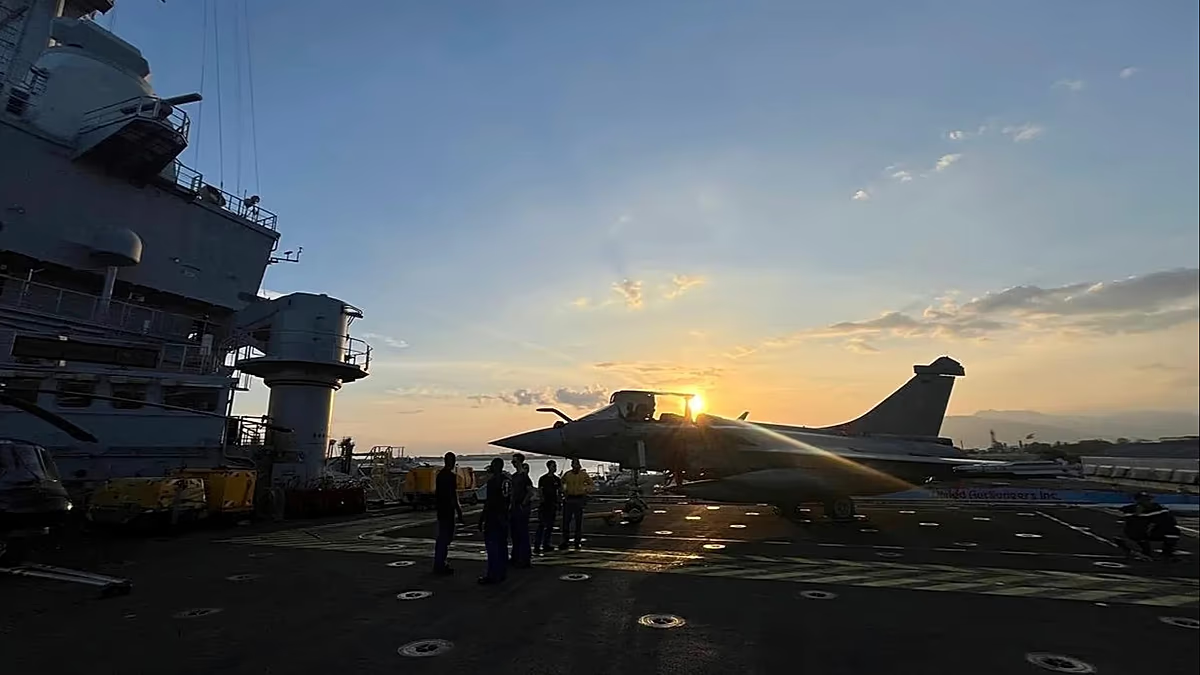
In a significant strategic shift, France’s naval flagship, the nuclear-powered aircraft carrier Charles de Gaulle, has moved south of the Suez Canal and into the Red Sea. This repositioning, announced by the French armed forces, is a preparatory step for a potential multinational mission to secure the Strait of Hormuz. The move brings France’s sole carrier strike group considerably closer to that critical Persian Gulf chokepoint, through which a fifth of the world’s oil normally flows. As Colonel Guillaume Vernet, spokesman for the French armed forces chief of staff, noted, this geographic proximity is key: “It’s closer to the Strait of Hormuz and will therefore enable us to react faster, once the conditions are met.” This deployment represents the latest phase in a major Middle East mobilization ordered by French President Emmanuel Macron in early March, directly responding to the regional crisis.
The urgency for this military posture stems from Iran’s effective closure of the Strait of Hormuz in early March, a retaliatory action following joint U.S. and Israeli strikes that killed Iranian Supreme Leader Ayatollah Ali Khamenei. The blockade has had an immediate and severe impact on global commerce, stranding approximately 2,000 ships in the Gulf and causing war-risk insurance premiums to skyrocket to four or five times their pre-conflict levels. With commercial traffic at a standstill, the economic pressure is immense. Colonel Vernet succinctly captured the stalemate: “Today the Strait of Hormuz is stuck because of the threat and the insurance premiums are so high. Not a single ship will jeopardise their trip or go there.” The French-British plan is fundamentally aimed at breaking this deadlock by restoring a sense of security sufficient for shipping to resume.
However, France is taking a deliberately cautious and conditional approach, distinct from the parallel American operation. Vernet stressed that the coalition, orchestrated by Paris and London and involving over 50 nations, will not spring into action until two clear thresholds are met. First, the direct threat to shipping from Iran must decrease. Second, the maritime industry must be reassured enough to voluntarily return to using the strait. Even if those conditions are achieved, the operation would still require the agreement of regional countries. This stands in contrast to “Project Freedom,” the U.S. escort mission already underway, which has reportedly drawn Iranian fire. Vernet emphasized the French-British plan is “defensive and consistent with international law,” highlighting a strategic preference for de-escalation and multilateral consensus before any operational trigger is pulled.
The planning for this contingent mission is the product of intensive diplomacy. President Macron and British Prime Minister Keir Starmer convened a summit of more than 50 countries in Paris in mid-April, building a broad international coalition. This political momentum was followed by a military planning conference hosted by the United Kingdom, where operational details were finalized by planners from over 30 nations. “Planning has been done and is ready to go,” Vernet confirmed. The positioning of the Charles de Gaulle strike group—which includes eight frigates and is part of a wider “unprecedented” French mobilization that also features two amphibious assault ships—is a tangible signal that this planning is serious. It places potent French air power within striking range of the strait without necessitating an immediate, potentially provocative entry into the Gulf itself.
France’s military footprint in the region extends beyond its carrier group, providing additional context for its role. The nation maintains a strategic airbase at Al Dhafra in the United Arab Emirates under a long-standing defence pact. From this base, French Rafale fighter jets have been actively engaged in intercepting Iranian drones and missiles over UAE airspace since the conflict began. This existing commitment underscores France’s vested interest in regional stability and its capability to project power. Meanwhile, the U.S. Navy has been blockading Iranian ports since mid-April, illustrating the complex and layered military landscape. By holding its carrier south of Suez, France positions itself as a ready but restrained force, capable of acting as part of a multilateral effort while avoiding direct entanglement in the ongoing U.S.-Iranian confrontations.
In essence, France’s movement of its premier naval asset is a calculated move of diplomatic and military signaling. It demonstrates serious intent to its coalition partners and to Iran, showing that a credible alternative force exists to secure vital sea lanes. Yet, by rigidly linking deployment to a reduction in threat and industry confidence, France is also communicating a clear desire to avoid precipitating further conflict. The Charles de Gaulle is now on the doorstep, waiting. Its mission will begin only if a fragile window of opportunity opens—a window where diplomacy has lowered tensions enough for commerce to tentatively restart, requiring a protective coalition shield to ensure it continues. The world now watches to see if that precarious moment will arrive and if this multinational plan will transition from poised readiness to active guardianship.