

The dream of a sustained human presence beyond Earth is rapidly transitioning from science fiction to tangible reality. Following the historic Artemis II mission, which will return astronauts to lunar orbit for the first time in over half a century, NASA and its partners are already laying the groundwork for the next, more challenging phase: not just visiting, but living on the Moon. Central to this vision is a powerful and reliable energy source, leading the United States to pursue an ambitious goal: deploying nuclear fission reactors on the lunar surface by the early 2030s. This endeavor, known as the Fission Surface Power Project, represents a fundamental shift in how we power exploration, moving beyond the limitations of solar panels to the steady, potent promise of atomic energy.
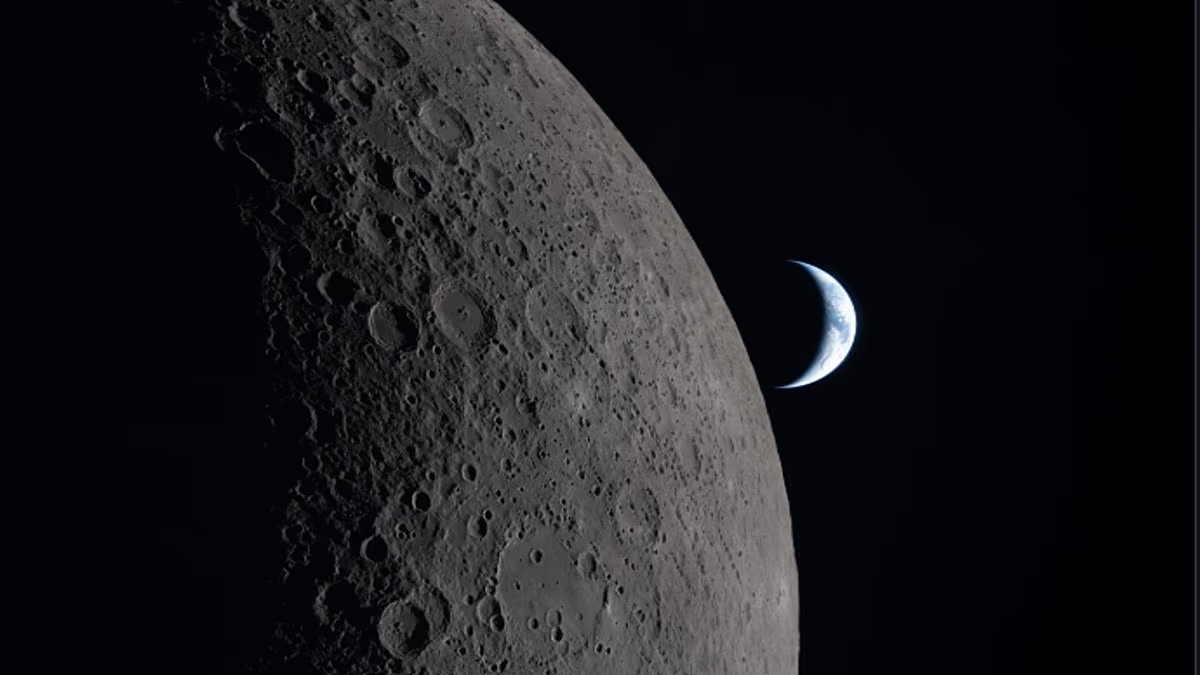
The driving force behind this nuclear push is the stark inadequacy of traditional energy sources for permanent off-world settlements. While solar power has faithfully served satellites and rovers, it cannot support the constant, high-energy demands of a human habitat. The lunar environment presents a particularly formidable challenge: a single night on the Moon lasts approximately 14 Earth days, plunging temperatures to extremes and rendering solar panels useless for weeks. Batteries lack the capacity to bridge this long gap. Furthermore, some of the most scientifically compelling sites, like the permanently shadowed craters at the lunar south pole believed to hold water ice, never receive sunlight at all. To truly unlock the Moon’s potential—to explore these shadowed regions, run life-support systems, conduct experiments, and extract resources—a base requires an uninterruptible power supply, independent of the sun.
This is where nuclear fission becomes indispensable. A compact surface reactor can provide a continuous, abundant stream of electricity and heat for a decade or more, utterly unaffected by the long lunar night or dusty conditions. The envisioned system, with a capacity of 40 to 100 kilowatts, would be sufficient to power a small habitat, scientific labs, and resource-processing equipment, forming the energetic heartbeat of an initial outpost. Beyond stationary power, nuclear technology also promises to revolutionize space travel itself. Nuclear electric propulsion systems could enable faster, more efficient journeys to Mars and deeper into the solar system, allowing spacecraft to carry out complex, long-duration missions without the crippling constraint of conventional fuel limits. As NASA Administrator Bill Nelson has emphasized, advancing this capability is critical for America’s future in deep space.
Recognizing the scale of the challenge, NASA is not acting alone. This national priority requires a collaborative effort, pooling expertise from the Department of Energy, the Department of Defense, and private industry. The White House Office of Science and Technology Policy (OSTP) has already issued guidelines to create a unified federal roadmap for space nuclear technology, underscoring its strategic importance. “Nuclear power in space will give us the sustained electricity, heating, and propulsion essential to a permanent presence on the Moon, Mars, and beyond,” the OSTP stated, framing it as the cornerstone of a multi-planetary future. The project aims to launch a demonstration reactor into orbit by 2028, serving as a crucial test before a lunar surface deployment.
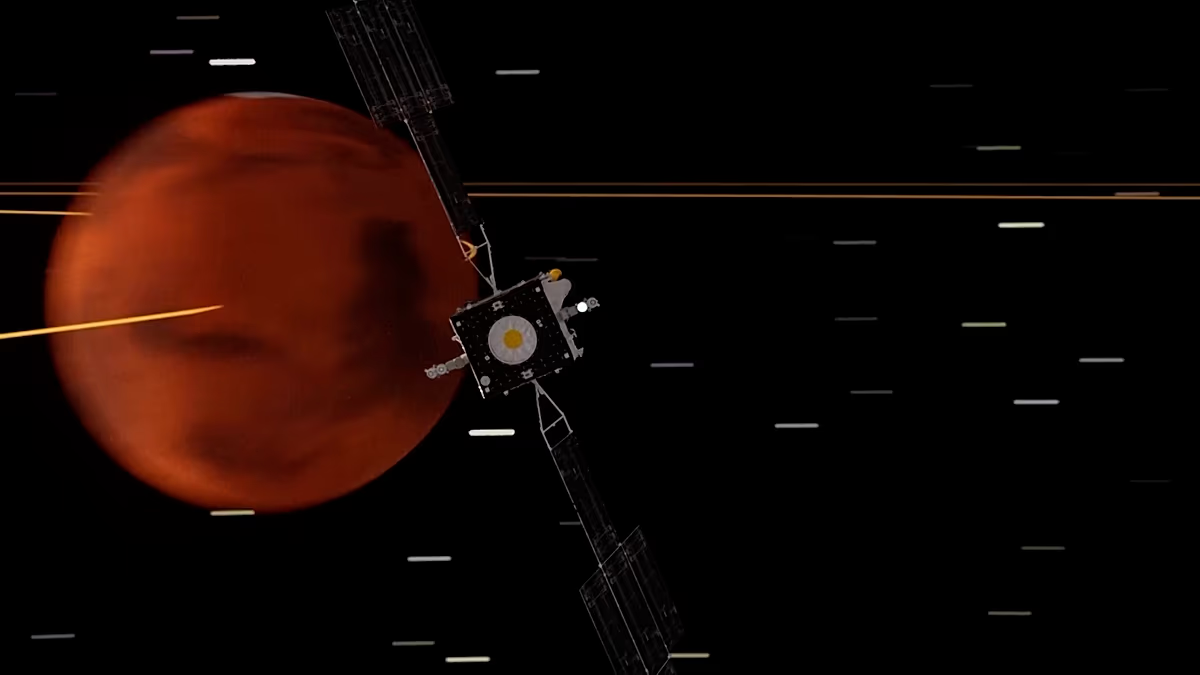
The design philosophy for these lunar reactors focuses on robustness and autonomy. They must operate for years with minimal maintenance from astronaut crews, be scalable to meet growing power needs, and be modular for potential use in different locations or configurations. Safety, of course, is paramount; the system will be designed to remain completely inert until activated on the lunar surface, ensuring no risk during launch or Earth orbit insertion. This technological leap is about more than just lunar logistics; it is a foundational step toward Mars. The Moon provides the perfect, relatively nearby test bed to prove and refine the fission power systems that will one day sustain human explorers on the Red Planet, where dust storms can blot out the sun for months and the energy demands will be even greater.
Ultimately, the pursuit of nuclear power in space is a bold statement of intent. It signifies a move from short-term expeditions to establishing a permanent foothold on another world. This initiative also carries significant geopolitical weight, as nations like China and Russia advance their own lunar ambitions. By pioneering this critical technology, the United States aims to solidify its leadership in space exploration and set the technical standards for the future. The fission reactor destined for the Moon is more than a power plant; it is the key that will unlock the darkness, providing the light, warmth, and energy necessary to turn a distant, barren landscape into a new home for humanity. The journey is beginning, and its success will be measured in the steady, unwavering hum of atomic energy on the silent lunar plains.