




With the Orion capsule’s successful splashdown in the Pacific Ocean still fresh, NASA is already pivoting its gaze to the ambitious future of its Artemis program. The recent Artemis II mission, which safely returned its four-person crew, was a triumph of human spaceflight, delivering breathtaking views of the far side of the Moon, a stunning solar eclipse as seen from lunar orbit, and setting a new record for the farthest distance humans have ever traveled from Earth. Yet, as entry flight director Rick Henfling noted upon the crew’s recovery, “The next mission’s right around the corner.” This forward momentum underscores a fundamental shift: Artemis is no longer merely about returning astronauts to the lunar surface for symbolic visits, but about laying the permanent groundwork for humanity’s sustained presence on another world. The splashdown was not an end, but a spectacular commencement of the program’s most complex and transformative phase.
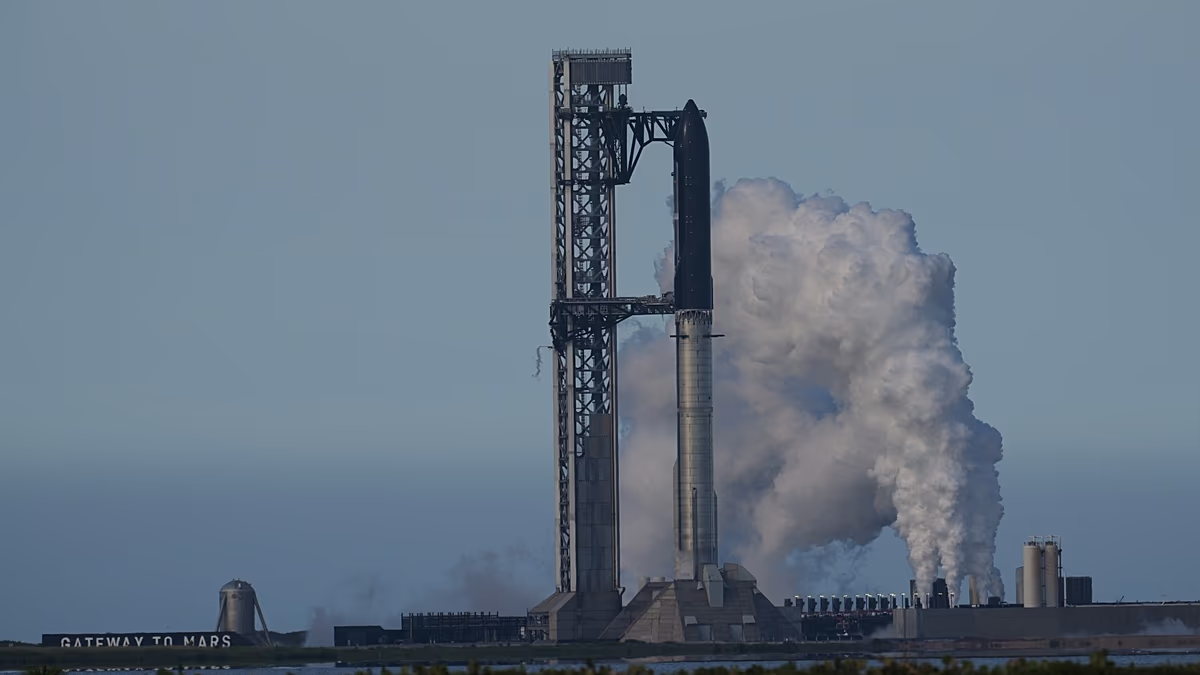
The immediate roadmap to this future has been strategically reconfigured. Initially, Artemis III was slated to be the program’s landmark crewed Moon landing. However, in a significant update announced in March, NASA redefined this mission as a critical demonstration. Slated for next year, Artemis III will now see astronauts dock their Orion capsule with a lunar lander in low Earth orbit. This “dress rehearsal” is designed to certify the new landing vehicles—one from Elon Musk’s SpaceX and another from Jeff Bezos’ Blue Origin—ahead of an actual surface mission. This change reflects the practical challenges of this new era. SpaceX and Blue Origin are in a high-stakes race to readiness, with Blue Origin targeting an uncrewed test launch of its Blue Moon lander later this year, while SpaceX’s colossal Starship-based lander works through its own development timeline. This pivotal test mission ensures that when humans next approach the Moon, the systems carrying them the final miles will be proven and safe.
Following this demonstration, the pace is intended to accelerate dramatically. NASA envisions launching one Artemis mission to the Moon every year. Artemis IV, currently planned for early 2028, is set to achieve what Artemis III originally promised: returning boots to the lunar regolith. On this mission, astronauts will transfer from Orion to a commercial lunar lander for their journey to the surface. This mission will mark the true beginning of the modern lunar exploration era, but it is merely the first step in a far grander architectural plan. Last month, NASA unveiled a detailed, phased strategy to evolve from these initial landings to a permanent lunar base. This vision transforms the Moon from a destination into a home, beginning with robotic scouts and culminating in a sustained human colony.
The first phase of establishing this base is one of robotic pioneering. Before crews take up long-term residence, NASA plans to send a suite of rovers, scientific instruments, and key technologies to the lunar surface. These initial deployments will serve as the foundation for all that follows, tackling essential questions: How can reliable power be generated through the long lunar night? How will robust communication networks be established across the dusty, rocky terrain? How do we best navigate and operate in this harsh, alien environment? The answers provided by these robotic precursors will directly inform the design of habitats and the protocols for human survival, ensuring that when astronauts arrive for extended stays, the fundamental infrastructure for life and work is already in place.
The subsequent phase is where human habitation begins to take tangible shape. This stage involves the construction of partially pressurised structures—the first true lunar dwellings—and the establishment of regular, reliable supply chains from Earth. A cornerstone of this effort is a major international collaboration with the Japan Aerospace Exploration Agency (JAXA), which is developing a sophisticated pressurised rover for crewed exploration. This vehicle will essentially be a mobile home and laboratory, allowing astronauts to traverse vast distances across the Moon’s surface for weeks at a time. This phase represents the transition from camping to homesteading, where the focus expands from mere survival to sustained operation, science, and exploration, supported by partnerships with nations like Italy and Canada contributing critical habitation, mobility, and logistics modules.
The final, long-range vision is one of permanence and growth. This phase will see the transfer of larger equipment and the gradual expansion of the base’s capabilities, moving definitively away from short-term expeditions. The goal is a continuous human presence on the Moon, an outpost that operates year-round. This ambition aligns with the strategic directives of the U.S. National Space Policy, which calls for NASA to lead the world in space exploration and reform commercial space operations. A permanent lunar base is more than a scientific outpost; it is a testbed for technologies needed for future Mars missions, a hub for unprecedented astronomical observation, and a powerful symbol of humanity’s future as a multi-planetary species. From the recent splashdown in the Pacific to the dream of a bustling lunar settlement, the Artemis program is methodically charting the course for our most audacious chapter in space exploration yet.