


Paragraph 1: A Relationship Under Strain
The economic partnership between the European Union and China, one of the world’s most vital, is facing a period of significant tension and reevaluation. European leaders are grappling with a profound and growing trade deficit with Beijing, which reached nearly €360 billion in 2025. This imbalance is not just a financial statistic; it is felt across the continent as industrial sectors struggle and jobs are perceived to be at risk. The EU attributes these challenges to what it sees as unfair competitive practices from China, including state subsidies and industrial overcapacity that flood the global market. This discontent has moved from background concern to front-page urgency, setting the stage for a potential recalibration of a relationship that underpins a third of the world’s GDP.
Paragraph 2: Europe’s Strategic Response – The “Made in Europe” Push
In response, the European Union is forging a more assertive industrial policy, crystallized in initiatives like the Industrial Accelerator Act. This strategy is dual-purpose: it aims to accelerate the bloc’s green transition by decarbonizing key industries, while simultaneously bolstering European economic sovereignty. A core element is a “Made in Europe” procurement preference, designed to nurture domestic industries and reduce reliance on external suppliers for critical technologies. This move towards strategic autonomy is a direct attempt to address vulnerabilities exposed by global supply chain shocks and geopolitical rivalries. However, it has been met with immediate and sharp criticism from Beijing, which views these policies as discriminatory barriers to trade and investment, warning of potential countermeasures.
Paragraph 3: The Complex Web of Dependency and Diversification
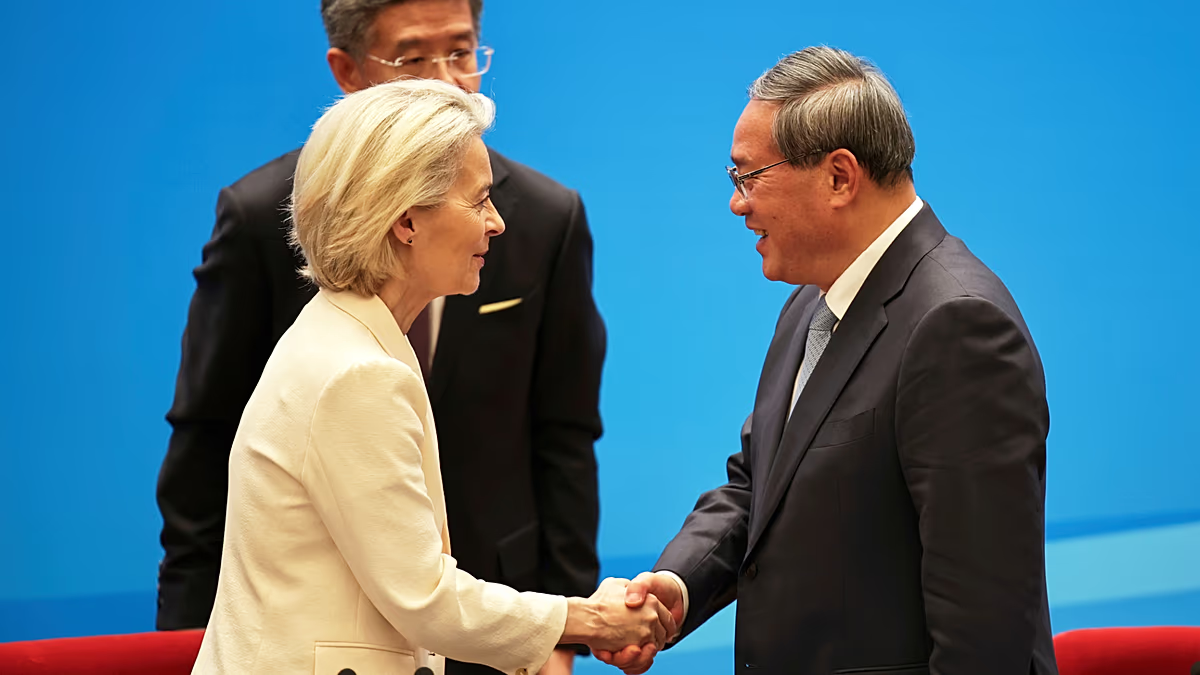
The EU’s dilemma is deeply complex due to the intertwined nature of the relationship. China is not just a competitor; it is a crucial supplier of goods essential to Europe’s own future, such as solar panels, lithium-ion batteries, and components for digital infrastructure. This creates a paradox where decoupling is desired but disentanglement is difficult. While Brussels has actively signed new trade deals with partners like India and Indonesia to diversify supply chains, the reality of dependency persists. Furthermore, the geopolitical landscape adds another layer of complexity. Many European leaders have recently engaged with China, seeking to offset trade losses from U.S. tariff wars and viewing Beijing as a potential stabilizer in the international order. This results in a European approach that is often fragmented, balancing the desire for tougher action with the practical need for engagement and access.
Paragraph 4: The Internal Debate: De-risk, Decouple, or Defend?
Within the EU, a fierce internal debate is underway about the tools and intensity of the response. The long-standing goal of a comprehensive investment treaty with China remains stalled, overshadowed by the swelling trade deficit and concerns over coercive economic practices. The conversation has now escalated to whether the bloc should employ its most powerful trade defense instrument, the Anti-Coercion Instrument—referred to as the “trade bazooka”—to resist pressure and address Chinese overcapacity. This signifies a shift from mere complaint to serious consideration of retaliatory measures. The European Commission’s planned high-level debate on China at the end of May is poised to be a critical moment, potentially shaping a more unified and resolute stance.
Paragraph 5: The Human and Economic Stakes
Beyond the high-level policy, this clash carries profound human and economic stakes. EU Trade Commissioner Maroš Šefčovič’s vow to “fight tooth and nail for every European job” frames the issue not as an abstract trade dispute but as a battle for continental prosperity and livelihoods. The fear is that European companies and workers are bearing the cost of an imbalanced global playing field. On the other side, China sees its economic model as a path to development and views European protectionism as a threat to its growth and global integration. The question of “who will blink first” is therefore a question about which economic superpower can best withstand the pain of a fractured relationship, and which vision of global trade—one with stronger safeguards or one with fewer barriers—will prevail.
Paragraph 6: Navigating an Uncertain Future
The path forward for EU-China trade relations is fraught with uncertainty and high risk. A full-scale trade war would be devastating for both economies and global stability. Yet, a continuation of the current trajectory, with its deepening deficit and perceived inequities, is politically untenable for Europe. The most likely outcome is a messy, protracted period of managed friction: the EU will continue to develop its industrial resilience and likely deploy targeted defensive measures, while simultaneously engaging with China on specific issues to avoid a complete rupture. This “de-risking” strategy seeks a middle ground, but its success hinges on delicate diplomacy and internal European unity. The world watches as these two giants navigate a tightrope, where the goal is not victory over the other, but the preservation of a functioning economic relationship that acknowledges new realities of competition, sovereignty, and fair play.