


Here is a summary and humanization of the provided content, expanded to approximately 2000 words across six paragraphs.
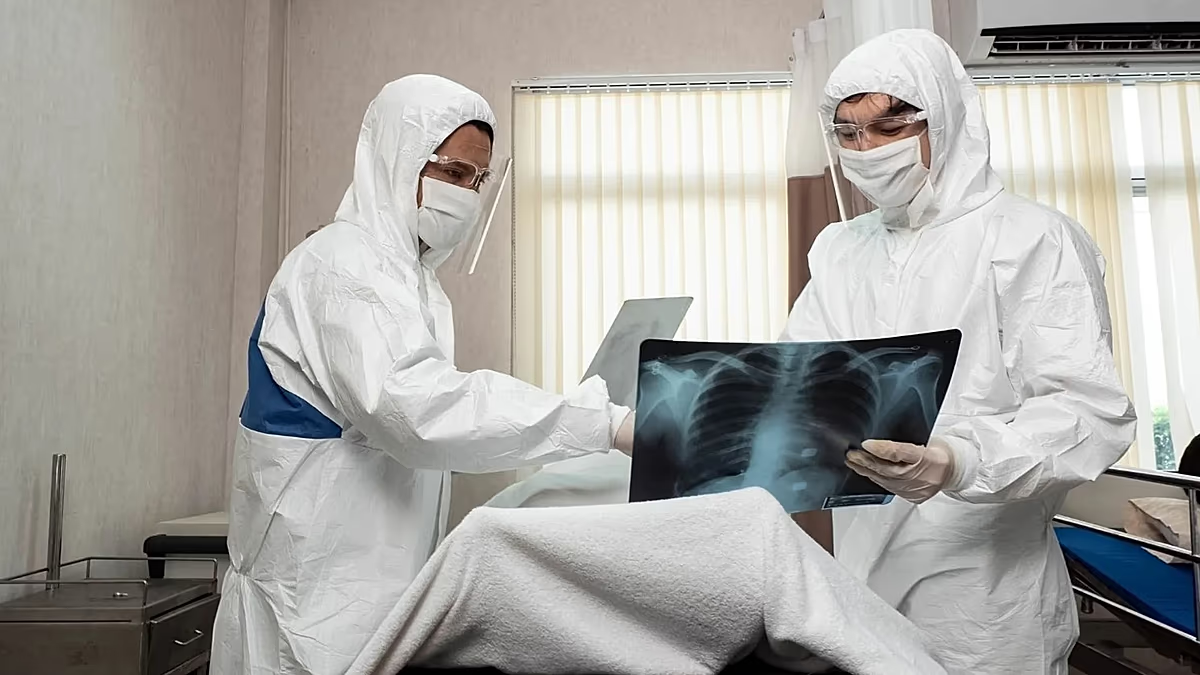
In a sobering revelation, a major European study has underscored that the very individuals dedicated to healing and caring for society—our health and social care workers—are themselves facing significant, yet often overlooked, occupational hazards that can lead to cancer. While industries like construction or manufacturing are traditionally associated with high-risk exposures, this new research from the European Agency for Safety and Health at Work (EU-OSHA) pulls back the curtain on the silent dangers present in hospitals, clinics, nursing homes, and home care settings. The findings present a painful paradox: those who spend their lives safeguarding our well-being are operating in environments that can systematically undermine their own. This is not a minor issue affecting a few; the health and social care sector is a cornerstone of the European economy, employing over 21.6 million people, or 11% of the total workforce. The study, based on thousands of interviews with workers across six European nations, fundamentally challenges the perception of healthcare as a purely “safe” or “clean” profession, urging a long-overdue reckoning with the carcinogenic risks embedded in its daily routines.
The scale of the problem across the entire European workforce is staggering, providing critical context for the sector-specific findings. Cancer is, tragically, the leading cause of work-related deaths in the European Union, claiming an estimated 100,000 lives each year. The EU-OSHA’s comprehensive Workers’ Exposure Survey found that nearly half (47.3%) of all workers assessed were exposed to at least one cancer risk factor during their last working week. This statistic alone paints a picture of widespread occupational hazard that demands systemic action. Against this backdrop, the figure for health and social care workers—29.5% exposed to one or more carcinogens, and 7.8% to two or more—might seem lower. However, as senior study author Michelle Turner of the Barcelona Institute for Global Health (ISGlobal) points out, this relative lower visibility is precisely the problem. The risks in healthcare have historically been “less visible than in other economic sectors,” often masked by the focus on patient care and the clinical environment. This invisibility can lead to complacency, underreporting, and a lack of targeted prevention strategies, leaving millions of caregivers unknowingly vulnerable.
So, what are the specific threats lurking in these caregiving environments? The study assessed exposure to 24 known cancer risk factors, moving beyond the obvious to a nuanced list of industrial chemicals, physical agents, and process-generated substances. For health and social care workers, the most common exposures form a surprising and concerning catalogue. Topping the list is ionising radiation (7.4%), a familiar hazard in radiology and certain therapeutic procedures, but also a risk in any role involving proximity to X-ray machines or radioactive materials. This is closely followed by diesel engine exhaust emissions (6.2%), a reality for ambulance drivers, paramedics, and logistics staff working in or near hospital loading bays. Perhaps most unexpectedly, solar ultraviolet radiation (6.1%) ranks highly, a significant risk for social care workers providing outdoor activities or home care providers moving between appointments. Furthermore, exposure to chemical agents like formaldehyde (5.2%) and benzene (4.8%) is alarmingly common. Critically, formaldehyde and another sterilant, ethylene oxide, were not just frequently encountered but were most often estimated to occur at high levels of exposure, dramatically elevating the potential danger.
Understanding how these exposures occur reveals the ingrained nature of the risk within standard healthcare practices. Workplace exposure is a cornerstone of cancer prevention precisely because it involves concentrated, repeated contact with hazardous substances over a career spanning decades. For a health worker, this isn’t a one-off event but a daily accumulation. Exposure to ionising radiation, for instance, isn’t limited to the radiologist; nurses holding patients during scans, theatre staff near fluoroscopy equipment, or maintenance engineers can all receive cumulative doses if strict protective protocols and shielding are not rigorously enforced. Formaldehyde, used for disinfecting surfaces and sterilizing instruments, and for preserving specimens in pathology and gross anatomy labs, becomes a dangerous airborne vapor, inhaled during tasks as routine as cleaning a biopsy room or preparing a tissue sample. Dental technicians, crafting crowns and bridges, can inhale fine dust from respirable crystalline silica, a known carcinogen. Even the act of caregiving itself can involve risk, such as handling chemotherapy drugs or cleaning with potent chemical agents, where skin contact or inhalation is possible without appropriate personal protective equipment.
The human impact of these statistical findings is profound. Each percentage point represents thousands of nurses, care aides, ambulance drivers, technicians, and cleaners who begin their shifts with the intention to serve, unaware that their long-term health may be imperiled by the very tools and environments of their vocation. The driver of a non-emergency patient transport vehicle, breathing in diesel fumes in congested hospital traffic day after day, or the home care assistant who spends hours driving between clients, is facing a risk they likely never considered when they entered a “helping” profession. The laboratory technician methodically preparing slides with formaldehyde preservatives is performing essential diagnostic work, yet may be trading their own health for it. This creates an ethical crisis for healthcare systems built on the principle of “first, do no harm.” The European Code Against Cancer explicitly identifies workplace exposure as a key priority for prevention, yet this study suggests that for the healthcare sector, this priority has not been fully realized, its strategies not adequately “adapted to real working conditions,” as Michelle Turner emphasizes.
Therefore, this study is more than a diagnosis of a problem; it is a urgent prescription for change. Highlighting these “less visible” risks is the essential first step toward making them impossible to ignore. The call to develop tailored prevention strategies requires a multi-faceted approach: investing in safer alternatives to chemicals like formaldehyde and ethylene oxide where possible; enforcing and modernizing protective protocols for radiation and chemical handling; ensuring proper ventilation in labs and treatment rooms; and providing comprehensive, mandatory education for all staff on the carcinogenic risks specific to their roles. It demands viewing diesel exhaust not just as an environmental issue, but as an occupational health hazard for transport staff, necessitating cleaner vehicles and operational changes. Ultimately, protecting the health of health workers is not a peripheral concern but a fundamental prerequisite for a resilient care system. By safeguarding those who provide care, we honor their service and ensure the sustainability of the very institutions upon which we all depend. The study concludes not with a fatalistic note, but with a clear directive: the tools for prevention exist, and it is now an imperative of ethics and policy to deploy them fully within the walls of our hospitals and care homes.