




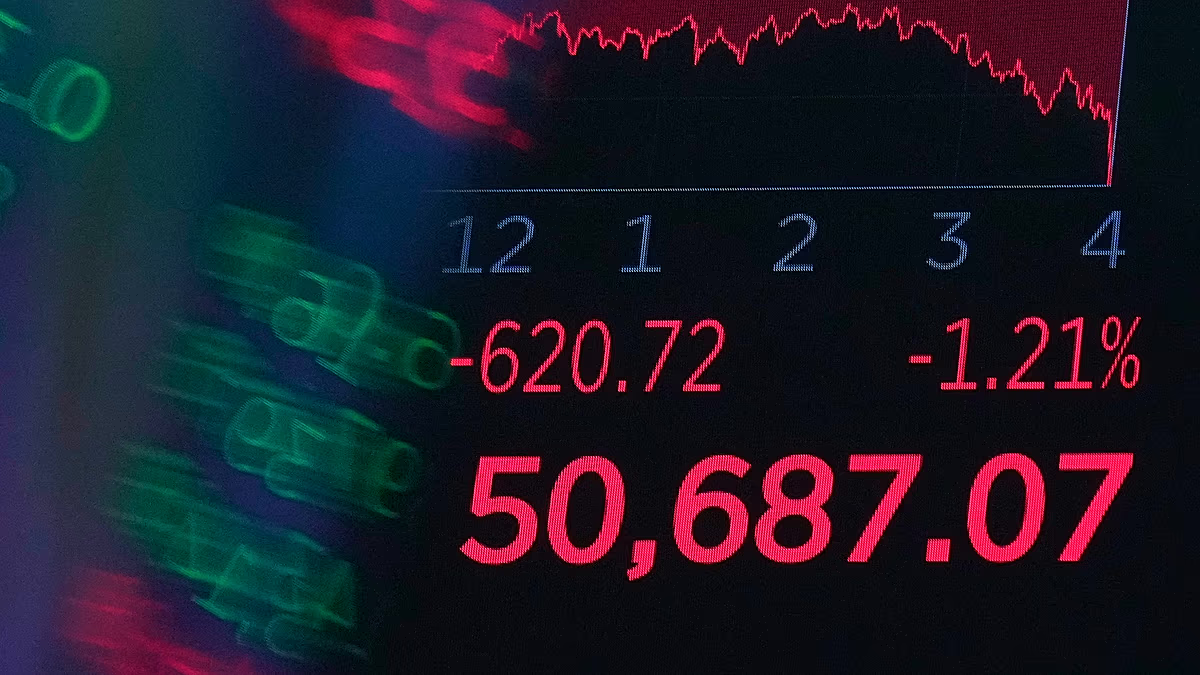
A palpable shift in investor sentiment swept across global markets as the trading week drew to a close. The previously unstoppable rally in artificial intelligence stocks, which had propelled indices to dizzying heights, began to show significant cracks, leading to a wave of caution. This was most evident in Asia, where markets opened Friday with steep declines. The retreat from AI-centric investments sparked a chain reaction, casting a shadow over European bourses as they commenced trading. London’s FTSE 100 and Frankfurt’s DAX both dipped into negative territory almost immediately. In contrast, Paris and Madrid managed modest gains, while Milan remained flat, painting a picture of a continent hesitantly assessing the damage from the East and bracing for key economic data from the West. The mixed opening underscored a market in transition, moving from a narrow, tech-driven euphoria to a broader, more anxious evaluation of economic fundamentals.
All eyes were firmly fixed on the impending release of the U.S. non-farm payrolls report, a critical barometer for the world’s largest economy. Investors were parsing every data point for clues about the Federal Reserve’s next move regarding interest rates. With analysts noting a nearly 40% chance of a rate hike by year-end, the sensitivity to the jobs numbers was extraordinarily high. This anticipation created a holding pattern across major asset classes. In the UK, a surprising and modest monthly decline in house prices, as reported by Halifax, added another layer of caution, suggesting that even resilient sectors were facing headwinds. The collective wait for the U.S. data highlighted a central truth of modern finance: the gravitational pull of American monetary policy remains immense, dictating the rhythm for global capital flows and risk appetite.
Parallel to the suspense over jobs data, the simmering tensions in the Middle East continued to weigh heavily on energy markets and, by extension, global economic stability. Oil prices found a fragile equilibrium after recent dips, with Brent crude hovering around $94.73 a barrel—a stark reminder of the geopolitical premium baked into costs since the outbreak of conflict. The effective closure of the Strait of Hormuz, a vital artery for global oil and gas, posed a persistent threat to growth and inflation worldwide. While tentative diplomatic steps had been taken, the rejection of a ceasefire by Hezbollah in Lebanon cast doubt on any imminent, lasting resolution. Commodity strategists noted that the market was still trading on the hope of a deal to reopen the strait, but the reality on the ground remained dangerously unresolved, leaving a sword of Damocles hanging over the global economy.
The core of the market’s unease, however, emanated from the dramatic cooldown in the AI sector. The previous day on Wall Street had provided a preview: while the Dow Jones soared to a record high thanks to rebounds in banks and small-cap stocks, the AI darlings suffered brutal setbacks. Broadcom’s shares plummeted over 12% on disappointing guidance, dragging down peers like Micron and CrowdStrike. This served as a catalyst for a long-anticipated reassessment, with analysts warning that valuations in the AI space had become stretched and detached from near-term realities. The baton of market leadership appeared to be passing, at least temporarily, from high-flying tech to more traditional cyclical sectors, suggesting a healthy, if painful, rotation that could broaden the market’s foundation beyond a handful of names.
This corrective wave crested powerfully in Asian trading sessions. Markets that had been standout beneficiaries of the AI boom bore the brunt of the sell-off. South Korea’s Kospi, which had roughly doubled over the past year, tumbled 5.1%, led by a staggering 8.6% drop in SK Hynix and a 5.4% fall for Samsung Electronics. Japan’s Nikkei also slipped, dragged down by tech shares like Tokyo Electron, despite positive domestic wage data. The declines across Hong Kong, Shanghai, and Australia confirmed this was a regional phenomenon, a collective deep breath after a period of breakneck speculation. It was a stark reminder that no trend, no matter how powerful, moves in a straight line forever, and that profit-taking and valuation concerns are inevitable forces of market gravity.
As Friday’s European session progressed, the financial landscape felt decidedly different from the one-sided optimism of recent weeks. The pullback in AI stocks, while sharp, injected a necessary dose of reality into the markets. Investors were now navigating a more complex environment, balancing hopes for a soft economic landing against the dual threats of persistent geopolitical strife and the uncertain path of interest rates. The stabilization in oil markets and the resilience in broader U.S. indices offered some counterbalance to the tech rout. In this new phase, success would likely depend less on chasing a single narrative and more on a nuanced understanding of macroeconomic signals, corporate fundamentals, and the ever-present undercurrents of global conflict. The fading of the AI craze marked not an end to innovation, but the beginning of a more mature, selective, and challenging market cycle.