



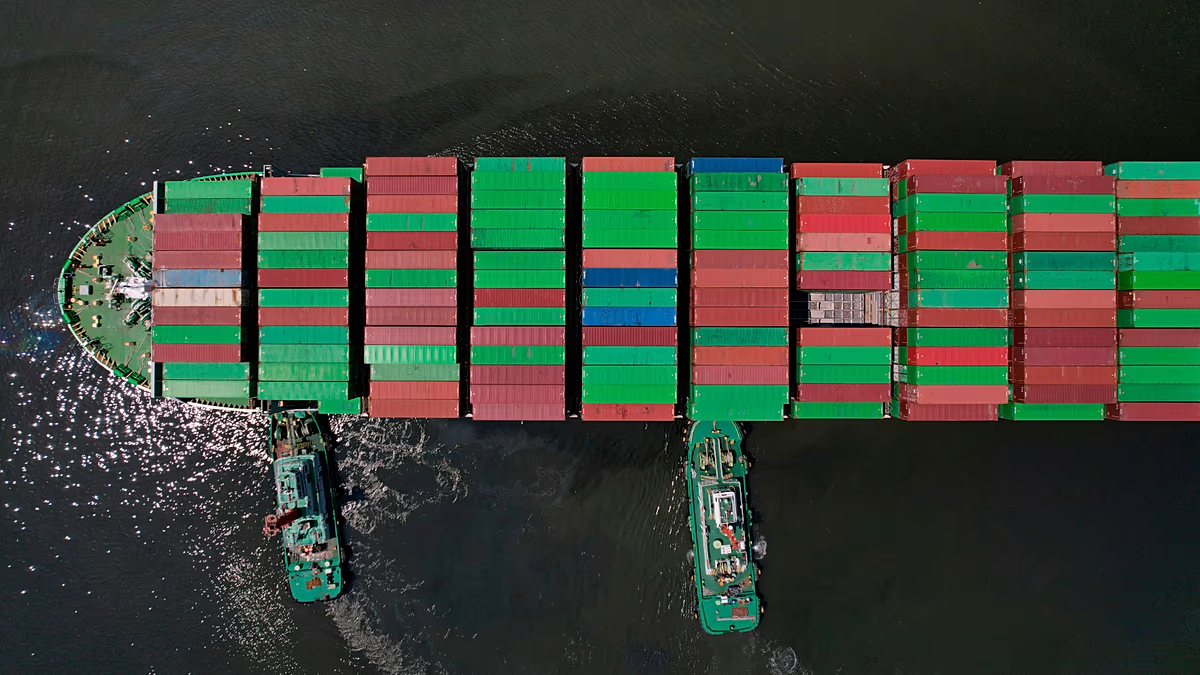
The ongoing conflict involving Iran has set off alarms across the global economy, with one of the most immediate and tangible impacts being a severe squeeze on the maritime shipping industry. At the heart of this crisis is the disruption in the Strait of Hormuz, a critical chokepoint through which about a fifth of the world’s oil supply flows. This turmoil has severely constrained supplies of bunker fuel, the thick, residual oil that powers the vast majority of the world’s commercial cargo ships. As these vessels are responsible for moving roughly 80% of globally traded goods, from electronics and clothing to food and fuel, the implications of this shortage stretch into every corner of the world. The situation highlights a stark vulnerability in our interconnected supply chains, where a geopolitical flashpoint in one region can swiftly threaten the engine of global trade, triggering fears of delayed goods, rising costs, and economic instability far from the conflict’s epicenter.
The strain is being felt first and most acutely in Asia, the powerhouse of global manufacturing and trade. The region, which depends heavily on Middle Eastern oil, is home to Singapore, the world’s largest refueling hub for bunker fuel. Here, the direct consequences of the Strait’s disruption are already visible: reserves are tightening and prices are soaring. Before the conflict, bunker fuel cost about $500 per metric ton in Singapore; by early May, that price had skyrocketed to over $800. While supplies have so far remained available, experts like Natalia Katona of OilPrice warn that a prolonged cutoff from key suppliers like Iraq and Kuwait will inevitably lead to physical shortages. This regional pressure point is magnified by the fact that more than half of all seaborne trade passed through Asian ports in 2024, meaning the pain will not be contained there for long.
In response to this mounting pressure, shipping companies worldwide are being forced into a defensive scramble. Their immediate toolkit is limited but crucial: to conserve precious fuel, many are deliberately slowing their vessels down and revising schedules, a practice known as “slow steaming.” Industry data shows the average speed of bulk carriers and container ships has already slowed by about 2% globally since the conflict began. Some firms are also accelerating investments in a future less dependent on traditional bunker fuel, ordering new ships capable of using alternative fuels like liquefied natural gas (LNG). However, as Henning Gloystein of Eurasia Group notes, not all companies can withstand this financial pressure indefinitely. The rising cost of simply moving goods—estimated by one group at over €340 million per day for the global industry—is an unsustainable burden that must eventually be passed on.
This pass-through of costs is where the abstract crisis on the high seas becomes painfully concrete for consumers and businesses. Initially, shipping firms have absorbed most of the higher fuel expenses, but analysts like June Goh of Sparta Commodities warn that this grace period is ending. Soon, these costs will be embedded in the price of shipping containers, which will then ripple through complex supply chains. As Oliver Miloschewsky of Aon explains, while the added cost to an individual product on a store shelf might seem small, the aggregated effect across countless goods can significantly influence broader consumer prices. The early signs are already visible in places like Singapore, where ferry operators have raised fares and cruise lines have added fuel surcharges, offering a microcosm of the inflationary wave that may follow.
Confronted with this reality, the industry is looking beyond short-term conservation toward a more fundamental energy transition. The current price shock is acting as a powerful catalyst, making investments in greener technologies more commercially viable. Håkan Agnevall of Wärtsilä points out that while the technology for lower-emission fuels exists, production is not yet at scale, and these alternatives often remain more expensive. Yet, the volatility of traditional bunker fuel is changing the calculus. Angad Banga of the Caravel Group notes that about a third of the new vessels his company is building will be “dual-fuel capable,” able to switch between bunker fuel and alternatives like LNG. This optionality, he argues, has “a measurable economic value” in an unpredictable world. While infrastructure for these new fuels is still developing, the direction is clear: the industry is being pushed, both by crisis and opportunity, toward a more diversified and resilient energy future.
Ultimately, the bunker fuel crunch triggered by the Iran conflict is more than a temporary shipping headache; it is a stress test for global trade and a warning sign. It exposes the profound risks of reliance on a single, geopolitically volatile fuel source and a handful of critical maritime passages. As Asia engages in “energy triage”—turning to coal, Russian oil, and nuclear plans to cope—the entire global system is reminded of its fragility. The coming months will reveal whether the shipping industry and the governments and consumers that depend on it can navigate this period of scarcity without severe disruption. In doing so, they may also accelerate an inevitable shift away from the polluting, sludge-like fuel that has powered globalization for decades, steering toward a future where trade is powered by more stable and sustainable means.