

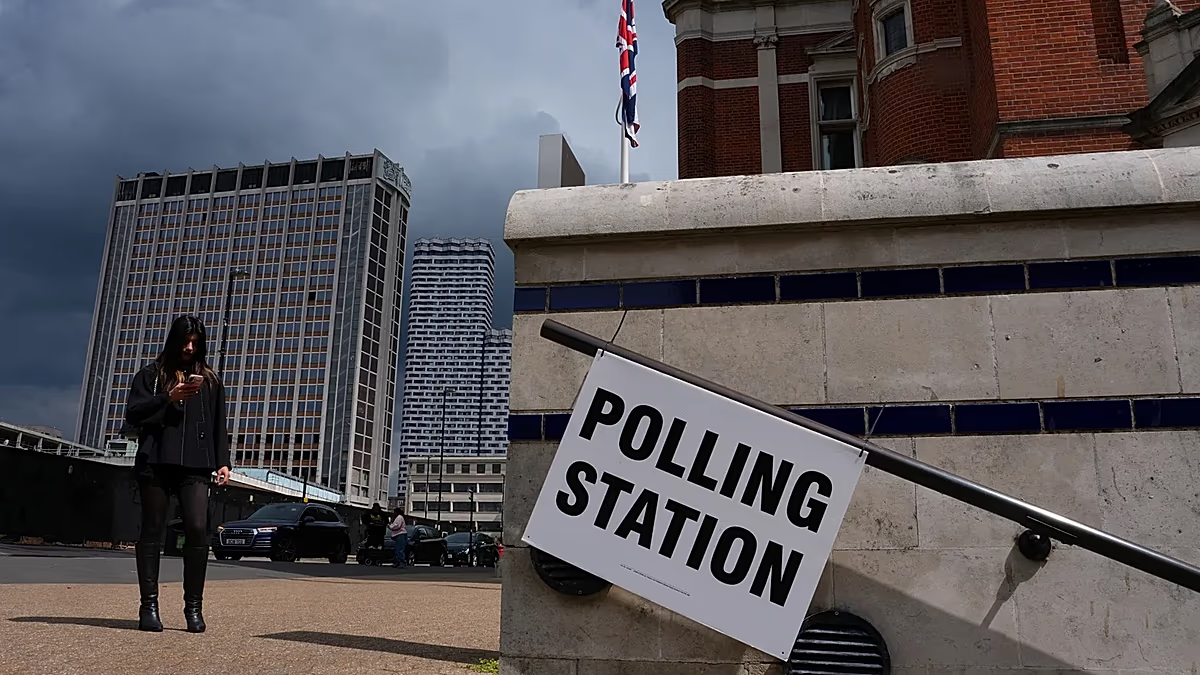
The United Kingdom is holding local and regional elections on Thursday, a critical political moment that could severely weaken Prime Minister Keir Starmer’s authority. These elections, which will fill thousands of local council seats and several mayoral offices across England, along with the entire devolved parliaments in Scotland and Wales, are typically dominated by grassroots concerns like road repairs and local services. However, Starmer’s opponents have successfully framed the vote as a sweeping public judgement on his premiership. After leading the Labour Party to a decisive victory less than two years ago, Starmer now faces the prospect of a devastating blow, with a poor performance potentially sparking an immediate leadership crisis within his own party.
The prime minister’s political standing has plummeted due to a series of unforced errors and policy struggles since he took office in 2024. His government has faced immense difficulty in jumpstarting the economy, fixing overstretched public services, and alleviating the burden of high living costs—challenges compounded by global instability, including a conflict involving Iran that has disrupted vital oil shipments. Perhaps most damaging was the self-inflicted scandal of appointing Peter Mandelson, a figure linked to the disgraced financier Jeffrey Epstein, as the UK’s ambassador to the United States. This decision sparked outrage and internal rebellion, forcing Starmer to survive a previous crisis in February. Now, with Labour defending around 2,500 local council seats, party members are anxiously bracing for significant losses that could reignite calls for his resignation.
Political analysts predict these elections will accelerate the dramatic fragmentation of Britain’s long-standing political order. For generations, power has oscillated between the Labour and Conservative parties, but that duopoly is now crumbling. The likely beneficiary of this upheaval is the hard-right Reform UK party, led by the populist Nigel Farage. With its potent mix of anti-immigration rhetoric and anti-establishment fervour, Reform is aggressively targeting traditional Labour heartlands in northern England and outer London. Simultaneously, the environmentally focused Green Party is poised to make substantial gains in city centres and university towns, appealing to voters disillusioned with the major parties’ approaches to climate and social issues. This multi-front battle signifies a profound shift in the political landscape.
The main opposition Conservative Party is also expected to lose ground, ceding some space to the centrist Liberal Democrats. Tellingly, in his final campaign message, Prime Minister Starmer barely mentioned the traditional Tory foe. Instead, he framed the choice as one between Labour’s “progress” and what he termed the “anger and division” of Reform or the “empty promises” of the Greens. This rhetorical shift underscores how the traditional political battle lines have blurred. Farage has boldly claimed that a strong showing for Reform would spell the end for Starmer, suggesting the prime minister could be “gone by the middle of summer.” The ripple effects are also felt in Scotland and Wales, where Reform hopes for inroads, though pro-independence parties are still favoured to lead their respective governments.
Professor Tony Travers of the London School of Economics succinctly captured Labour’s daunting challenge: the party is fighting on multiple fronts across the entire nation. In England, it is hemorrhaging support to Reform, the Greens, the Liberal Democrats, and even the weakened Conservatives. In Scotland and Wales, it must also contend with powerful nationalist movements. This scattered opposition means Labour could lose seats to a diverse array of challengers in different regions, a scenario that would highlight its struggle to maintain a cohesive national coalition. The results will thus provide a intricate, locality-by-locality map of Britain’s new political fractures, revealing where each alternative party is finding its niche.
Voting will conclude at 10 p.m. local time, with the first results from overnight counts trickling in soon after. However, the full picture and its national implications will become clear only by Friday afternoon, as the bulk of the results are declared. Beyond the immediate fate of councillors and mayors, this election serves as a massive mid-term report card for Keir Starmer. The outcome will determine whether he can steady his leadership and rebuild public trust with years still to go before the next general election, or if the devastating losses will trigger a period of profound instability and a bitter fight for the soul of the Labour Party. The votes cast are not just about local issues; they are a barometer of national discontent and a potential catalyst for a new and more volatile era in British politics.