


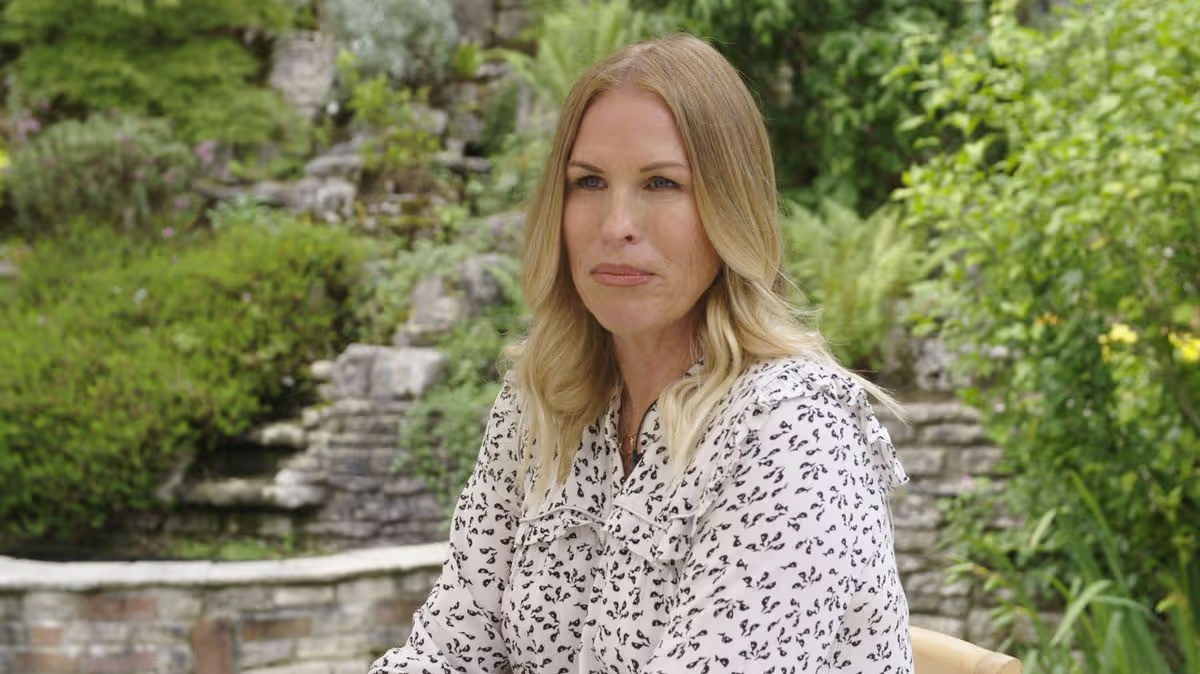
The Unending Shadow: Becki Houlston’s Fight Against a Monster and Systemic Failure
Becki Houlston carries a burden that is both specific and hauntingly vague. She is one of more than a hundred women believed to have been targeted by John Worboys, the notorious “black cab rapist,” whose reign of terror spanned years due to catastrophic police failings. Yet, unlike some victims who have a definitive account of assault, Becki’s trauma is wrapped in a terrifying uncertainty. She knows she was drugged by the man now known as John Radford, but the exact nature of what he did to her in that altered state remains lost in the fog of the chemicals he administered. This lack of certainty—the inability to say, “I was raped” or “I was sexually assaulted”—creates a unique and enduring anguish. It is a void filled with nightmares of possibilities, making her pursuit of justice not just about punishment, but about reclaiming a truth stolen from her.
Worboys’ crimes, between 2002 and 2008, represent a staggering failure of institutional protection. Initially, 14 women reported being drugged and attacked by a black taxi driver, but police failed to connect these separate incidents into a pattern of predatory behavior. Many victims were dismissed because they had been drinking, their credibility unfairly undermined. When Worboys was finally arrested in 2007 after assaulting a teenage student, the investigation was bungled: his home wasn’t searched, crucial CCTV evidence was lost, and he was released with a decision that there was “no case to answer.” This bureaucratic incompetence and dismissive attitude directly enabled him to attack at least 30 more women before a dedicated murder squad finally linked the cases and apprehended him in 2008. The Met Police has since apologized, acknowledging “serious failing,” but for Becki and others, this admission cannot erase the years of vulnerability they endured.
Becki’s personal encounter with Worboys occurred in 2002. After a night out in Bournemouth, she was picked up by his cab. Using a practiced persona of a “cheeky, chappy London cabbie,” he concocted a story of a casino win and pressured her to celebrate with champagne he had in the car. Despite her attempts to end the journey at her home, he kept her engaged, topping up her drink. Her last memory, pieced together later, was of him having moved from the driver’s seat to beside her. The warm, bitter drink had done its work. She woke up the next day with the visceral knowledge that she had been drugged, but no clarity on what followed. It was only in 2018, seeing Worboys in the press, that she connected her experience to his crimes and came forward to lawyer Harriet Wistrich.
Worboys was convicted in 2009 of attacking 12 women and given an indefinite sentence. However, the system continued to fail his victims. In 2017, a decision to grant him parole was made without informing most survivors and without considering the numerous alleged attacks not pursued in court. A public outcry led by victims and their advocates successfully overturned that decision. In 2019, he was sentenced to life with a minimum six-year term for four further offences. Becki’s case, while recognized, was not among these new convictions. Now, with a fresh parole hearing looming, her fear is palpable. “It’s tough knowing Worboys could be out any minute,” she states, and her determination to stop that is the driving force of her ongoing advocacy.
This fight for accountability and safety is why Becki has supported the ITV drama Believe Me, which dramatizes this harrowing saga. She hopes the series, featuring Daniel Mays as Worboys, will amplify the story, validate the experiences of survivors, and perhaps encourage other women who may have been silenced or uncertain to come forward. For Becki, the drama is a tool in a crucial campaign. Beyond her personal trauma, she is a trauma therapist, and her professional understanding of psychological harm deepens her resolve. She articulates the profound violation of premeditation: “Somebody has hunted you down with the sole intention of seriously harming you.” This intentionality, combined with the erased memory, creates a complex PTSD that she battles both personally and professionally.
Becki Houlston’s story is a microcosm of a larger narrative: of a predator exploiting systemic weaknesses, of victims being doubted and then disregarded by authorities, and of the long, arduous path survivors must walk to secure even a semblance of justice. Her vow to fight to keep Worboys jailed is not just about one man; it is a stand against the culture of disbelief and procedural failure that allowed him to operate for so long. It is a demand for a system that truly listens, effectively investigates, and consistently prioritizes the safety and dignity of victims over bureaucratic ease. Her uncertainty about what exactly happened to her in that cab may never be resolved, but her certainty about fighting for a future where such predators are relentlessly pursued and securely contained is unwavering.