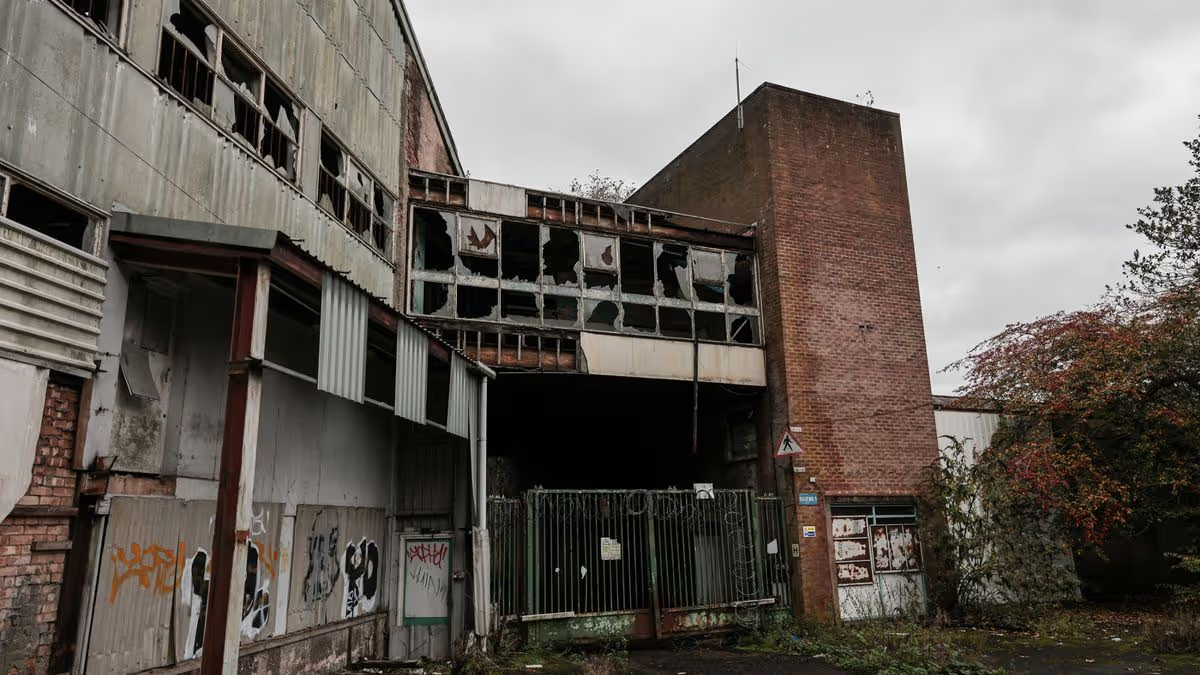




For over two decades, the colossal ghost of the Turner Brothers Asbestos factory has loomed over Rochdale, a decaying monument to the town’s industrial past. Once the largest asbestos plant in the world, employing thousands, its 72-acre site now stands as a crumbling, toxic ruin that residents have grimly nicknamed “Britain’s Chernobyl.” This label speaks not to a sudden catastrophe, but to a slow, pervasive environmental disaster that continues to blight the landscape and haunt the community. Despite its closure in the late 1990s, the factory’s legacy is far from buried. Locals live with the daily sight of its derelict laboratories and collapsing structures, a constant reminder of a dangerous past that, they fear, is actively seeping into the present and threatening future generations.
This fear has crystallized around the site’s alarming accessibility, particularly to children who see it not as a hazard, but as an adventure playground. The perimeter fencing is routinely breached, and young explorers venture inside, unknowingly threading through a landscape where asbestos-laden debris may litter the ground. Even more alarming is the attraction of the nearby River Spodden, where a weir known locally as “Paradise” becomes a popular swimming spot in summer. Residents are terrified that runoff and erosion from the contaminated site may have poisoned these waters, meaning children could be exposed to deadly fibres not just by air, but while bathing. As retired health and safety expert Mick Coats, a 32-year resident, starkly puts it: if this were a field of unexploded bombs, authorities would be compelled to act. The community’s urgent question is why this invisible, slow-acting threat does not command the same decisive response.
The health implications underpinning these fears are severe and well-documented. Asbestos, once a ubiquitous construction material, is a proven carcinogen. Inhaling its microscopic fibres can lead to mesothelioma, lung cancer, and asbestosis—a cruel, incurable lung-scarring disease that can take decades to manifest. The history of the Turner Brothers site is written in these illnesses. The factory itself was the workplace of Nellie Kershaw, who in 1924 became the first medically recorded victim of occupational asbestosis at just 33 years old. Denied compensation and left in poverty, her tragic case epitomizes the human cost. Today, long-retired workers and their families still live with the consequences. Locals speak of knowing former employees who “struggle to breathe” or can only walk a few yards without gasping, a living testament to the factory’s enduring and poisonous legacy.
Frustration is mounting among the community over what they perceive as glacial progress in remediating the site. While an investigation a decade ago found no airborne fibres above a specific detection limit, this offers little comfort to those watching children climb through broken windows. Residents like Andy Mason, who lives next door with his young family, articulate a profound sense of injustice. He describes the site as a “modern-day Chernobyl” and argues passionately that society must “take ownership and put it right,” rather than passing an environmental disaster from one generation to the next. Their proposed solution is clear: a full, government-funded clearance of the structures, the sealing of the land with a protective clay cap, and its transformation into a safe, green space for the community—a true “country park” to finally cleanse the wound.
The response from authorities, however, highlights a complex web of challenges. The council states that resident safety is its “most important priority” but explains that transformative action depends on cooperation with the private landowner, Spodden Park Ltd. The company, in turn, reports an “ongoing battle” with trespassers, citing regularly damaged fences and destroyed CCTV cameras. They stress that asbestos is only dangerous when disturbed and plead with the public to stay away, while promising weekly monitoring and collaboration with the council on security. This cyclical problem—where trespass prompts security measures that are then breached again—leaves residents in a perpetual state of anxiety, feeling trapped between an intractable owner and an impotent bureaucracy, while the danger persists.
Ultimately, the story of Rochdale’s asbestos factory is a cautionary tale about time, legacy, and accountability. The physical decay of the buildings mirrors the slow-motion nature of the diseases it caused, both operating on a timeline far longer than political or business cycles. Twenty years after the last worker left, the community remains a prisoner of this past, fighting for a future free from fear. They are guardians not just of their children’s immediate safety, but of a collective memory that insists this history must be conclusively and physically laid to rest. Until the site is permanently secured and decontaminated, the shadow of “Britain’s Chernobyl” will continue to fall over Rochdale, a stark reminder that some industrial legacies are far easier to create than they are to erase.