


The Human Cost of a Fragile Ceasefire in Southern Lebanon
A temporary and tenuous ceasefire in southern Lebanon was shattered over the weekend, underscoring the profound human suffering and geopolitical tensions that continue to plague the region. On Saturday, despite an ongoing truce, a series of Israeli airstrikes struck several villages, killing at least seven people and wounding others, according to Lebanon’s state-run media. These strikes are part of a broader, weeks-long Israeli military campaign that has seen entire neighborhoods near the border systematically leveled. For the residents of these villages, the promise of a ceasefire has offered little reprieve, as the sounds of explosions and the sight of destruction have become a grim routine. The attacks highlight how quickly diplomatic agreements can unravel when deep-seated hostilities and security fears persist, leaving civilians caught in a deadly crossfire with no safe haven.
Military Justifications and the Reality on the Ground
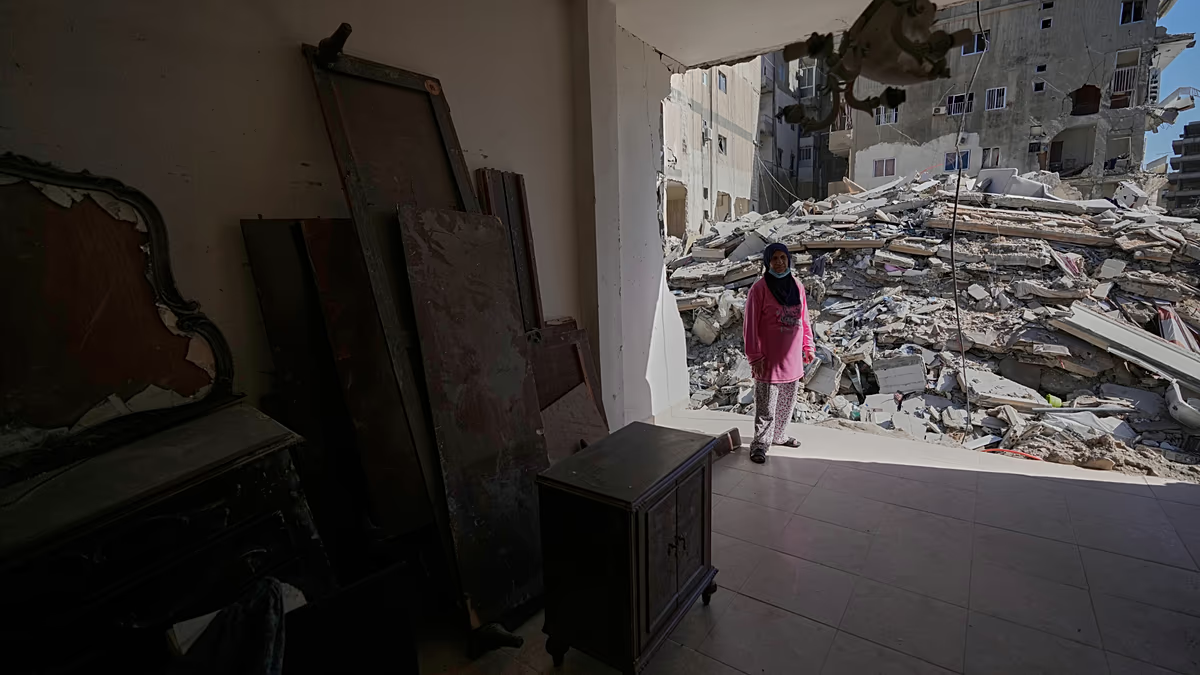
The Israeli Defense Forces (IDF) asserted that all airstrikes conducted over the past 24 hours specifically targeted infrastructure belonging to Hezbollah, the Iran-backed militant group. In a statement, the military emphasized that its operations were directed solely at Hezbollah and not at Lebanon or its civilian population, claiming adherence to international law and citing “imperative military necessity.” The IDF also released a video showing the destruction of what it described as a booby-trapped football stadium in the town of Bint Jbeil, framing such actions as necessary responses to Hezbollah’s rocket fire at Israeli troops. However, on the ground, the reality appears starkly different. Observers and residents report the wholesale demolition of residential neighborhoods, raising urgent questions about the scale of destruction and its impact on non-combatants. This disparity between official narratives and lived experiences fuels distrust and deepens the humanitarian crisis.
A Displaced Population and Warnings of Further Escalation
Compounding the immediate violence, the IDF issued new evacuation warnings for residents of nine southern Lebanese villages, part of a broader strategy that includes maps of a “forward defence line” extending several kilometers into Lebanon. Israeli officials have openly discussed intentions to occupy parts of southern Lebanon, effectively preventing thousands of displaced people from returning to their homes. For families like that of Hassan Sweidan, a resident of a neighboring village, the destruction is methodical and total. Looking across at the town of Beit Lif, Sweidan noted, “They were demolishing it gradually until they reached the main square, and now, as you can see, there are no more houses.” This systematic displacement not only erases communities but also sows seeds of long-term instability, as generations lose their homes, livelihoods, and sense of security.
The Challenges of Verification and Accountability
Amid the chaos, independent verification of the situation remains severely hampered. Due to security risks and limited access, neither United Nations peacekeepers nor Lebanese officials have been able to conduct detailed surveys of the villages undergoing demolition. This lack of transparency makes it difficult to assess the full extent of civilian casualties or property damage, allowing conflicting accounts to flourish. Hezbollah, for its part, confirmed carrying out attacks on Israeli troops using a drone in a coastal village, illustrating the tit-for-tat nature of the conflict. With both sides exchanging fire despite the ceasefire, the absence of reliable, on-the-ground oversight means that violations can easily go unrecorded, undermining efforts to hold actors accountable and perpetuating a cycle of violence with impunity.
The Fragility of Diplomatic Efforts
The recent violence occurs against the backdrop of a 10-day ceasefire that began on Friday, which was subsequently extended by three weeks. Yet, the continued strikes by both sides reveal the fragility of such diplomatic efforts when underlying issues remain unresolved. Ceasefires, while intended as humanitarian pauses, often prove unstable in the absence of comprehensive political agreements addressing core grievances. For Israel, the primary concern is neutralizing Hezbollah’s military capabilities along its border; for Hezbollah and its supporters, resistance is framed as a necessary defense. This fundamental disconnect ensures that temporary truces are frequently breached, leaving civilians in a perpetual state of anxiety and uncertainty, never knowing when the next explosion might come.
Looking Ahead: The Human Toll and the Path Forward
As the conflict persists, the human toll mounts—lives lost, families torn apart, and communities erased. The destruction in southern Lebanon is not merely a matter of damaged buildings but of shattered futures, with psychological trauma and economic devastation likely to endure long after the fighting stops. Moving forward, a sustainable solution will require more than fleeting ceasefires; it demands genuine international engagement to address the root causes of the conflict, ensure humanitarian access, and support rebuilding efforts. Until then, the people of southern Lebanon remain trapped in a devastating limbo, their lives held hostage to geopolitical maneuvering and military calculations that too often overlook their humanity and their right to peace.