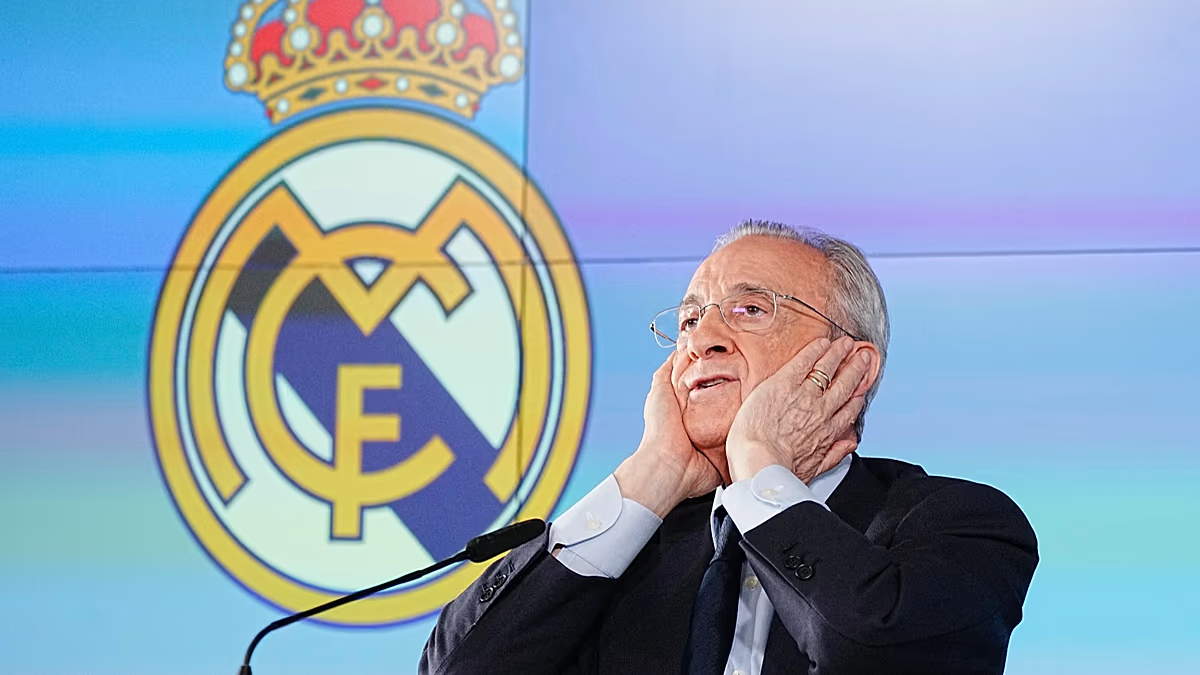


Real Madrid, a club synonymous with both sporting excellence and intense internal politics, found itself at the center of a dramatic and unexpected spectacle this week. In a hastily convened press conference that crackled with tension, the club’s usually composed president, Florentino Pérez, delivered a fiery, hour-long defense of his leadership. The setting, the club’s training center, came just two days after a painful 2-0 defeat to arch-rival Barcelona, a loss that sealed the league title for the Catalan side and deepened the gloom over a second consecutive trophyless season for Madrid. Rather than addressing the team’s on-pitch failures, Pérez launched a counter-offensive, framing himself not as a steward of fading fortunes, but as the victim of a shadowy conspiracy. He defiantly called for new club elections, challenging any hidden opponents to step into the light and face him directly. “This is the opportunity I am giving them,” he declared, transforming a moment of vulnerability into a public dare.
The core of Pérez’s argument was the allegation of an “organised campaign” designed to undermine him and, by extension, the club itself. The 79-year-old construction magnate, now in his seventh term as president, appeared uncharacteristically agitated, engaging in pointed exchanges with journalists he accused of being part of the plot. He claimed the campaign was being “orchestrated by bad journalists and non journalists,” explicitly naming several media outlets and figures. For Pérez, this was not merely criticism borne of recent poor results; it was a targeted effort to “destroy Real Madrid.” He sought to disentangle his personal leadership from the team’s performance, acknowledging the shared “frustration” of a barren season while reminding everyone of the 66 titles won across soccer and basketball under his presidency. The implication was clear: current struggles were a temporary blip, while the alleged conspiracy against him was an existential threat to the institution.
Pérez then turned to a recent, embarrassing incident within the squad as proof of malign internal forces. He referenced the leaked news of a training-ground fight between players Federico Valverde and Aurélien Tchouaméni, which resulted in heavy fines. With palpable anger, he argued the leak was far more damaging than the altercation itself, a common occurrence in high-stakes environments. “We know who it was,” he stated ominously, suggesting the information was weaponized by someone within the club’s orbit to damage morale and leadership. This dovetailed with his dismissal of bizarre personal rumors, including one that he was terminally ill. “They said I have cancer and that it was terminal,” he revealed, calling it “the most undignified thing that has ever happened to me.” By presenting himself as a target of both professional sabotage and vile personal smears, Pérez painted a picture of a president under siege, fighting not for his job, but for the club’s very honor.
The president’s counterattack extended far beyond the confines of the Santiago Bernabéu. In his most explosive remarks, he pledged to escalate the long-simmering “Negreira case” involving Barcelona to European football’s governing body, UEFA. The scandal revolves around Barcelona’s historical payments to a company owned by José María Enríquez Negreira, the former vice-president of Spain’s refereeing committee. While Barcelona maintains the payments were for technical reports and not to influence match officials, Pérez framed it as unparalleled corruption. “It is the biggest scandal in history,” he proclaimed, announcing that Madrid was preparing “an important dossier” for UEFA to “address it at its root.” This move internationalizes a bitter domestic feud and positions Pérez not just as a defender of Real Madrid, but as a crusader for the purity of the global game, shifting the narrative from his own troubles to alleged systemic wrongdoing by a bitter rival.
By the conclusion of the extraordinary session, the mood had shifted from one of confrontation to something resembling defiance laced with a hint of relish. Dismissing any notion of fatigue or ill health, Pérez asserted his daily, hands-on involvement in both the club and his business empire. His closing remark, “I could stay here all afternoon. I had a really good time,” was a masterstroke of political theater. It reframed the entire event from a defensive press conference into a platform of his own choosing, a show of strength and stamina aimed at his detractors. He avoided direct commentary on the squad’s future, sidestepping questions about a potential return for former coach José Mourinho, to keep the focus squarely on his narrative of a club under external and internal attack, with him as its steadfast guardian.
Ultimately, Florentino Pérez’s performance was a multifaceted political maneuver. It was a rallying cry to the club’s membership, a warning to internal leakers and plotters, a broadside against the media, and a declaration of legal war against Barcelona on the European stage. By calling early elections, he seeks to force a definitive verdict on his leadership, betting that his legacy and his portrayal of the club as a besieged fortress will resonate more with voters than the recent lack of silverware. The conference laid bare the intense pressures and Byzantine power struggles that operate behind the glittering façade of a global football superclub. Whether this bold strategy consolidates his power or hastens his exit will now be decided not in the press room, but in the court of member opinion, as the shadow campaigns he denounced are now invited into the full light of a presidential election.