



The recent Hungarian election, which ended Viktor Orbán’s 16-year tenure, has sent a powerful message across Europe. Speaking to Euronews, EU Competition Commissioner Teresa Ribera framed the result not merely as a domestic political shift, but as a profound affirmation of European identity. She observed that Hungarians, in large numbers, chose to reaffirm their place within the European project, opting for closer integration over the nationalist isolation that had characterized Orbán’s rule. This vote, she described, was a “very clear” and decisive call for change, demonstrating that deep public support for the EU often survives beneath the surface of political rhetoric. For Ribera, the outcome exposed the ultimate limitation of sustained anti-EU narratives: that over the medium term, citizens consistently recognize the value of collective European cooperation and the protection it affords their rights.
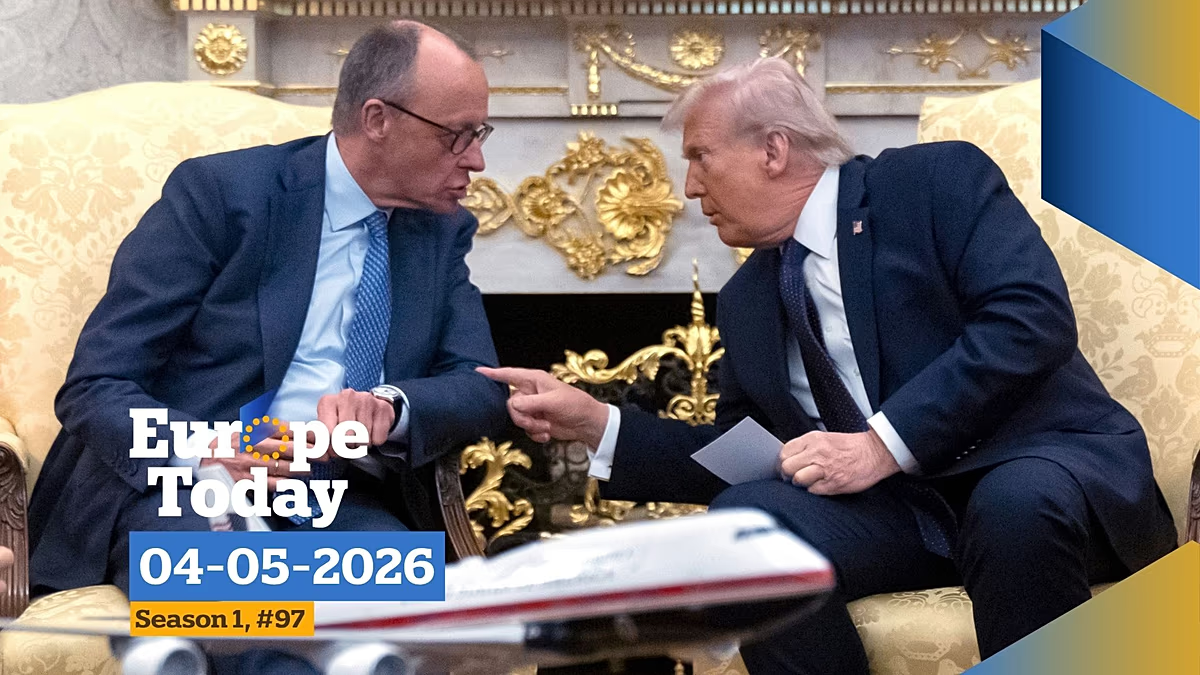
Orbán’s defeat also carries significant implications for transatlantic relations. As a key European ally of U.S. President Donald Trump, Orbán had positioned himself as a disruptive force and a vocal critic of EU policies. His campaign received direct support from the Trump administration, with Vice President JD Vance personally campaigning for him and praising his conservative ideology. Ribera pointedly noted that this heavy-handed American endorsement proved futile. She interpreted the election result as revealing the “limitations and harm” of a U.S. approach that borders on interference, one that has frequently dismissed EU leadership as weak and criticized its policies on migration and digital regulation. The Hungarian people’s choice, in her view, rejected a U.S. narrative that warns of the EU’s “civilisational erasure” and instead validated the Union’s cohesive path.
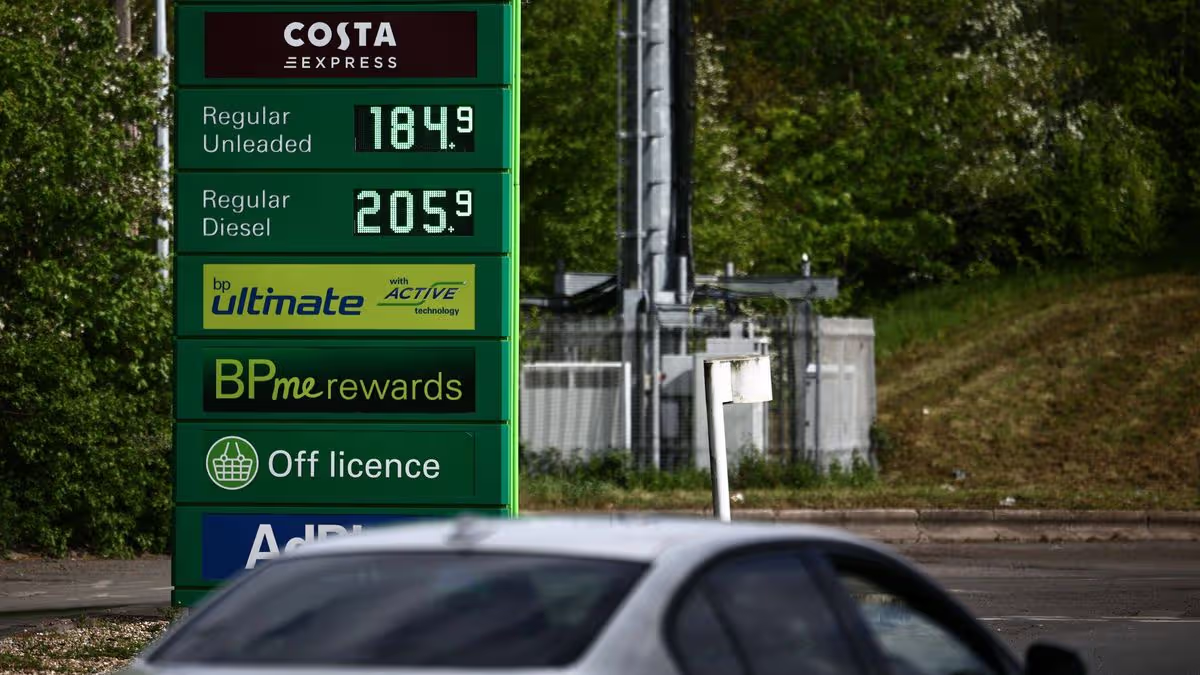
Beyond geopolitics, Commissioner Ribera addressed pressing internal EU matters, particularly the contentious green agenda. Amid a volatile global energy market shaken by conflict in Iran, some member states like Italy have pressured the Commission to suspend climate policies. Ribera, a staunch climate advocate, responded with a firm but nuanced stance. While acknowledging the need for operational flexibility in response to crises, she unequivocally ruled out any permanent rollback of environmental regulations. She argued that accelerating the transition to cleaner, homegrown energy is not just an ecological imperative but the fastest route to achieving genuine economic security and independence for the bloc. Her position underscores a central belief: that long-term stability and sovereignty are inextricably linked to a committed green transition.
This commitment to a principled framework extends to her core portfolio: competition policy. Following reports that the Commission might overhaul merger rules to foster “European champions”—large companies capable of rivaling U.S. and Chinese giants—Ribera clarified that any update would not equate to deregulation. She confirmed that the EU is in the final phase of modernizing its competition toolkit to reflect today’s digital and globalized economy. However, she stressed that this adaptation does not mean abandoning the mission’s core purpose: protecting consumers and ensuring fair markets. “We will not give anyone a blank cheque,” she affirmed, signaling that while the EU seeks to empower its companies for global scale, it will not sacrifice rigorous standards that prevent monopolistic practices and safeguard public interest.
Ribera’s interview ultimately paints a picture of a European Union at a pivotal moment, navigating external pressures, internal debates, and a renewed sense of self-determination following the Hungarian election. The victory of a pro-European coalition in Hungary serves as a tangible rebuke to both internal populism and external attempts to fracture the Union. It strengthens the hand of officials like Ribera, who advocate for a resilient, rules-based, and forward-looking EU. Her dual emphasis—on an unwavering green transition and a robust but modernized competition policy—defines a vision of European power built not on weakness or deregulation, but on strategic autonomy, innovation, and principled governance.
The full conversation, available on Euronews, offers a deeper insight into this vision. As the EU processes this significant political shift in Hungary and confronts ongoing global instability, the principles Ribera articulates—collective solidarity, institutional integrity, and a commitment to sustainable security—will likely guide critical debates in the coming years. The Hungarian electorate’s choice has reinforced a foundational idea: that despite frequent challenges and criticisms, the desire to “be Europeans” and to fight for common rights remains a powerful, enduring force within the Union.