


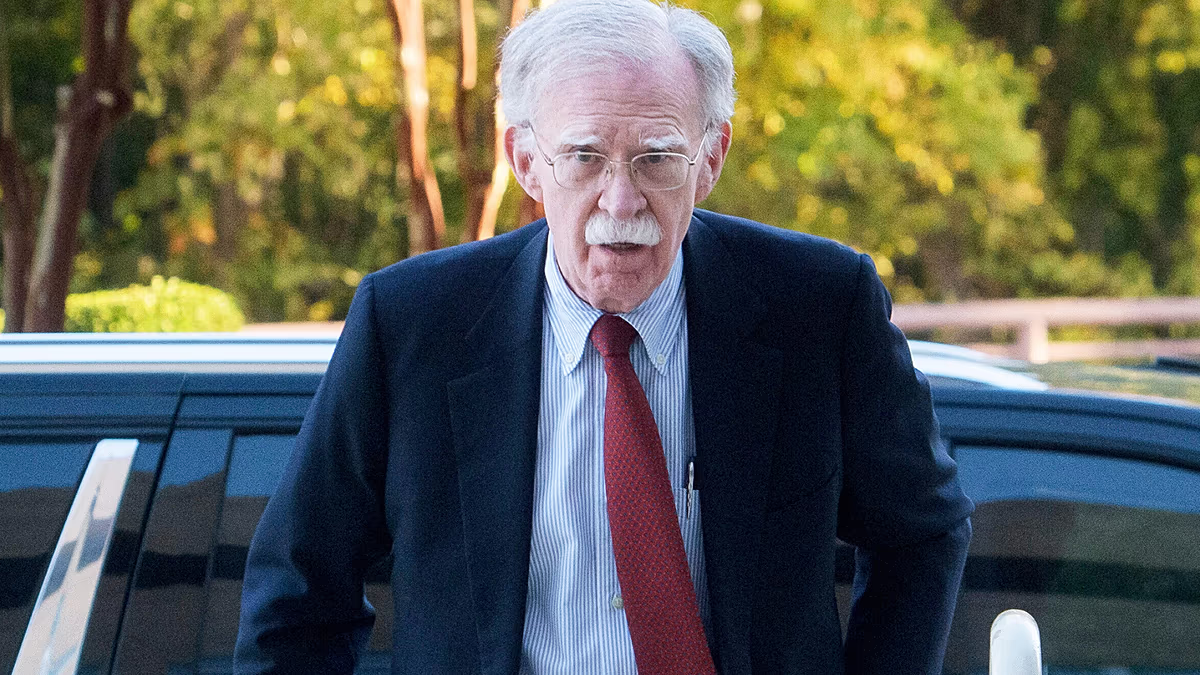
Former National Security Adviser John Bolton has delivered a scathing critique of the recent framework agreement between the United States and Iran, accusing President Donald Trump of being strategically outmaneuvered and prioritizing domestic economic concerns over long-term national security. In an interview with Euronews at the G7 summit, Bolton, who served as a key advisor to Trump during his first term, asserted that Iranian negotiators had expertly exploited the President’s desperation for a deal to end the conflict, ultimately securing terms disproportionately favourable to Tehran. “They’ve played him like a violin,” Bolton stated bluntly. “That’s why they’ve got the deal that they want.” His central thesis is that the administration, in its rush to conclude hostilities, has sacrificed crucial geopolitical leverage for the immediate goal of lowering gasoline prices, a move he characterizes as a fundamental misjudgment.
Bolton elaborated that Trump’s primary focus was not on the intricate strategic implications of the pact but on tangible economic relief for American consumers. “Trump isn’t thinking about the geo-strategic implications of the deal. He’s thinking of one thing. He wants the strait open. He wants Gulf oil on international markets. He wants the price of gasoline at the pump down. That’s all he cares about,” he claimed. When pressed on whether this equated to trading national security for cheaper fuel, Bolton’s reply was unequivocal: “I think that’s basically what it comes down to.” This perspective frames the agreement not as a diplomatic victory but as a transactional concession, where urgent domestic political needs ahead of the midterm elections overshadowed the imperative to curb Iranian regional influence and nuclear ambitions.
A significant point of contention for Bolton is the opaque nature of the agreement. He highlighted the absence of a publicly available text as a major red flag, arguing that the devil, as always, resides in the details. “If it were a great deal, it would be out in public. And I think that tells you pretty much what you need to know,” he remarked. Key questions remain unanswered, including the precise limits on Iran’s uranium enrichment programme, the scope and permanence of sanctions relief, and the concrete mechanisms for reopening the vital Strait of Hormuz. Bolton contends that without these specifics, the headline announcements are meaningless, and the agreement could allow Iran to retain a dangerous level of latent nuclear capability while reaping substantial economic rewards.
Furthermore, Bolton vehemently rejected the White House’s narrative that recent U.S. and Israeli strikes have catalyzed a meaningful change in Tehran’s leadership or ideology. “The change of leadership is only because we’ve killed the top four or five hundred people in the existing regime and you’re down now to their seconds and deputies. So, yeah, it’s different people, but it’s the same fanatic regime,” he argued. This skepticism extends to Iran’s longstanding assurances on nuclear weapons. He pointedly noted Iran’s 56-year membership in the Nuclear Non-Proliferation Treaty as proof that formal commitments are hollow. “They just don’t mean it,” he said, dismissing any guarantee from the current Iranian power structure as inherently unreliable.
Bolton also warned that the agreement itself has fundamentally weakened Washington’s strategic position. By opting for a deal with a militarily weakened Iran, he argued, the U.S. has signalled an unwillingness to execute further strikes, thereby forfeiting its most potent form of leverage. “That takes away the biggest weapon we have, the biggest leverage we have over Iran. That’s all they will understand,” Bolton asserted. In his view, Tehran’s negotiators accurately perceived Trump’s vulnerability—his need for a pre-election foreign policy win and economic stabilizer—and skillfully capitalized on it. “He’s desperate for a deal. And they have manoeuvred him,” Bolton concluded, painting a picture of an asymmetrical negotiation where one side was tactically focused while the other was politically distracted.
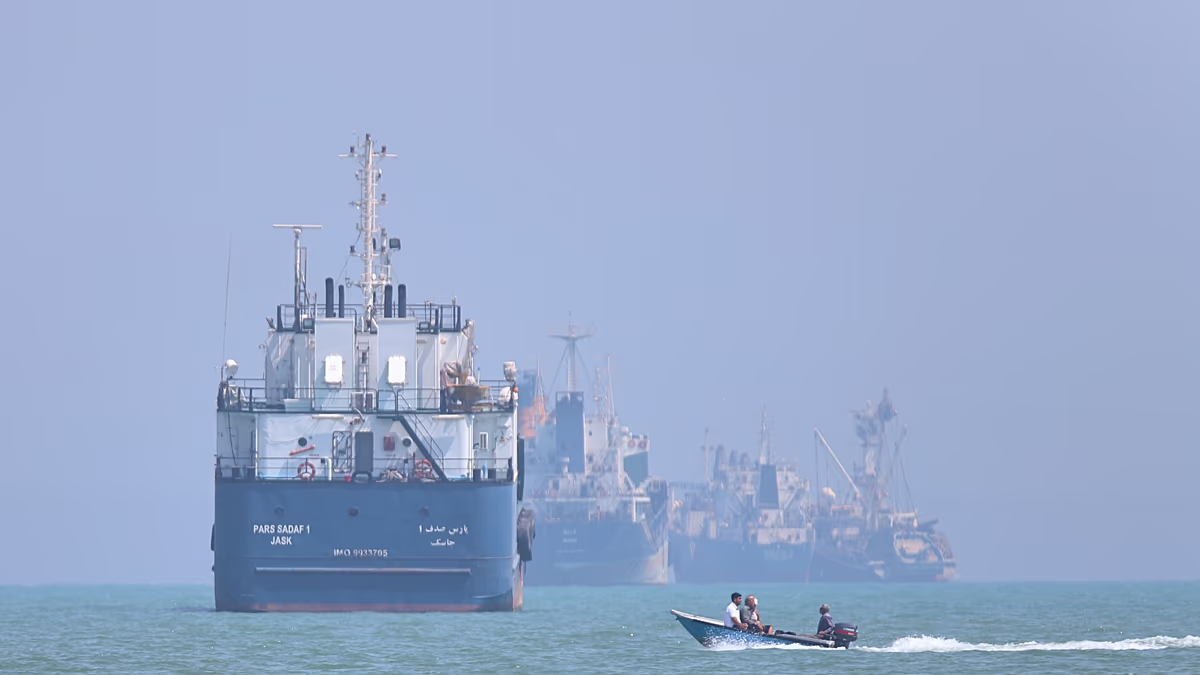
Finally, Bolton expressed deep skepticism about the prospect of a European-led naval force ensuring freedom of navigation in the Strait of Hormuz, a component discussed at the G7. He questioned its potential efficacy, asking, “Is it going to be like a UN peacekeeping force that just waves as the ceasefire is violated? Nobody’s ever addressed that question.” His comments underscore a broader theme in his critique: a fundamental lack of enforceable mechanisms and clear consequences within the current framework. While European leaders like France’s Emmanuel Macron pledged to play a role, Trump’s own mixed signals—both criticizing allies for lack of support and suggesting little help would be needed—reveal, in Bolton’s assessment, an ad-hoc and incoherent approach to a complex and enduring strategic challenge, with concessions made that may haunt future administrations.