



Of course. Here is a summary and humanization of the provided content, expanded into six paragraphs.
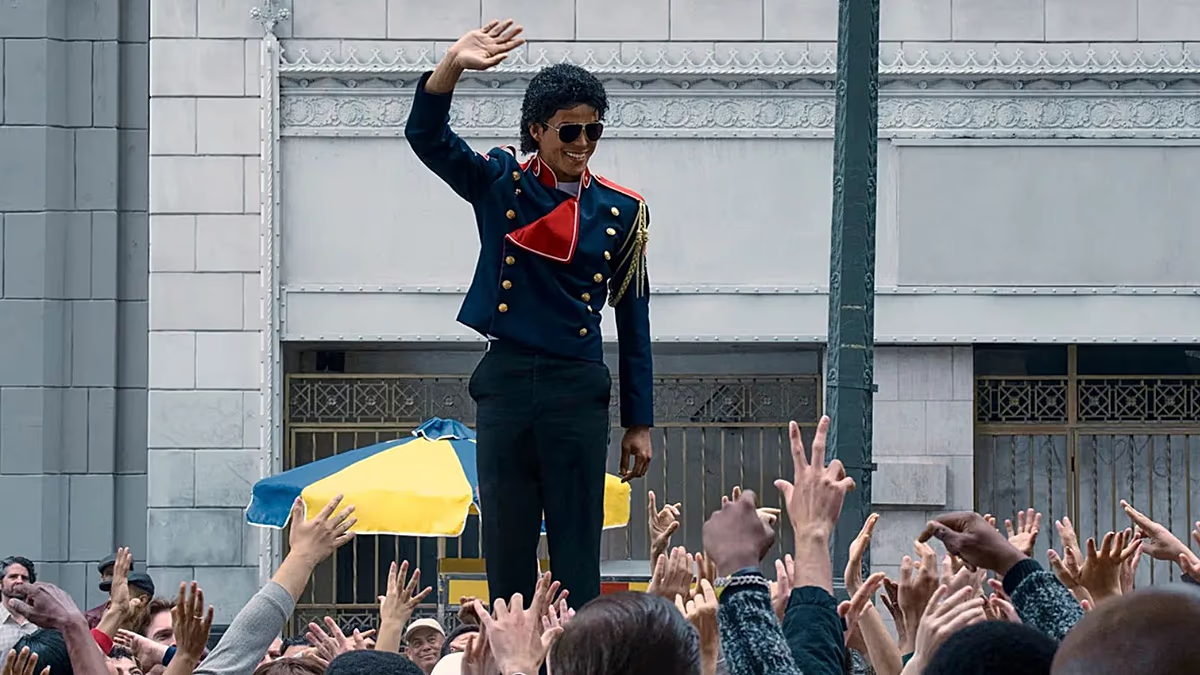
The new Michael Jackson biopic, simply titled Michael, has achieved a monumental and record-breaking box office debut, defying both its overwhelmingly negative critical reception and a famously troubled production process. According to studio estimates, the film opened with an astounding $97 million in U.S. and Canadian theaters, far surpassing initial projections of around $70 million. This debut shatters previous records for music biopics, eclipsing the openings of Straight Outta Compton ($60.1 million) and Bohemian Rhapsody ($51 million). When combined with a powerful international launch of $120.4 million, the film’s global opening weekend total reached $217.4 million—a new high watermark for the genre. Lionsgate chairman Adam Fogelson pointed to “massive engagement” across all audience demographics as a signal of this potential success. With a theatrical run now underway globally (except in Japan, where it opens later), and a production budget nearing $200 million, Michael stands as one of the most expensive biopics ever made. Given its explosive start, there is a significant chance it could ultimately surpass Bohemian Rhapsody to become the highest-grossing music biopic in history.
However, this commercial triumph exists in stark contrast to the film’s artistic reception and the controversy that shadows its subject. Co-produced by the Jackson estate, the biopic has been widely criticized as a sanitized, formulaic portrait. Reviews have been overwhelmingly negative, describing it as a “drama-free, estate-controlled excuse to sell more albums” and an “insultingly blatant hagiography.” The film has been accused of stripping away any contentious elements from Jackson’s early life, including the alleged violent abuse by his father, his early encounters with sexuality, and his struggles with body dysmorphia. Notably, some members of Jackson’s own family, including his sister Janet and his daughter Paris, have publicly opposed the film, with Paris calling it “fantasy land.” This critical and familial rejection underscores a fundamental conflict: the film is designed as a celebratory monument, but many view Jackson’s life story as inherently and profoundly complex.
The production of Michael was itself marred by significant legal and ethical complications. After initial shooting was completed, producers faced a costly crisis. The original third act of the film focused on the allegations made by Jordan Chandler, whom Jackson settled with for $23 million in 1994. A critical condition of that settlement legally barred the Jackson estate from ever mentioning Chandler in a movie. This required a massive, last-minute overhaul. A sizeable portion of the film was cut and reshot at an estimated cost of up to $50 million, borne by the estate. Director Antoine Fuqua and screenwriter John Logan reworked the narrative to conclude in 1988, thereby avoiding any depiction of the later accusations. This expensive pivot ensured the film’s compliance but also cemented its approach as one that sidesteps the most controversial chapters of Jackson’s life.
The release of Michael has reignited painful conversations for the men who accuse Jackson of childhood sexual abuse. James Safechuck, an accuser featured in the 2019 documentary Leaving Neverland, released a supportive statement directed at other survivors amid the film’s promotional barrage. He noted that the widespread praise and promotion of Jackson could be “triggering for survivors who have their own ‘Michael’ in their lives.” Safechuck offered solidarity, urging survivors to lean on supportive communities and affirming that “telling the truth and telling what happened is a good thing, and that it’s a part of your healing.” His message highlights the emotional toll that the celebratory biopic imposes on those who believe Jackson harmed them.
Documentarian Dan Reed, who directed Leaving Neverland, has also openly questioned the biopic’s omission of the allegations. He expressed a grim view that the film’s success suggests “people don’t care that he was a child molester.” Reed posited that for many, love for Jackson’s music overshadows the serious accusations, and he challenged the authenticity of a Jackson story that completely ignores them: “How can you tell an authentic story about Michael Jackson without ever mentioning the fact that he was seriously accused of being a child molester?” This critique points to the central ethical dilemma of the film: is it possible, or even responsible, to craft a definitive biographical portrait of Michael Jackson while entirely excising the darkest and most legally fraught allegations that define his legacy for so many?
Ultimately, Michael represents a fascinating and divisive cultural phenomenon. It is a film that has achieved staggering commercial success by presenting a streamlined, estate-approved version of a legend’s rise. Yet, it is enveloped by a storm of criticism—from reviewers who find it artistically hollow, from family members who find it false, from survivors who find it traumatic, and from observers who find it ethically compromised. Its production story is one of a last-minute, multi-million-dollar salvage operation to avoid legal peril. The biopic’s triumph at the box office and its failure in the court of critical and moral opinion exist simultaneously, mirroring the enduring dichotomy of Michael Jackson himself: the unparalleled, beloved artist versus the man shrouded in grave and unsettling accusations. The film, like the icon it portrays, leaves us with a fractured picture, where record-breaking numbers and profound discomfort reside side by side.