


Of course. Here is a summary and humanized version of the content, expanded into six paragraphs.
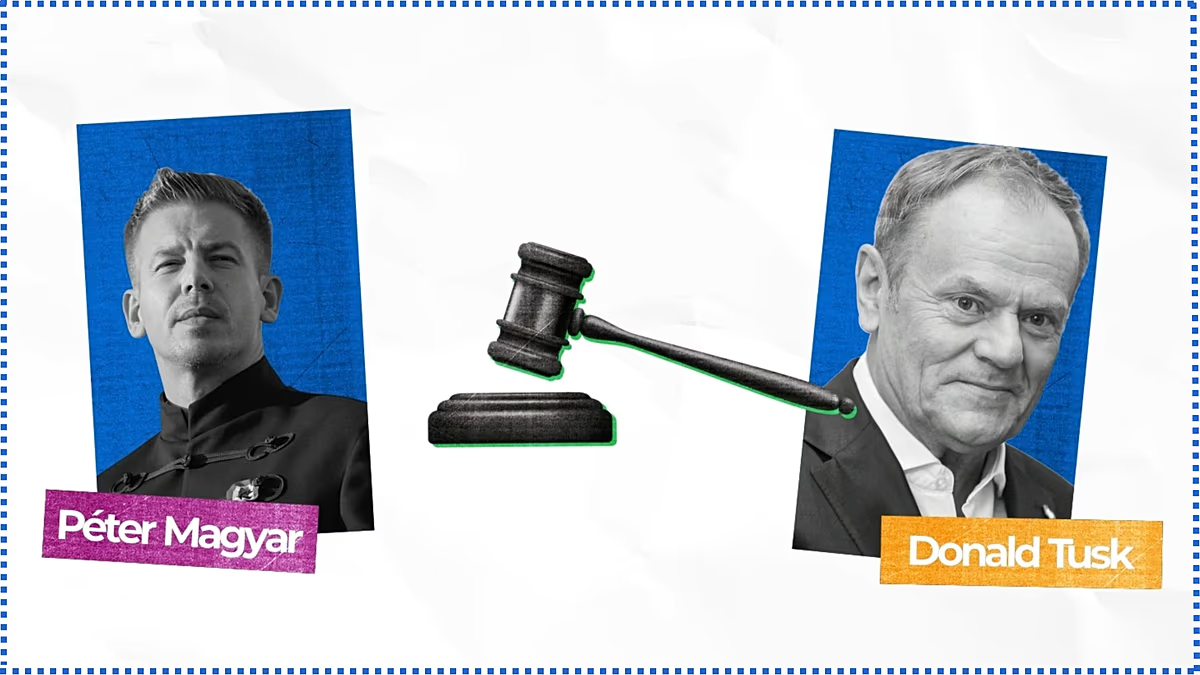
In late 2023, Poland’s newly elected Prime Minister, Donald Tusk, authored a modern political blueprint: how to rapidly dismantle years of entrenched illiberal governance. This “shock therapy” approach, designed to undo the legacy of his predecessors, is now being studied intently by Hungarian opposition leader Péter Magyar as a potential model for his own country. The parallels between their situations and goals are striking, suggesting a new template for political transitions in Central Europe.
The playbook’s first, and most dramatic, tactic concerns state media. To bypass the opposition of President Andrzej Duda, Tusk’s government used a parliamentary resolution to instantly dismiss the management of Poland’s state broadcasters, effectively taking the network offline overnight. Magyar has explicitly vowed to employ the same shock therapy. Following a heated interview on Hungarian public television—which he likened to “North Korean propaganda”—he promised to suspend the national broadcaster’s signal the moment he takes office, aiming to break its grip as a government propaganda tool.
Secondly, both leaders prioritized judicial reform and European integration from day one. A key shared objective was joining the European Public Prosecutor’s Office (EPPO), reversing their predecessors’ refusals to participate. However, the paths differ in complexity. In Poland, Tusk has faced severe gridlock, struggling with presidential vetoes and requiring legal creativity to advance reforms. Magyar, conversely, would wield a formidable two-thirds constitutional majority, granting him significant power to enact change swiftly. This strength is already noted by EU officials, who are in Budapest discussing the release of €10.4 billion in frozen recovery funds, anticipating his ability to push through necessary reforms.
The third area of action targets state assets and institutions. Tusk rapidly purged the management boards of state-owned enterprises, most notably the oil giant Orlen. Magyar is preparing a similar sweeping overhaul across Hungary’s state-backed entities. His plans include recovering misappropriated state assets and cutting funding to ideological networks like the Mathias Corvinus Collegium (MCC), which are seen as pillars of the outgoing government’s support system.
However, this aggressive strategy carries inherent risks. Moving too swiftly can invite legal missteps and procedural errors, potentially undermining the legitimacy of the reforms. Critics of Tusk’s approach, including defenders of Poland’s previous government, argued that his predecessors did not directly obstruct the transition, implying the “shock therapy” was unnecessarily disruptive. This underscores a central tension: the desire for swift change versus the need for stable, lawful processes.
Ultimately, a new pattern seems to be emerging in Central European politics. The transition from illiberal to liberal governance is increasingly characterized by decisive, overnight actions—a deliberate shock therapy aimed at dismantling old systems before they can resist. Whether this approach proves to be a sustainable model for democratic restoration, or a reactive tactic with unforeseen consequences, remains a critical question for Poland, Hungary, and beyond. As these events unfold, they represent a significant test of how democracies can reset after periods of concentrated political control.