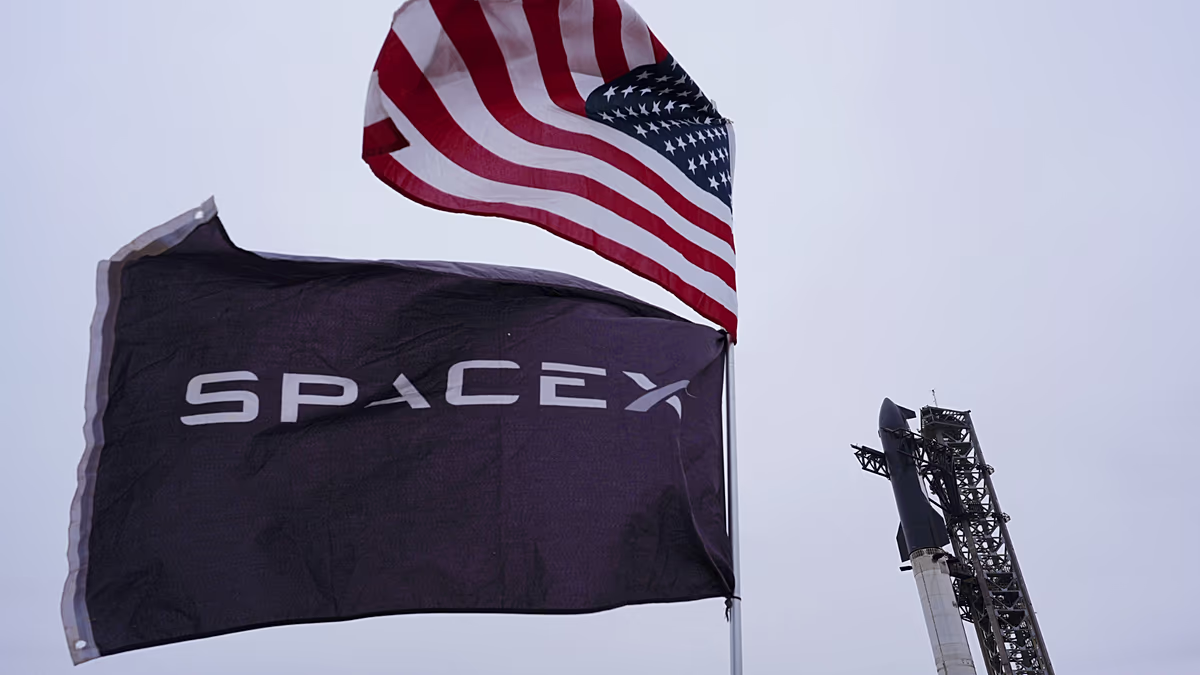





In a significant move that signals the maturation of the artificial intelligence industry, OpenAI, the creator of the revolutionary ChatGPT, has taken a concrete step toward becoming a publicly traded company. The San Francisco-based firm announced it has confidentially submitted preliminary paperwork to the U.S. Securities and Exchange Commission (SEC), a formal procedure that begins the journey toward an eventual Initial Public Offering (IPO). This strategic filing, OpenAI noted, was announced proactively because “we expect it to leak,” but the company emphasized that an actual public listing “may be a while.” The leadership acknowledges a complex set of trade-offs, as certain ambitious goals might be easier to pursue away from the intense quarterly scrutiny of public markets. Nonetheless, this move keeps their options open, providing the flexibility to accelerate their timeline if conditions become favorable, and positions them alongside rivals like Anthropic and Elon Musk’s SpaceX, who are on similar paths.
This pivotal decision arrives at what analysts describe as a “precarious moment” for the pioneering AI lab. Founded in 2015 as a non-profit dedicated to developing safe and beneficial AI for humanity, OpenAI has undergone a profound transformation, evolving into a commercial powerhouse currently valued at a staggering $852 billion. The drive for an IPO, first suggested by CEO Sam Altman last year as the company’s “most likely path,” is fundamentally fueled by an insatiable need for capital. Developing advanced AI systems requires monumental investments in computing infrastructure, top-tier research talent, and expansive data resources. As analyst Nate Elliott pointed out, with fierce competition from giants like Google and well-funded peers like Anthropic, OpenAI has few other avenues to secure the “enormous capital required to support its costs,” especially as it reportedly spends more than it earns in pursuit of dominance.
The path to this point has been carefully engineered and legally tumultuous. Last year, OpenAI restructured its business, converting into a “public benefit corporation” while remaining under the ultimate control of its original non-profit board—a design intended to balance commercial ambition with its founding mission. Furthermore, a major legal cloud was dispelled just last month when a federal court dismissed a lawsuit from co-founder Elon Musk, who had sought to oust Altman and reverse the company’s for-profit shift. This victory removed a significant barrier, clearing the runway for its financial future. Internally, the company is already operating with the rigor of a public entity, as noted by Chief Financial Officer Sarah Friar, who stated they are measuring revenue by SEC standards to be ready. She highlighted the advantage of accessing the vast public markets and framed an IPO as a “credentialising moment” of transparency and governance.
Financially, the imperative is clear. Unlike traditional software companies, leading AI firms like OpenAI, Anthropic, and SpaceX are engaged in a capital-intensive arms race, investing billions in hardware and research long before achieving profitability. OpenAI has guarded its precise revenue figures and profit timeline, but the scale of its ambition necessitates a corresponding scale of funding. Friar has indicated that the company’s current valuation would place it among the top 15 largest companies in the S&P 500, a testament to the market’s belief in AI’s transformative potential. Tapping public equity markets would provide not just a war chest to outspend competitors, but also a liquid currency for acquisitions and talent retention, solidifying its position at the forefront of the industry for the long term.
Beyond the balance sheet, OpenAI’s leadership frames this financial strategy within a grand vision for AI’s role in society. In a statement coinciding with the SEC filing, Altman outlined audacious long-term goals: developing an automated AI researcher, significantly accelerating global economic growth, and ultimately providing “everyone on Earth a personal AGI”—an Artificial General Intelligence capable of outperforming humans across a wide range of tasks. He described the company’s evolution from pure research to commercial products, and now into a third phase focused on the “broad distribution of AI-driven benefits.” This rhetoric aligns with recent high-level discussions, including a meeting with Senator Bernie Sanders, who has proposed public ownership stakes in major AI companies, and echoes broader political conversations about ensuring the public shares in the prosperity generated by artificial intelligence.
Ultimately, OpenAI’s confidential SEC filing is more than a routine financial procedure; it is a landmark event at the intersection of technology, finance, and societal governance. It marks the point where one of the most influential architects of the AI revolution prepares to invite the world to own a piece of its future. The company stands at a crossroads, navigating the tensions between its non-profit origins and its commercial imperatives, between breakneck competition and its stated mission to widely share gains. As it moves closer to a public debut, every step will be scrutinized for how it balances the pursuit of transformative intelligence with the responsibilities of capital markets and the profound promise of ensuring that the age of AI benefits all of humanity.