



Of course. Here is a summary and humanization of the provided content, expanded to the requested length.
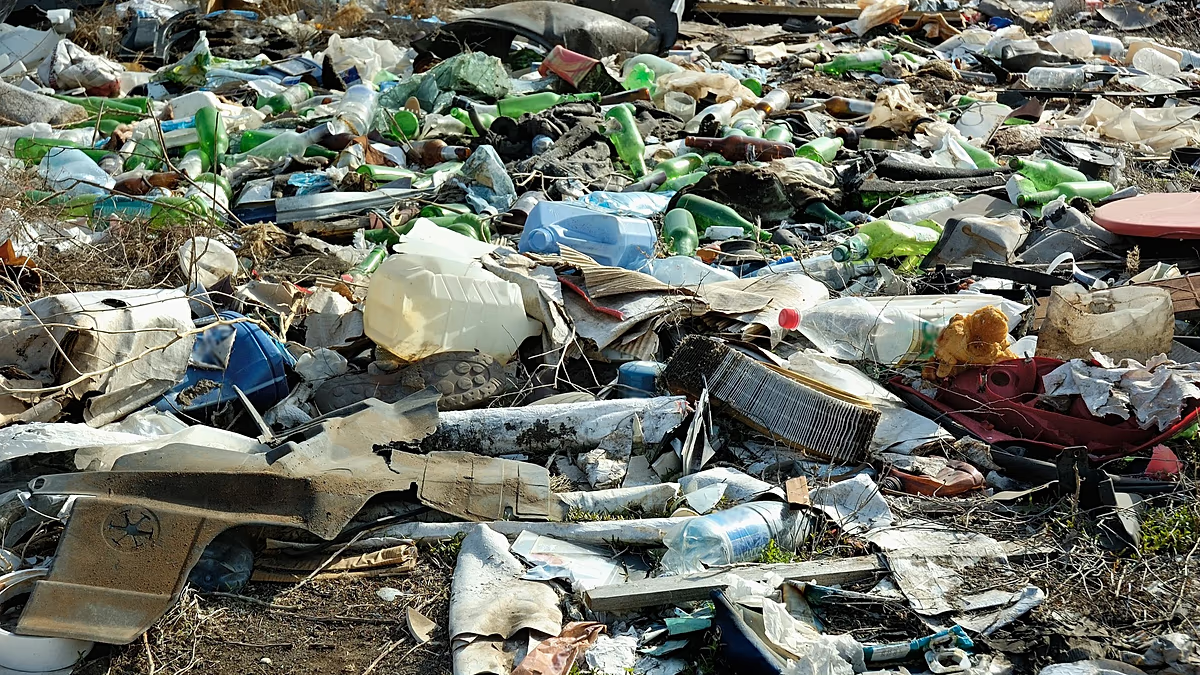
A scenic bird-watching destination at the end of the world has found itself at the center of an international medical mystery. The investigation into a tragic hantavirus outbreak, which originated on the cruise ship MV Hondius, has zeroed in on a landfill on the outskirts of Ushuaia, Argentina. It is here, authorities suspect, that a Dutch couple on a dream trip may have been exposed to the virus. This theory, however, has ignited a fierce dispute with local officials in Ushuaia, who feel their region is being unfairly targeted. They vehemently deny their area is the source, pointing out that the province of Tierra del Fuego has not recorded a single case of hantavirus in nearly three decades. The fear is that such speculation, splashed across global headlines, could devastate a tourism economy that thrives on the very pristine natural beauty now under suspicion.
The journey that led to this point is a somber tale of adventure ending in tragedy. The couple, aged 70 and 69, arrived in South America in late November 2025, embarking on an extensive months-long tour by car across Argentina, Chile, and Uruguay. Their travels were precisely the kind of immersive experience many seek, culminating in a cruise from Ushuaia, a gateway to Antarctic wonders. Yet, shortly after embarking on the MV Hondius, the husband fell ill. He died on April 11th. His wife, having disembarked, later died in South Africa while attempting to return home to Europe. This rapid, deadly progression underscores the severity of the outbreak and sent shockwaves through international health circles.
Complicating the response is a stark and troubling reality: Argentina is no longer a member of the World Health Organization (WHO), having formally exited in March 2025, alongside the United States. This departure has created a palpable gap in the formal global health infrastructure during a crisis. While Argentine officials maintain they can cooperate fully on technical matters through regional bodies like the Pan American Health Organization, the WHO’s director-general has publicly urged the country to reconsider. The situation highlights the fragile nature of international health collaboration in an era of shifting geopolitical alliances, making coordinated research and data-sharing more challenging just when it is most needed.
The scientific focus returns repeatedly to a specific and elusive creature: the Oligoryzomys longicaudatus, or the long-tailed pygmy rice rat. This tiny, protected rodent, weighing less than a handful of coins, is the natural reservoir for the particular strain of hantavirus in question—the Andes strain. What makes this variant exceptionally dangerous is its unique ability to spread from person to person, which likely explains how the infection spread from the initial couple to others aboard the confined environment of the cruise ship. The rats themselves, which live in brushy areas and are adept jumpers, carry the virus without showing symptoms, passing it among themselves through fights or mating. Their populations are difficult to track, fluctuating with climate and food supply, turning them into invisible, mobile vectors in the ecosystem.
Back in Argentina, the national statistics are alarming and add urgency to the investigation. The mortality rate for hantavirus in the country has skyrocketed from an already concerning 17% in recent years to over 33% in the last year alone. This dramatic spike has set off alarm bells not only domestically but within global health monitoring networks. In response, Argentine technical teams are preparing to descend on the suspected Ushuaia landfill area, aiming to capture rodents and test for the virus’s presence to confirm or refute the transmission hypothesis. Furthermore, the country has activated international cooperation channels, pledging to share genetic material from the strain with laboratories in Spain, South Africa, the Netherlands, and the United Kingdom in an effort to improve global diagnostic protocols.
Ultimately, this story is a collision of human ambition, natural danger, and bureaucratic friction. It is about a retiree’s dream voyage, a province’s vulnerable reputation, a virus’s deadly leap from the wild, and the complexities of modern global health governance. As scientists hunt for a tiny rat in a vast landscape, and diplomats navigate strained relationships, the outbreak serves as a stark reminder of our interconnected vulnerability. The pathogens of remote ecosystems do not respect tourist itineraries or political borders, and understanding their pathways requires a unity that, in this instance, is being tested before the world’s eyes.