



Amidst a fragile and tense pause in hostilities, the United States and Iran appear to be inching toward a more lasting resolution to a conflict that has destabilized the Middle East and rattled global markets. President Donald Trump, expressing cautious optimism, stated his belief that the war is “very close to over,” suggesting that Iran is keen to reach a deal. He emphasized the devastating impact of the US military campaign, bluntly noting that a sudden withdrawal would leave Iran needing decades to recover. This rhetoric underscores a dual strategy of applying maximum pressure while dangling the prospect of relief, a hallmark of his administration’s approach. As the critical ceasefire deadline of April 22nd looms, international mediators are laboring to solidify the tentative peace, with the United Nations and Pakistani officials actively facilitating discussions.
The path to a permanent agreement, however, is strewn with formidable obstacles that derailed previous negotiations. According to officials close to the talks, three major sticking points remain: the future of Iran’s nuclear program, the reopening of the strategically vital Strait of Hormuz, and the highly contentious issue of wartime reparations. Each of these points touches a raw nerve of national sovereignty and regional influence for Tehran. While diplomats work behind the scenes, the situation on the ground remains volatile. The United States has maintained its naval blockade on Iranian ports, a primary source of economic pressure, prompting Tehran to issue fresh threats. This delicate dance between diplomatic progress and military posturing reveals the deep mutual distrust that any deal must overcome.
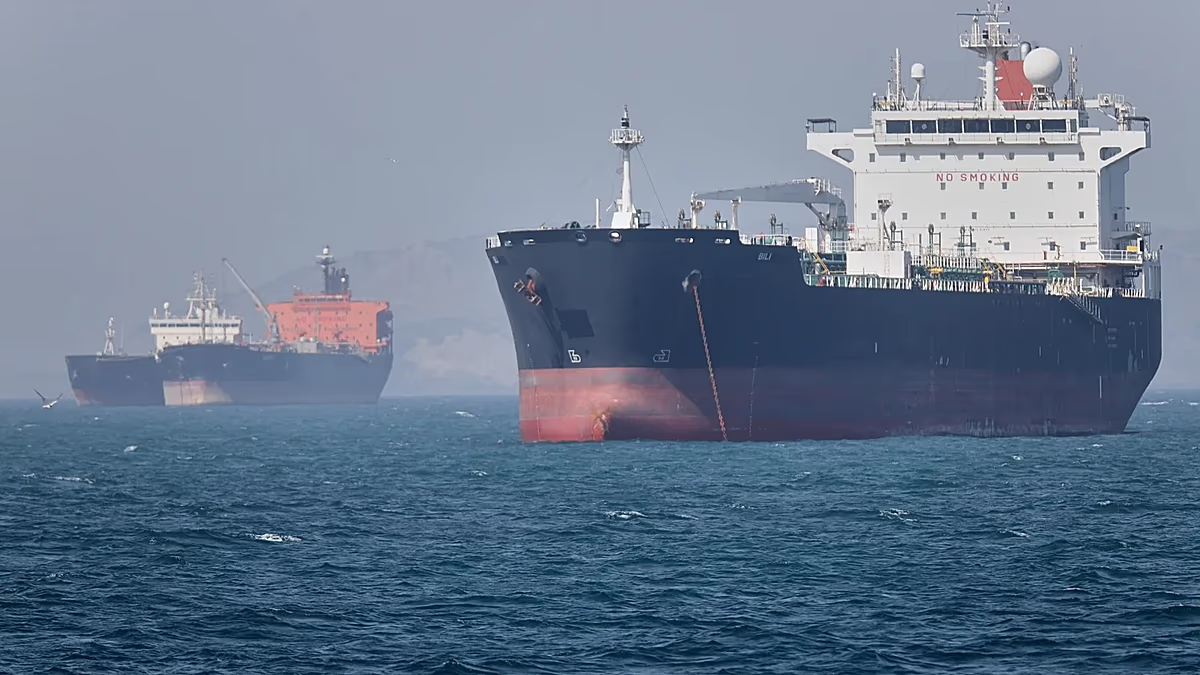
The economic stakes of this conflict and its potential conclusion are immense, as reflected in immediate global market reactions. News of progress in talks prompted a drop in oil prices and a rise in US stocks, a clear signal from investors breathing a tentative sigh of relief. The catalyst for this global anxiety was Iran’s decisive move in the early days of the war to effectively shut down the Strait of Hormuz. This chokepoint, through which a substantial portion of the world’s seaborne oil passes, became a flashpoint, sending shockwaves through energy markets and highlighting the profound interconnectivity of regional conflict and global economic security. The recent market optimism hinges entirely on the Strait reopening, making it a central bargaining chip in the negotiations.
While the US-Iranian ceasefire holds, however shakily, a parallel and related conflict continues to simmer. Israel has persisted in its military campaign against Iran-backed Hezbollah in Lebanon, conducting aerial and ground operations even amidst the broader truce. This sustained offensive risks unraveling the delicate progress made between Washington and Tehran, as Iran has explicitly warned that continued attacks on its proxy could jeopardize the entire ceasefire. This complex dynamic illustrates the layered nature of the conflict, where bilateral talks are inextricably linked to regional proxy battles. Hezbollah itself has openly rejected diplomatic overtures, specifically denouncing a recent historic meeting between Lebanese and Israeli ambassadors in Washington and vowing to continue its armed resistance.
That groundbreaking meeting, hosted by US Secretary of State Marco Rubio, marked the first direct talks between Lebanon and Israel in decades. Lasting over two hours and described by the US State Department as “productive,” the discussions aimed to lay the groundwork for future direct negotiations. Yet, Hezbollah’s forceful rejection of the dialogue underscores a fundamental reality: any comprehensive peace must account for non-state actors who wield significant power and whose sponsors are at the negotiation table. Israel’s determination to continue fighting Hezbollah, despite the US-Iran truce, suggests that it views this front as a separate security imperative, one it is unwilling to pause even for the sake of broader regional de-escalation.
In conclusion, the world is witnessing a precarious moment of possibility, fraught with risk. President Trump’s declaration of a war “very close to over” reflects a potential turning point, driven by economic exhaustion and diplomatic hustle. Yet, the celebration is premature. True peace depends on bridging deep chasms over nuclear ambitions, economic compensation, and vital sea lanes. Furthermore, the continued violence along the Israel-Lebanon border serves as a stark reminder that a deal between nation-states does not automatically silence the guns of their proxies. The coming days will test whether mediators can translate cautious words into a binding agreement that not only ends the direct US-Iran confrontation but also begins the even more daunting task of untangling the web of regional animosities that fuel the wider conflict.