


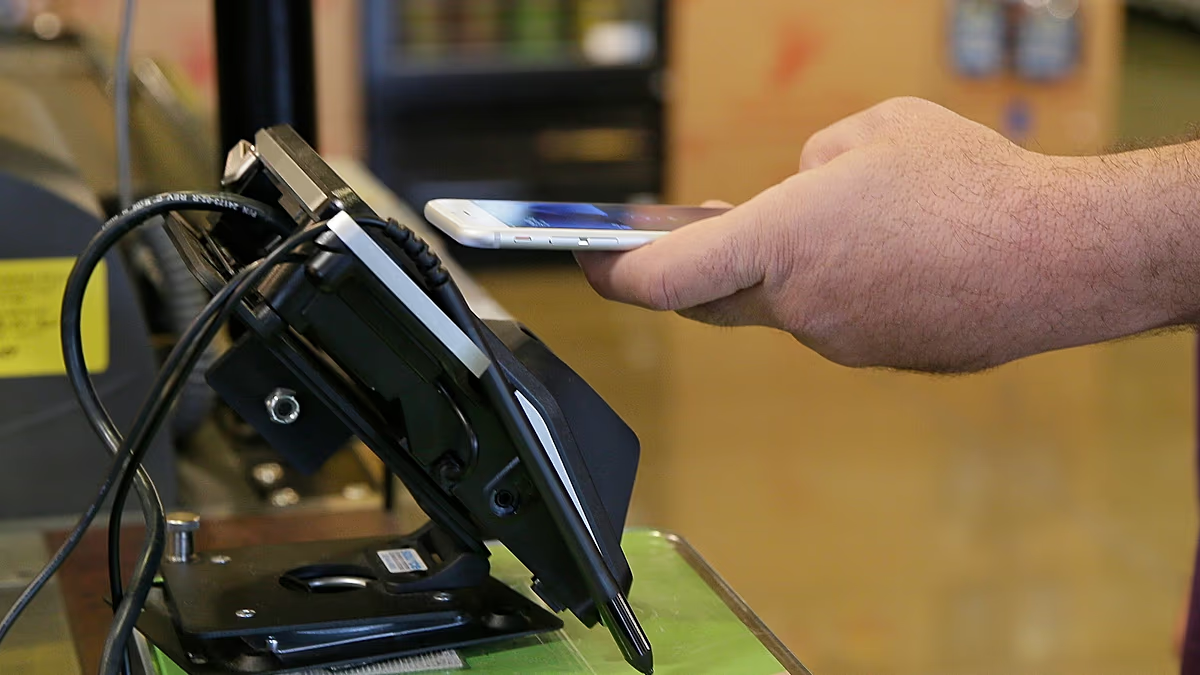
Bizum, the beloved Spanish payment app that has already rendered cash obsolete at countless dinner tables and social gatherings, is now stepping decisively off the smartphone and into the physical world. Starting in May 2026, its new “Bizum Pay” feature will allow customers in brick-and-mortar shops to tap their phones and complete purchases not through global card networks, but via a direct, instant transfer between Spanish bank accounts. This technical shift is profound: it replaces the traditional journey of a payment through Visa or Mastercard’s systems—and their associated fees and data flows—with a domestic rail that moves money instantly from one Spanish account to another, without foreign intermediaries. The implications stretch far beyond convenience, touching on costs, data sovereignty, and the very infrastructure of daily commerce.
This move is the next logical step for a platform that has already achieved something remarkable: unifying Spain’s entire banking sector. Born as an interoperability experiment among banks, Bizum has grown into a national ecosystem with over 30 million users—essentially every banked adult in Spain—supported by around 40 financial institutions in a cohesive bloc. This level of cooperation is a rare feat in Europe, where fragmentation often stifles such initiatives. With 111,000 businesses already integrated and handling millions of instant transfers daily, Bizum has built a trusted, default payment method for digital life. Its expansion into physical stores, led by major banks like CaixaBank and Sabadell, leverages this immense existing user base, turning a ubiquitous social payment tool into a potential point-of-sale champion.
The impact on Spain’s retail landscape could be transformative, especially for merchants. In e-commerce, Bizum has proven its ability to streamline payments and reduce cart abandonment, processing over 100 million transactions in 2025 alone. In physical stores, its primary advantage is cost: it promises significantly lower fees for merchants compared to the typical 0.2% to 2% charged by international card networks. With instant settlement and no reliance on foreign aggregators like Stripe or PayPal, local businesses with a predominantly Spanish customer base have a clear financial incentive to adopt it. Industry observers project that within two to three years, Bizum could capture between 25% and 35% of all payment volume in Spanish shops, reshaping the economics of everyday retail.
For consumers, the change will be seamless—the same familiar app used to split a restaurant bill will now pay for groceries or a coffee. However, the battle for their loyalty will intensify. Global card networks like Visa and Mastercard, which have seen domestic systems like Pix in Brazil and UPI in India eat into their market share, will aggressively defend their position. Their historical playbook involves two key weapons: loyalty programs—cashback, rewards points, and purchase insurance that a simple transfer system like Bizum does not yet offer—and credit. The ability to defer payment remains a powerful trump card. While Bizum moves real money instantly, card networks effectively “sell time.” Thus, we can expect fierce competition, particularly around high-value purchases and micro-payments, as each side leverages its unique strengths.
Spain’s success with Bizum also casts a revealing light on the rest of Europe. Why is there no French or German equivalent? The answer lies in fragmentation. While Spanish banks rapidly agreed on a single, unified standard, European payment initiatives elsewhere have often been born divided or stalled by competing interests. Spain’s model is now not just a domestic triumph; it is being positioned as a foundational blueprint for a pan-European solution. Through the EuroPA Alliance and the European Payments Initiative (EPI), Spain is leading the ambition that a Spaniard could one day pay in a Milan café or a Lisbon bar as easily as they send a birthday gift today. This export of the model represents a quiet but significant shift in European financial sovereignty, building infrastructure that is both efficient and continentally cohesive.
Ultimately, Bizum’s move into physical shops is more than a feature update; it is a strategic evolution of a national digital public utility. It reduces reliance on U.S.-owned infrastructure and keeps spending data and transaction fees within the Spanish—and potentially European—ecosystem. For a country that has already embraced the app as a social and digital payment standard, this expansion feels like a natural next step. It promises to make daily transactions faster, cheaper for merchants, and just as simple for users, while setting the stage for a broader European payments integration. As Bizum transitions from splitting tapas bills to powering supermarket checkouts, it solidifies its role not just as a convenient app, but as a pivotal piece of Spain’s—and perhaps Europe’s—financial future.