



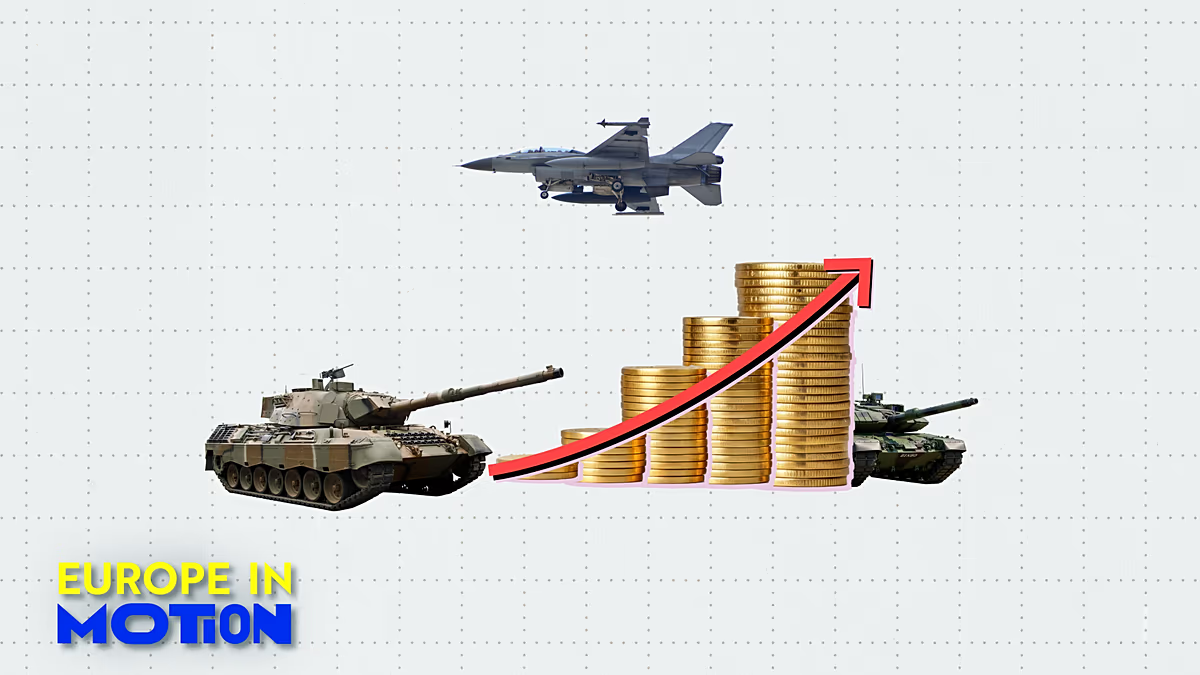
A profound and rapid transformation is underway across Europe, as nations translate long-standing promises into concrete financial commitments for their collective defence. After years of diplomatic encouragement and, more recently, pointed pressure from the United States, European capitals are opening their treasuries at an unprecedented pace. In 2025 alone, the continent’s defence investments surged by 14%, reaching a staggering €739 billion—the most dramatic year-on-year increase since the 1950s. This tidal wave of spending, documented by the Stockholm International Peace Research Institute (SIPRI), is more than a simple political reaction; it is a fundamental recalibration of European security policy. Driven by a potent mix of external warnings and the stark, sobering reality of war on the continent’s doorstep, NATO members are now racing not just to meet the old 2% of GDP benchmark, but to approach a newly ambitious target of 5% by 2035.
The sheer scale of this shift is embodied by Germany, which has emerged as the new engine of European military power. With a monumental 24% increase in spending to approximately €97 billion, Germany has overtaken the United Kingdom to become Europe’s largest defence investor and the world’s fourth-largest. This is not merely an accounting exercise; it represents a historic break from decades of post-war military caution. As Colonel (ret.) Ralph Thiele explains, the Bundeswehr is pursuing 153 major projects aimed at nothing less than becoming “the strongest conventional armed force in Europe.” This vision includes a massive overhaul of its army with new Puma fighting vehicles and advanced infantry systems, a urgent push to close critical air defence gaps with hundreds of new anti-aircraft systems and Eurofighter jets, and a significant naval expansion. Furthermore, Germany is deliberately extending its defence posture into new domains, with strategic investments in spy satellites and space-based systems, recognizing that modern warfare is no longer confined to land, sea, and air.
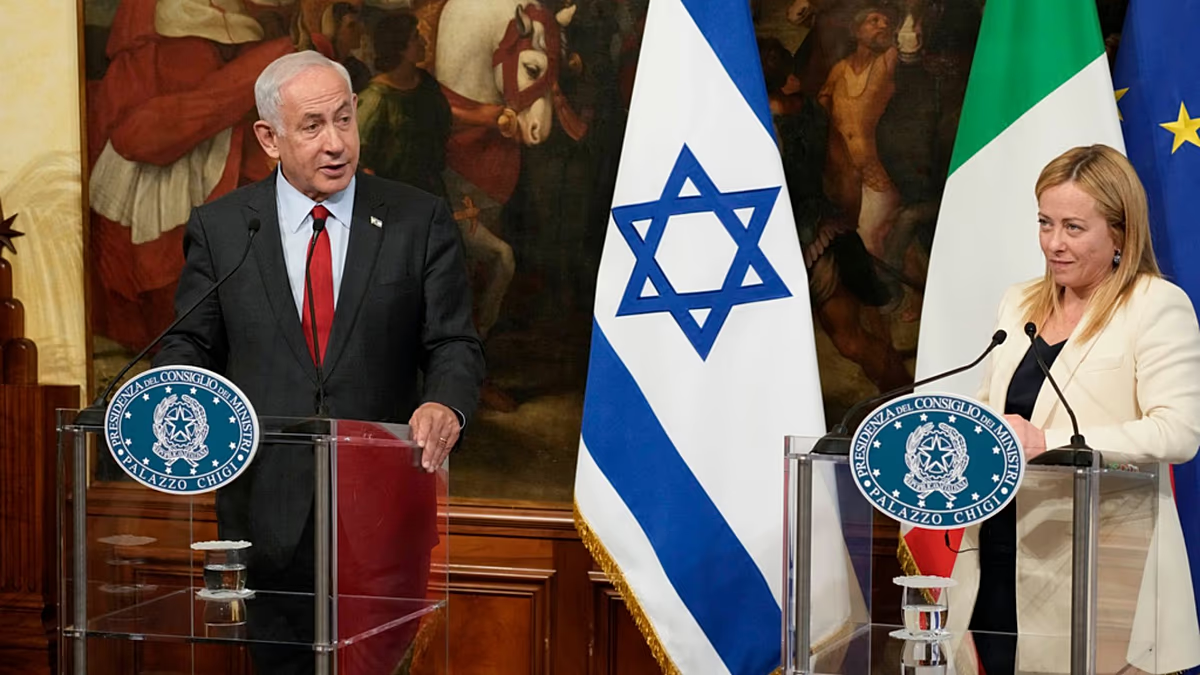
Germany’s dramatic rise is part of a broader continental surge, with other major economies following suit despite fiscal challenges. Italy, for instance, increased its military budget by 20%, bringing it level with global military powers like Israel. Perhaps most telling is the case of Spain, long considered a habitual underperformer within NATO. In 2025, it executed a staggering 50% increase in defence spending, finally reaching the alliance’s former 2% of GDP target for the first time in over three decades. This move signals that the imperative for enhanced defence is now felt acutely across the entire European geography, from its central heartland to its southern periphery. The message is clear: the era of relying on the strategic umbrella of others is decisively over, replaced by a collective understanding that continental security requires shared, substantive sacrifice.
To truly understand national priorities, however, one must look beyond raw cash figures to spending as a share of a country’s total economic output. This metric reveals which nations are treating defence as an existential priority. Here, the map of Europe tells a story of geography defining destiny. While Ukraine leads the world at an estimated 40% of GDP—a testament to its fight for survival—the highest spenders in the rest of Europe are all nations that share a border with Russia. Poland stands at the forefront, dedicating 4.5% of its GDP to defence, a clear reflection of its frontline status. It is followed closely by Latvia and Estonia, while Norway also registers a high commitment. This sharp contrast underscores how the perceived immediacy of the threat directly shapes fiscal policy. Conversely, nations with historically neutral stances or distant from the conflict, such as Ireland and Switzerland, occupy the bottom of the ranking, highlighting the persistent political and strategic diversity within Europe.
This sweeping rearmament is inextricably linked to the ongoing war in Ukraine, which acts as both a catalyst and a grim laboratory for modern conflict. The war has forced a fundamental reassessment of stockpiles, industrial capacity, and the very nature of attritional warfare. Interestingly, while Europe spends more, the United States reported a 7.5% decrease in total military expenditure in 2025. This drop is largely attributed to a political deadlock that blocked new financial aid to Ukraine, contrasting sharply with the $127 billion approved in the three prior years. Despite this decrease, the U.S. still accounts for a dominant one-third of all military spending among the world’s top 15 nations. Meanwhile, Russia, the aggressor state, has managed to continuously increase its military budget since 2022 despite severe sanctions. As SIPRI notes, Moscow has adapted its strategy, shifting towards procuring high volumes of cheaper weapon systems to sustain its long war of attrition. This adaptation demonstrates that the conflict is driving evolutionary changes in military economics on both sides.
In conclusion, Europe is navigating a pivotal moment, constructing a new security architecture funded by historically large defence budgets. The numbers—from Germany’s transformative investment to Spain’s catching-up surge and Poland’s frontline commitment—paint a picture of a continent reluctantly but decisively moving from a post-Cold War peace dividend to a pre-war preparedness premium. This is not a uniform march, as national histories and geographic realities produce varying levels of urgency, but the overall direction is unmistakable. The war in Ukraine has proven that peace in Europe cannot be assumed, and that conventional, high-intensity warfare remains a devastating reality. The challenge now extends beyond mere spending to effectively building integrated, interoperable forces, revitalizing dormant defence industries, and ensuring this financial commitment translates into genuine, lasting security. The continent is, in essence, investing in its own sovereignty, hoping that this unprecedented financial outlay will be the surest guarantee of a future where such weapons are never needed.