



The Pluto Debate: A Scientific and Sentimental Reconsideration
The classification of celestial bodies is often viewed as a settled matter of cold, objective science, but the recent comments of NASA Administrator Jared Isaacman at a Senate budget hearing have reignited a passionate debate that intertwines scientific discovery with human sentiment. In discussing NASA’s future, Isaacman expressed his personal alignment with the camp seeking to restore Pluto’s status as a full-fledged planet. This reopening of a question many considered closed since 2006 highlights how our understanding of the cosmos evolves not just with new data, but with renewed perspective, blending rigorous criteria with a natural human affinity for the worlds we explore.
The 2006 Decision: A Formal Definition and Its Consequences
Pluto’s journey from planet to dwarf planet began with a formal definition. Since its discovery in 1930 by Clyde Tombaugh, it was cherished as the solar system’s ninth planet. However, in 2006, the International Astronomical Union (IAU), the globally recognized authority for such designations, established three clear criteria for planetary status: orbiting the Sun, possessing sufficient gravity to achieve a spherical shape, and having “cleared” its orbital neighborhood of other significant debris. Pluto satisfied the first two conditions but failed the third. It resides within the densely populated Kuiper Belt, a region teeming with icy bodies, and does not gravitationally dominate its orbit. This logical, if stringent, application of the rules led to its reclassification as a “dwarf planet,” a decision that was met with both scientific acceptance and public dismay.
New Horizons and the Rebirth of Wonder
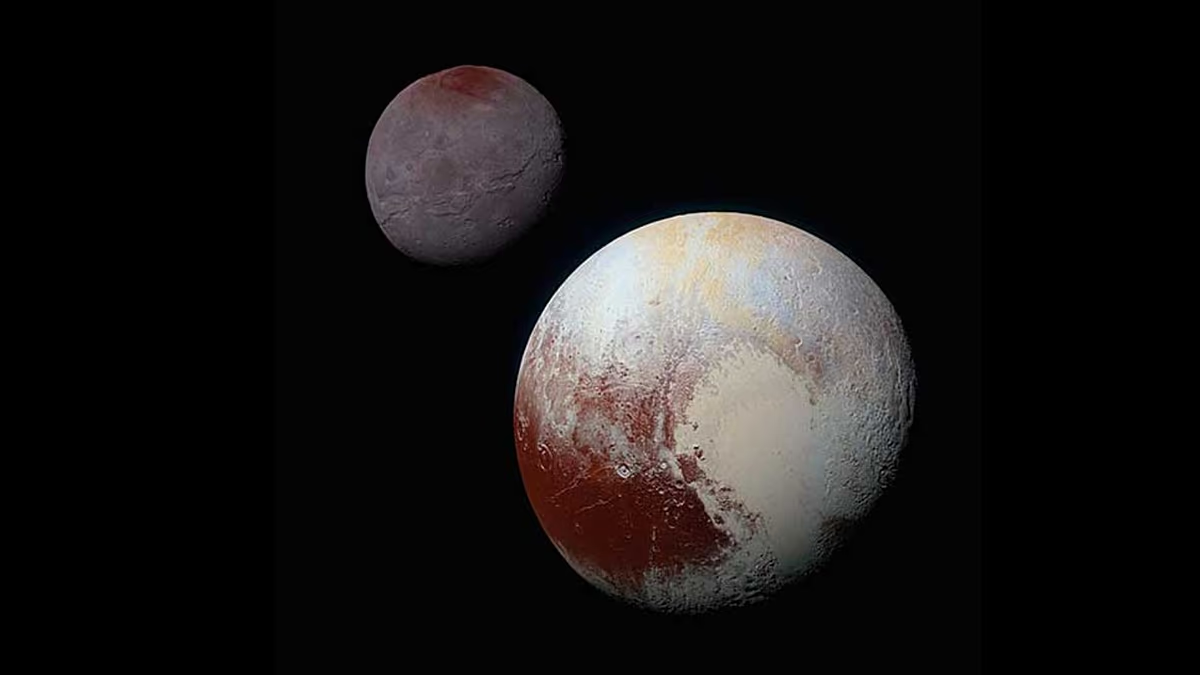
Part of the current momentum to reconsider Pluto stems directly from breathtaking scientific progress. The IAU’s 2006 decision was made with a limited view of Pluto, then a distant speck. In 2015, NASA’s New Horizons mission transformed that speck into a world. The close-up images revealed a landscape of stunning complexity: towering mountains of water ice, vast glaciers of flowing nitrogen ice, a heart-shaped basin, and evidence of possible geological activity. This was not a simple, dead ball of ice, but a dynamic, geologically rich body. These discoveries challenged old assumptions and infused the debate with new substance. Scientists and the public alike began to question whether a definition that excludes such a complex and active world might be too narrow, focusing more on orbital mechanics than on the intrinsic nature of the body itself.
The Human Element: Sentiment, Legacy, and Scientific Advocacy
The hearing itself underscored the human dimensions of this scientific issue. The question was posed by Senator Jerry Moran of Kansas, a state proud to claim Clyde Tombaugh as a native son. This personal connection illustrates how planetary status transcends mere taxonomy; it touches on legacy, cultural identity, and our collective narrative of exploration. Isaacman’s response was not a unilateral declaration but a stated intention to “escalate” scientific papers through the community to revive the discussion. This represents a shift from passive acceptance to active advocacy, suggesting NASA may formally marshal new evidence from missions like New Horizons to argue that our definitions should evolve alongside our understanding.
The Authority of the IAU and the Path to Potential Change
Despite these developments, the path to any official change remains complex. The IAU holds the sole international authority for celestial nomenclature, and it has not revisited its 2006 ruling. Any proposal to redefine “planet” would need to gain substantial traction within this global body of scientists, likely requiring a consensus that the current definition is insufficient or that Pluto meets a revised set of criteria. The debate often centers on the third criterion—“clearing the orbit.” Some planetary scientists argue this condition is problematic; for instance, Earth does not fully clear its orbit of near-Earth objects, and Jupiter shares its orbit with thousands of Trojan asteroids. A revised definition might place greater weight on geophysical properties—like having a complex, differentiated structure—properties Pluto demonstrably possesses.
Conclusion: An Open Question in an Expanding Universe
For now, Pluto’s official designation remains “dwarf planet.” However, the combination of new scientific data from New Horizons, advocacy from figures within NASA, and enduring public and sentimental attachment has ensured the question is vibrantly alive. Whether its status changes will depend on the strength and persuasiveness of the scientific arguments presented and on whether the international community decides that our categorization should reflect not just where a body is, but what it is. The story of Pluto is a reminder that science is a continuous conversation, a process of reconciling elegant definitions with the messy, wonderful complexity of the real universe. Its future classification will ultimately reflect not just a conclusion about one distant world, but about how we choose to understand our place in the cosmos.