


The Sky of Tomorrow: How Airbus is Redesigning Flight for a Crowded World
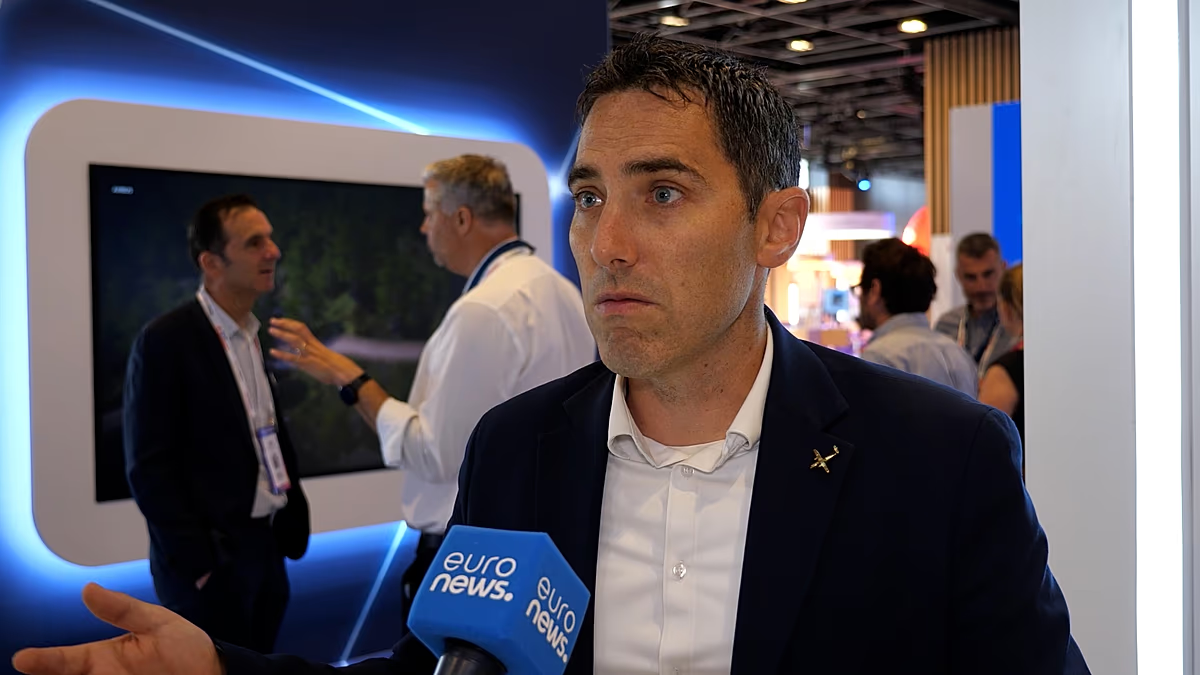
As global demand for air travel continues to soar, the skies and airport tarmacs beneath them are becoming increasingly congested arenas. Recognizing this pressing challenge, European aerospace leader Airbus is spearheading a suite of innovative tests aimed at fundamentally transforming how aircraft navigate our busier world. The company projects that the number of aircraft in service could double within the next twenty years, a growth trajectory that starkly outpaces the expansion of physical airport infrastructure. This impending reality means that the entire ecosystem of flight—from taxiways jammed with planes to airspace thickened with traffic—must operate with unprecedented efficiency and safety. To navigate this future, Airbus is turning to cutting-edge technology, asserting that smarter automation, not just bigger airports, is the key to unlocking smoother journeys. As Jonathan Rigaud, head of Airbus’s pioneering Optimate project, explains, the mission is to harness available technology in novel ways to overcome the mounting complexities of modern aviation, ensuring that the promise of connectivity does not falter under the weight of its own success.
At the heart of this endeavor is the Optimate demonstrator project, a floating laboratory for intelligent automation. This initiative employs a powerful combination of artificial intelligence (AI), quantum sensing, and advanced data fusion techniques. Rigaud outlines three core pillars for Optimate: safeguarding an aircraft’s intended route, optimizing operational efficiency at every stage, and crucially, supporting pilots during moments of low visibility, such as in heavy fog or torrential rain. By integrating tools like radar, LiDAR, and computer vision with AI, the system learns to perceive its environment with remarkable acuity, distinguishing between normal surroundings and potential hazards. This technological sentry is designed not to replace human judgment but to augment it, providing pilots with a clearer, more comprehensive understanding of their situation. The goal is to make every flight not only safer but also more predictable, transforming the cockpit into a hub of enhanced situational awareness where technology acts as a tireless co-pilot, filtering data and highlighting risks.
A significant focus of this research is on the often-overlooked phase of flight: taxiing. Today, aircraft spend an average of over twenty minutes rolling on the ground, burning fuel without ever leaving the tarmac. Airbus sees this as a critical area for improvement, both for economic and environmental sustainability. Through Optimate, the company is developing systems to foster seamless communication between aircraft, airlines, and air traffic control. This interconnected network could enable smarter, collaborative decision-making—choosing the most efficient taxi routes, coordinating engine start-times to minimize idle burns, and avoiding unnecessary stops. The vision is a harmonized airport ground operation where information flows freely, eliminating waste and reducing emissions. To trial these concepts safely, Airbus has employed a unique “aircraft on wheels,” a truck-based demonstrator that has already logged over 400 hours of testing at complex hubs like Paris Charles de Gaulle Airport. This rigorous real-world proving ground is helping engineers decide which innovations are ready for integration into the next generation of aircraft.
In an era marked by geopolitical tensions, Airbus is also proactively addressing vulnerabilities in one of aviation’s bedrock systems: GPS. Incidents of GPS signal jamming and spoofing have highlighted the risks of over-reliance on any single navigation source. In response, Airbus is pioneering resilient backup systems that would allow aircraft to navigate confidently even if satellite signals are compromised. This involves exploring alternative technologies like quantum sensing, which uses the principles of quantum physics to measure motion with extreme precision, and visual navigation systems that can “see” and recognize terrain. The strategy, known as sensor fusion, involves weaving together data from these diverse sources—inertial systems, visual cues, and quantum measurements—to create a robust and independent navigational picture. Rigaud emphasizes that this multi-layered approach ensures aircraft are not tethered to one point of failure. The philosophy is one of graceful degradation; if one system falters, others seamlessly fill the void, guaranteeing that the aircraft’s positional awareness remains intact.
Throughout this technological evolution, Airbus maintains a steadfast principle: the pilot remains the ultimate authority in the cockpit. The role of automation, from AI hazard detection to sensor fusion navigation, is not to usurp command but to empower it. These systems are designed as advanced decision-support tools, synthesizing vast streams of complex data into clear, actionable insights for the human crew. They handle the computational heavy lifting, managing the growing intricacies of dense airspace and congested airports, so pilots can focus on higher-level strategy and safety management. This human-centric approach ensures that technology enhances expertise rather than replacing it, preserving the critical balance between automated assistance and professional judgment. The future cockpit, as envisioned by Airbus, will be a collaborative space where human intuition and machine precision work in concert to tackle the challenges of tomorrow’s airspace.
The work of the Optimate project represents more than just incremental upgrades; it is a holistic reimagining of the flight lifecycle for a new era. By targeting efficiencies from the gate to the runway and into the sky, Airbus is building a blueprint for an aviation system that can scale sustainably. The lessons learned from thousands of hours of testing are now crystallizing into tangible technologies for current and future aircraft. In confronting the dual challenges of booming demand and climate change, Airbus’s research underscores a vital truth: the solution to a more crowded world lies not only in building more infrastructure but in flying more intelligently. Through smarter automation, resilient systems, and an unwavering focus on the pilot-team, Airbus is steering the industry toward a future where air travel remains safe, efficient, and accessible, no matter how crowded the skies above us become.