


Paragraph 1
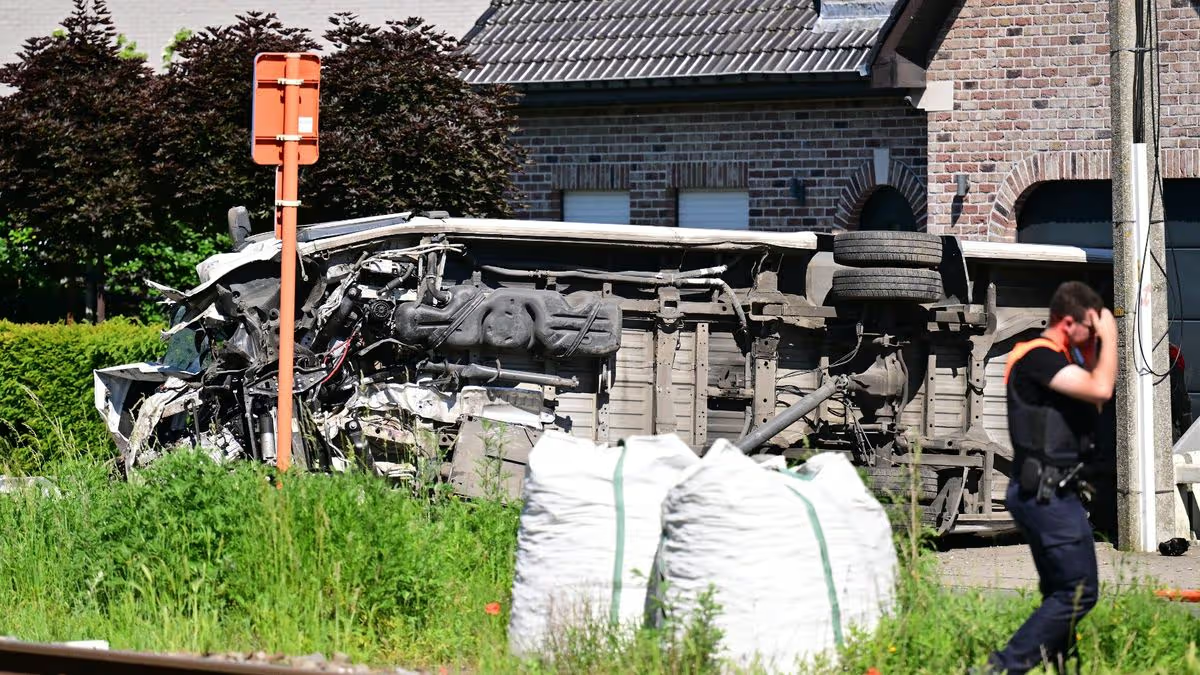
A day that began with the ordinary rhythms of a school morning in Buggenhout, Belgium, ended in profound tragedy on Thursday. At precisely 8:08am, a minibus carrying local school children approached the railway level crossing on Stationsstraat. In a catastrophic collision that has stunned the nation, the vehicle was struck by an oncoming train. The immediate aftermath was a scene of devastation and emergency response, shattering the quiet of the Flemish municipality. This was not a remote or obscure crossing, but a point in the heart of a community where daily life routinely intersects with the rail network, making the event all the more harrowing for its familiar setting.
Paragraph 2
The human cost of the collision is both specific and heartbreaking. Transport Minister Jean-Luc Crucke confirmed the devastating news: four lives were lost. Among them were two young schoolchildren, whose journeys that morning were tragically cut short. Also killed were the minibus driver, tasked with the children’s safe passage, and a chaperone accompanying them. The loss extends beyond these individuals to encompass their families, friends, classmates, and the entire fabric of Buggenhout, where such a close-knit community feels every loss acutely. The sudden erasure of these four lives casts a long shadow of grief, leaving a community to grapple with unanswered questions and immeasurable sorrow.
Paragraph 3
While the minibus bore the horrific brunt of the impact, the train and its passengers were also thrust into a nightmare. The railway company, NMBS, reported that approximately 100 people on board the train experienced the violent jolt of the collision and the subsequent emergency stop. The immediate priority was their safe evacuation, a task undertaken by the rapidly deployed fire brigade. While physically, the majority escaped serious injury, the psychological trauma was significant. One passenger was treated in hospital for shock, a testament to the severe emotional distress inflicted upon all who witnessed the event firsthand. Their ordinary commutes were violently interrupted, leaving them as unintended witnesses to a tragedy that will likely linger in their memories.
Paragraph 4
In the search for understanding, early technical data from the railway infrastructure operator, Infrabel, provides a stark and puzzling picture. According to their initial reports, the safety systems at the crossing were fully operational and activated at the time of the accident. The warning lights were red, and the protective barriers were duly closed, indicating that the crossing was clearly signaling the train’s approach. Furthermore, the train driver executed an emergency braking maneuver in the critical moments before impact, suggesting an awareness of the impending danger. This information sharply contradicts any assumption of a system failure, instead pointing the focus toward the actions and circumstances surrounding the minibus at the crossing.
Paragraph 5
The central, agonizing question—how a vehicle came to be on the tracks despite closed barriers and red lights—now forms the core of an official investigation. Belgian authorities have launched a comprehensive probe to piece together the final seconds leading to the crash. Investigators will scrutinize all factors, including the condition of the minibus, potential distractions, the driver’s actions, the visibility at the crossing, and whether any external elements played a role. The goal is not to assign blame in haste, but to establish a definitive and factual chronology that can provide clarity to the grieving families and inform future safety measures. This process is meticulous and necessary, a search for truth amid the rubble.
Paragraph 6
Beyond the immediate shock and the ongoing investigation, this tragedy serves as a somber reminder of the inherent vulnerability at the interface of road and rail. Level crossings, even with advanced warning systems, represent points of immense kinetic force meeting everyday traffic. The incident in Buggenhout will inevitably reignite discussions about crossing safety, the possibility of additional physical safeguards, and the perennial need for public vigilance. For now, however, the focus remains on human compassion. Belgium mourns the loss of two children, a driver, and a chaperone, offering solidarity to a wounded community. The memory of this morning will stand as a poignant testament to how swiftly routine can turn to tragedy, and how a single moment can forever alter countless lives.