


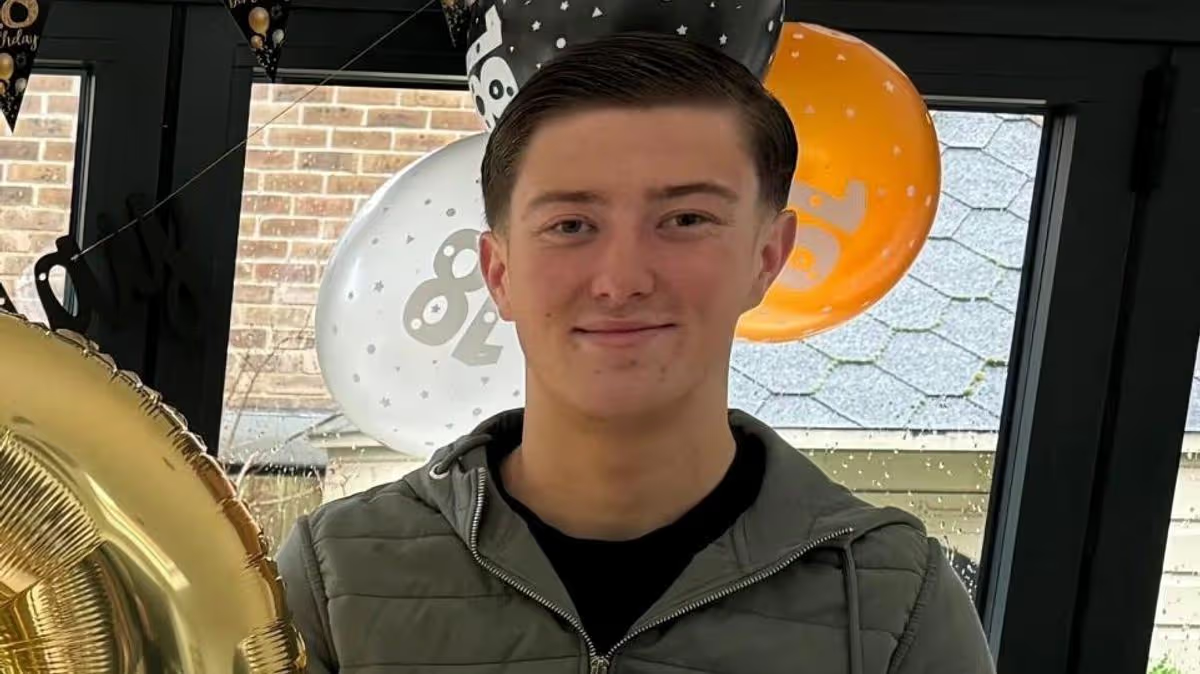
In the quiet aftermath of an unimaginable loss, Olivia Nowak, a 22-year-old sister grappling with a grief no sibling should ever bear, turned to the digital echoes of a happier time. Ten days after her 18-year-old brother, Henry, was fatally stabbed in December 2025 while a student in Southampton, she began to share video tributes on social media. These were not mere collections of photos, but intimate, moving glimpses into a shared life, set to the poignant soundtrack of Coldplay’s “Yellow.” The most striking of these, a 53-second clip, captures the essence of what was lost: a smiling, bright-eyed young man, seemingly ready to embrace every possibility the future held. In one tender segment, filmed within the warm confines of their family home in Chafford Hundred, Essex, Henry and Olivia are seen dancing together, laughing in a moment of pure, unguarded joy. This digital memorial, shared in June 2026, served as a public declaration of a private bond, showing the world not a victim, but a vibrant soul whose light was brutally extinguished.
Olivia’s tributes painted a portrait of a relationship that was the bedrock of her life. The videos, evolving into a series of cherished memories, revealed the depth of their connection. In one, the siblings are seen holding hands, a simple gesture overflowing with unspoken solidarity and affection. Another clip, a snapshot from a family holiday, shows Henry with his arm wrapped firmly around his sister’s shoulders, both beaming at the camera—a frozen moment of perfect camaraderie. Through these fragments, Olivia communicated what words often fail to capture: the inside jokes, the shared silliness, the unconditional support that defines a close sibling bond. Her accompanying caption, “Never felt pain like this. Forever my best friend. Fly high my angel brother,” was a raw testament to a dual reality: the profound pain of his absence intertwined with the enduring strength of his presence in her heart. He was, as she poignantly stated, “forever 18,” eternally preserved in her memory as the lively young man on the cusp of adulthood.
Henry Nowak was more than a headline; he was a beloved son, a university student who had ventured to Southampton to build his own path, and one of four siblings in a tight-knit family. The laughter that filled his family home and the dreams he carried to university stand in stark, tragic contrast to the violence that claimed his life. In June 2026, a measure of judicial closure arrived when A-List Digwa was sentenced to life in prison, with a minimum term of 21 years. While the legal process reached a conclusion, for a family like the Nowaks, such a verdict is not an end but a difficult landmark in a lifelong journey of grief. The gavel’s sound cannot restore a stolen future, mend a shattered family dynamic, or answer the endless questions that haunt those left behind. Justice, however necessary, is a separate realm from healing.
Olivia’s act of publicly sharing these private moments transcends personal catharsis; it becomes a powerful, humanizing force in a narrative too often reduced to statistics. In a media landscape where victims can become peripheral figures in stories about crime and punishment, she deliberately recentered her brother’s humanity. By choosing clips of dancing, laughter, and holidays, she insisted that we remember Henry for how he lived, not just how he died. This conscious curation of memory is a form of resistance against the finality of violence, an affirmation that the love and joy he embodied cannot be erased. Her tribute is a reminder that behind every tragic news article is a universe of lost potential, broken connections, and a reservoir of love that has nowhere to go.
The choice of Coldplay’s “Yellow,” a song about steadfast devotion and seeing the brilliance in another person, is profoundly fitting. Its lyrics, “Look at the stars, see how they shine for you,” echoed in Olivia’s tribute, suggest a love that persists beyond physical presence. In her grief, Olivia has built a constellation of memories, each video a shining point of light that keeps Henry’s spirit vividly alive in the digital firmament. This ongoing act of remembrance illustrates the modern, complex landscape of mourning, where social media becomes a sanctuary for preserving legacy and connecting with communal support. Her profile became a living memorial, a place where friends, family, and even strangers could witness the beauty of the bond they shared and offer solace.
Ultimately, Olivia Nowak’s heartfelt tributes tell a universal story of love, loss, and the indomitable human need to hold onto light in the deepest darkness. While the legal system has delivered its sentence, Olivia’s sentence is lifelong: to carry the love for her brother forward. Through her courage in sharing their joy with the world, she ensures that Henry is remembered not as a case number or a victim, but as a dancing, beaming, beloved best friend and brother. Her grief underscores a devastating truth about senseless violence—it steals not one life, but alters countless others, leaving siblings to navigate a world permanently dimmed. Yet, in her enduring tribute, she demonstrates that even the most profound sorrow cannot extinguish the luminous legacy of a loved one’s spirit.