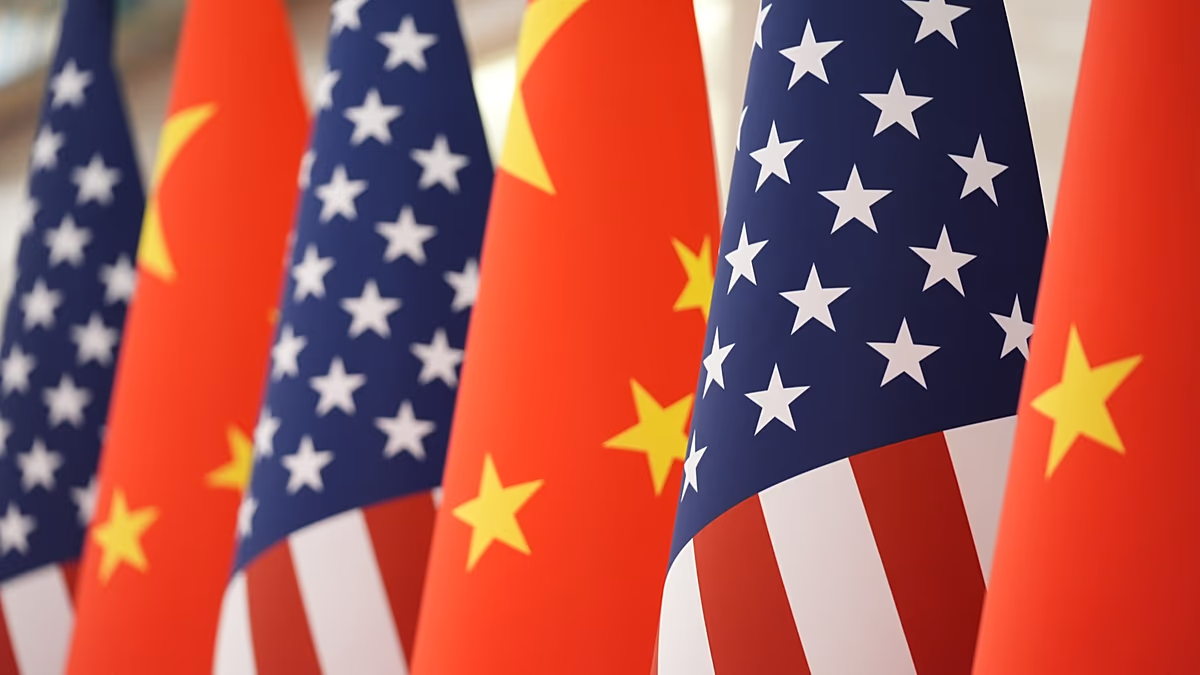
In the ongoing geopolitical chess match between the world’s two largest economies, China has executed a strategic countermove, imposing targeted economic measures against a selection of American firms. Announced by its Commerce Ministry, these actions are a direct response to the United States’ recent expansion of its own trade blacklist, which targets Chinese companies alleged to have ties to the People’s Liberation Army. Beijing framed its decision not as aggression, but as a necessary and proportionate act of self-defence, aimed at safeguarding its national security interests. This tit-for-tat escalation underscores a troubling reality: despite high-level diplomatic efforts to stabilise relations, the foundational tensions over technology supremacy and national security continue to drive both nations toward a more confrontational posture.
The core of China’s new policy involves stringent export controls, prohibiting Chinese companies from supplying “dual-use” items—products with both civilian and military applications—to ten specific U.S. entities. The listed companies, spanning the defence, aerospace, and critical minerals sectors, include notable names like Ball Aerospace & Technologies, Oshkosh Defense, and L3Harris Maritime Services. Particularly significant is the inclusion of firms like MP Materials and USA Rare Earth, which are involved in rare earth mining and processing. Rare earth elements are vital for everything from smartphones to jet fighters, and China dominates the global supply chain, granting these controls substantial symbolic and potential practical weight. The ministry further warned that these restrictions would apply to any global entity attempting to channel Chinese-origin dual-use goods to the blacklisted companies.
Parallel to the export controls, China’s Finance Ministry widened the economic pressure by banning government agencies from purchasing products from 46 American companies. This separate list reads like a who’s who of the U.S. defence industry, featuring giants such as Lockheed Martin, Raytheon, and units of General Dynamics. This procurement ban is a classic tool of economic statecraft, aiming to financially penalise these contractors by shutting them out of the vast Chinese public sector market. While the direct financial impact on these large corporations may be limited relative to their total revenue, the move carries profound political symbolism, representing a formal decoupling in a sensitive sector and signalling that commercial relationships are now inseparable from strategic rivalry.
This latest friction erupts merely a month after a summit between U.S. President Donald Trump and Chinese President Xi Jinping, which was intended to mend ties and reduce punitive tariffs. The rapid resurfacing of hostilities highlights the deep-seated and intractable nature of the dispute, which has decisively pivoted from trade imbalances to a broader technological and ideological cold war. The trigger for China’s retaliation was a U.S. Defense Department decision to add several flagship Chinese tech companies, including Alibaba and Baidu, to its “Chinese military enterprise” list—a designation that blocks them from U.S. military contracts. Baidu’s vehement rejection of the accusation as “totally baseless” illustrates the fierce corporate and national pride at stake, with each side accusing the other of weaponising commerce under the guise of security.
The implications of this cycle extend far beyond the boardrooms of the specifically named companies. By explicitly stating that its export restrictions will also target any foreign organisation acting as an intermediary, China is casting a wide net, compelling global businesses to choose sides in a fragmented technological landscape. This creates a chilling effect on international supply chains, forcing multinational corporations to navigate a labyrinth of conflicting national security edicts. For the targeted American rare earth firms, the controls are a stark reminder of strategic vulnerability, potentially complicating efforts to build independent, non-Chinese sources for these critical materials—a key U.S. policy objective.
Ultimately, this exchange marks another deepening of the rift between the two superpowers, moving beyond rhetoric into concrete actions that entrench the bifurcation of global tech and industrial ecosystems. While both nations insist their measures are defensive, the reciprocal nature of the sanctions risks locking them into an escalatory spiral from which disengagement becomes increasingly difficult. The situation presents a formidable challenge for global stability, as the competition for technological dominance and supply chain security continues to override the economic interdependence that once defined the relationship. The world now watches as two economic giants, unable to find a lasting compromise, slowly construct separate and competing spheres of influence.