Ten Years On: Revisiting the Promises and Realities of Brexit
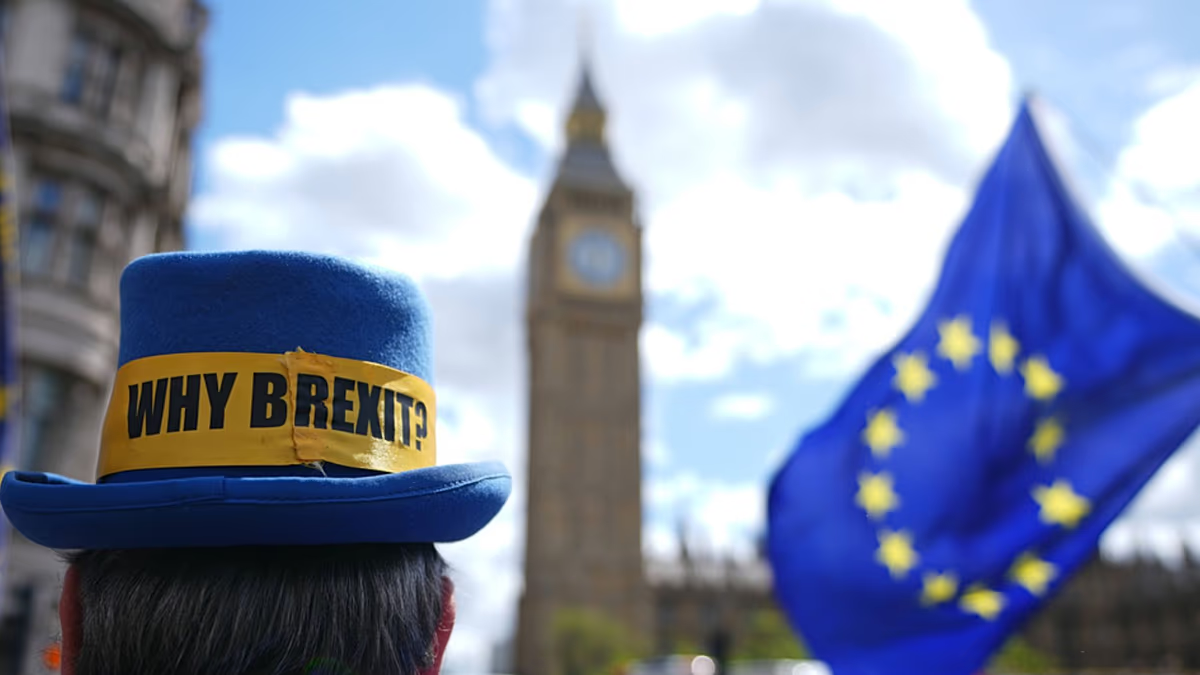
A decade has passed since the United Kingdom voted by a narrow margin—52% to 48%—to leave the European Union. The referendum on June 23, attribute:2016, triggered years of agonising political negotiation and turmoil, culminating in an official departure in early 2020. While the intervening years have flown by, the fundamental debate over whether Brexit represents a benefit or a self-inflicted wound for the UK endures. Polls consistently indicate that a majority of the public now views Brexit as a failure, yet arguments persist across every front: the economy, immigration, bureaucracy, and national security. Revisiting the core claims of the 2016 campaign reveals a landscape where many warnings have materialised, while many promises have not.
On the Economy: A Clear and Costly Impact
One of the most persistent claims of the Remain campaign was that leaving the EU would inflict significant harm on the UK economy. In 2016, then-Chancellor George Osborne warned of a recession, soaring unemployment, and a permanent reduction in GDP. A decade later, the overwhelming consensus among economists and institutions like the UK’s own Office for Budget Responsibility (OBR) is that this prediction has proven accurate, albeit as a gradual erosion rather than a single catastrophic event. The OBR estimates a 4% reduction in productivity and a long-term 15% decline in trade with the EU. New trade deals with non-EU nations have failed to offset these losses. Economists like Professor Jonathan Portes of King’s College London estimate the cost to be a 3-5% reduction in GDP, while others cite figures as high as 8%. As Mark English of the European Movement UK summarises, the question is no longer if Brexit harmed the economy, but whether some consider this a “price worth paying.” While global shocks like the pandemic and the war in Ukraine complicate the analysis, researchers agree all methodological paths point in the same direction: Brexit has delivered a significant and lasting economic penalty.
On Immigration: A Promise Unfulfilled
For many voters, regaining control of borders was Brexit’s central appeal. Prominent Leave campaigners like Boris Johnson and Michael Gove argued that EU membership made promises to reduce net migration to “tens of thousands” impossible. Brexit did indeed end freedom of movement, leading to a dramatic fall in net migration from the EU, which turned negative after 2022. However, this drop was more than offset by a record rise in immigration from outside the EU, driven by humanitarian schemes, student visas, and a post-pandemic labour market hungry for skills. Consequently, overall net migration reached historic highs in 2023 before moderating. As Portes notes, the Brexit promise of a new points-based system was fulfilled, but the “strong implication” of a major reduction in overall numbers was not. In essence, the UK swapped one migration stream for another, with the total flow increasing. The nation, like other wealthy countries, demonstrated a structural need for inward migration; when the EU door closed, others opened wider.
On Bureaucracy: From Streamlining to New Barriers
Leave advocates promised an escape from stifling EU “red tape,” envisioning a liberated, agile Britain. Remainers, including then-Prime Minister David Cameron, warned of a return to “endless forms” for businesses. The reality has aligned more closely with the warnings. By leaving the EU’s single market, UK businesses lost the advantage of following one set of rules to sell across a continent; they now face customs declarations, rules of origin checks, and regulatory barriers for their largest export market. Furthermore, to avoid imposing even greater costs on trade, the UK has largely preserved alignment with EU standards, forgoing a radical “bonfire of regulations.” As English points out, the UK helped design the single market to reduce bureaucracy, and leaving it handed a competitive advantage to EU rivals. The administrative burden has shifted and in many cases increased, with a significant expansion of civil service work required to manage the new post-Brexit systems, contradicting the promise of a regulatory liberation.
On Security: Cooperation, but with Friction
Security was a key battleground, with then-Home Secretary Theresa May arguing that EU membership made the UK safer, while Leavers dismissed this as “Project Fear.” May’s specific warnings about losing access to vital EU security databases—such as the Schengen Information System for tracking wanted individuals, Europol’s intelligence networks, and the European Arrest Warrant—have materialised. Experts agree this has not led to a dramatic, catastrophic collapse in security. However, it has erected tangible and unnecessary hurdles. The loss of real-time data sharing and the streamlined arrest warrant means cooperation with European partners is slower and more cumbersome. As Portes states, it is “clearly not helpful.” The UK must now rely on slower, ad-hoc agreements, making cross-border crime fighting and terrorism prevention less efficient than it was within the EU’s collaborative frameworks.
The Enduring Divide and the Road Ahead
A decade on, Brexit is not a settled historical event but a continuing process with daily consequences. The initial, sharp political battles have given way to a grinding reality of economic underperformance, complex new trade frictions, and record immigration under a different guise. Promises of transformative sovereignty have been tempered by the practical necessities of geography and trade, keeping the UK closely aligned with the rules of its nearest neighbour and largest market. The debate has evolved from theoretical projections to lived experience, and for a majority of the public, the assessment is negative. Yet, the nation remains divided, with a significant portion viewing these costs as justified by the principle of self-governance. The ultimate legacy of the 2016 vote is still being written, but the first ten years have provided substantial evidence that the path chosen has proven more difficult, more costly, and less liberating than its advocates promised. The UK continues to navigate its new, independent relationship with Europe, learning that sovereignty in a globalised world brings not only the power to choose one’s own rules, but also the full responsibility for their consequences.