


A Surprise Review and a Fiery Ultimatum: U.S. Shakes NATO’s Foundation
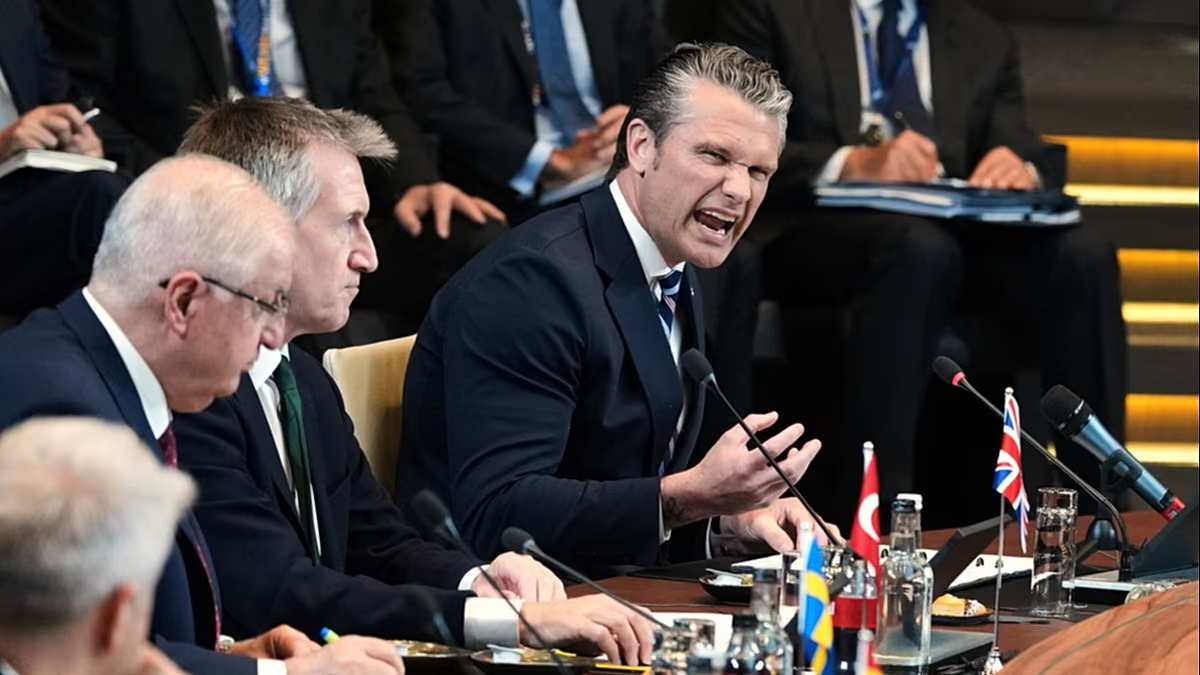
In a move that startled European allies and Canada, U.S. Defense Secretary Pete Hegseth used a meeting in Brussels to announce a sweeping, six-month Pentagon review of American forces stationed across Europe. The outcome, he declared, would hinge directly on one critical factor: the speed with which European nations assume “primary responsibility” for their own security. This announcement was not framed as a collaborative discussion, but as a unilateral ultimatum, marking yet another unpredictable shift from Washington under the Trump administration. For allies still reeling from years of mixed signals—including sudden troop drawdowns, threats to annex Greenland, and recent warnings about reduced U.S. military support—Hegseth’s proclamation felt like another destabilizing jolt, forcing them to confront the reality of an increasingly transactional and demanding superpower partner.
Secretary Hegseth’s address to the gathered defense ministers was less a diplomatic briefing and more a public reprimand. He framed the review as a pass-or-fail test for individual NATO members, stating bluntly, “It’s a review that some countries will fail and others will pass with flying colours.” His central accusation was that European allies had failed in their most basic obligations, specifically citing the denial of basing and overflight rights for potential U.S. operations against Iran. He portrayed this not as a complex geopolitical choice by sovereign nations, but as a personal betrayal that endangered American lives. “These allies… put America’s sons and daughters, our sons and daughters, at risk,” he charged, framing the review as a necessary audit of whether the U.S. could reliably count on its allies in moments of crisis.
The Defense Secretary’s critique, however, rapidly expanded far beyond military logistics into a broadside against Europe’s societal and political priorities. In remarks echoing earlier controversial statements by Vice President JD Vance, Hegseth launched into a tirade against what he depicted as Europe’s misplaced values. He lamented that the continent’s focus had shifted from hard power to “gender equity and climate change and defence austerity,” linking this to open borders, expanding welfare states, and, ultimately, a crumbling belief in “itself and its civilisation.” This fusion of security policy with culture-war grievances was particularly jarring in the halls of NATO, an alliance built on collective defense, and served to alienate many of the officials present who sat in stony silence.
The performative nature of the visit was underscored by Hegseth’s early departure, which occurred well before the meeting’s conclusion and hours before a critical address by Ukrainian President Volodymyr Zelenskyy. This symbolic exit, just after delivering his confrontational message, reinforced the perception of an administration impatient with alliance consensus-building. Speaking to reporters at the airport, Hegseth struck a slightly more conciliatory tone, noting some allies had pledged to meet defense spending targets, while warning that “outliers” would be dealt with clearly during the review. Yet, the overall effect was one of a superior issuing demands rather than a partner engaged in dialogue.
The immediate fallout was a palpable climate of uncertainty. German Chancellor Friedrich Merz responded with a stoic acknowledgement that Europe had long known it must “do more,” a sentiment reflecting a weary resignation across the continent. The announced review casts a shadow over the upcoming NATO leaders’ summit in Turkey, where allies now face the prospect of navigating not just external threats, but an internal reckoning dictated by Washington. The fundamental question Hegseth posed—whether Europe is willing and able to be the primary guardian of its own security—is valid and longstanding. But the manner of its delivery, laden with accusation and political provocation, risks fracturing the very unity required to achieve that goal.
Ultimately, Hegseth’s Brussels performance was a stark illustration of the new, turbulent chapter in transatlantic relations. The six-month review creates a sword of Damocles hanging over the alliance, with the future posture of U.S. troops—a cornerstone of European security for 75 years—now contingent on a passing grade from Washington. While European leaders like Merz insist they are accelerating their efforts, the process has been poisoned by distrust and hectoring. The challenge for NATO is no longer merely about increasing defense budgets or acquiring new capabilities; it is now also about managing a fraught relationship with a key ally that appears to view the alliance not as a vital community of shared destiny, but as a group of underperforming subordinates on probation.