

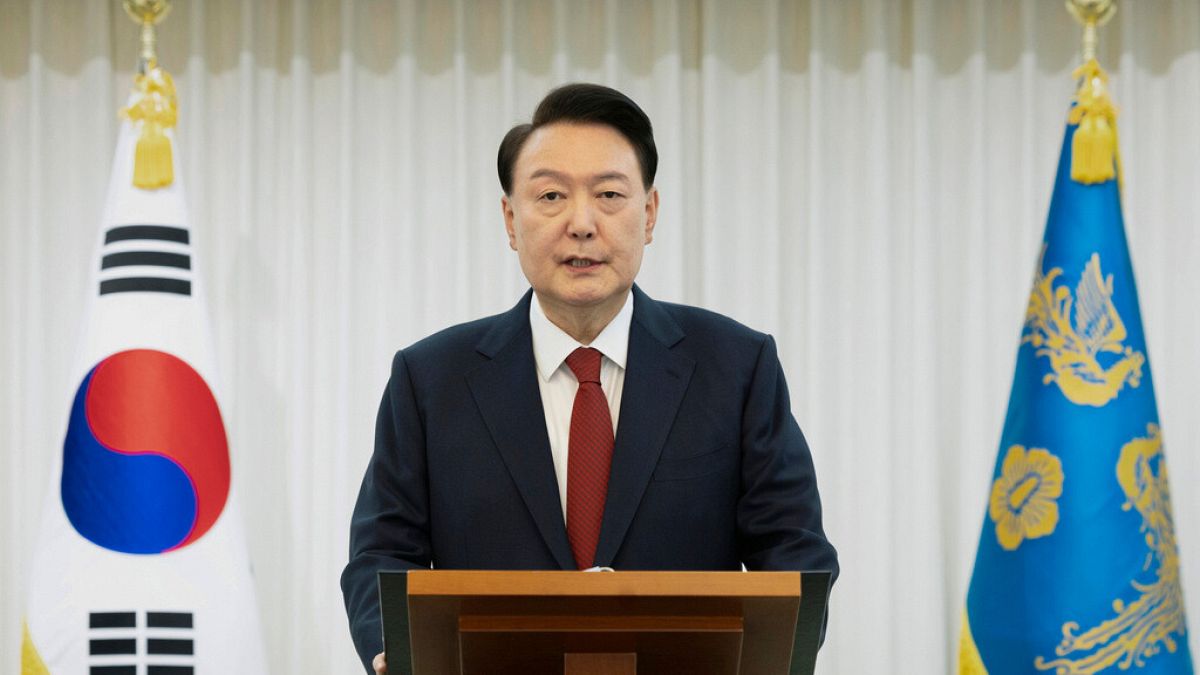
The political landscape of South Korea has been thrown into turmoil following a controversial decision by President Yoon Suk-yeol to impose martial law, a move that ultimately led to his impeachment by the National Assembly. This dramatic turn of events has sparked widespread protests, resignations within the ruling party, and a looming constitutional court battle that will determine the president’s fate. The incident underscores the deep political divisions within the country and raises concerns about stability and future governance.
The crisis began in early December when President Yoon, in a surprise televised address, declared martial law, citing the need to combat “anti-state forces.” This drastic measure immediately drew sharp criticism and sparked public outrage. Critics argued that the invocation of martial law was an overreach of presidential power and an unwarranted response to the perceived threat. The opposition parties condemned the move as an act of rebellion, emphasizing that such a declaration should be reserved for wartime or similar emergencies, a condition that clearly did not exist in South Korea. The president’s justification for the drastic measure was seen by many as a thinly veiled attempt to suppress dissent and consolidate power.
The imposition of martial law was short-lived, however, as members of parliament forced their way into the closed National Assembly building to vote down the presidential decree. This act of defiance by the legislature demonstrated the growing opposition to Yoon’s leadership and his perceived authoritarian tendencies. The swift reversal of the martial law order did little to quell the public outcry. Hundreds of thousands of protesters took to the streets of Seoul, demanding Yoon’s arrest and resignation. The demonstrations underscored the depth of public anger and frustration with the president’s actions.
In the aftermath of the martial law debacle, the political fallout continued to escalate. Han Dong-hun, the chairman of Yoon’s People’s Power Party (PPP), resigned, taking responsibility for the crisis. Han acknowledged the potential for violence had the martial law order not been lifted, expressing concern about a potential clash between protesters and the military. His resignation signaled the beginning of a deeper rift within the ruling party, with factions loyal to Yoon squaring off against those who opposed his actions.
The National Assembly subsequently voted to impeach President Yoon, marking a historic moment in South Korean politics. While the PPP officially opposed impeachment, reports suggest that a significant number of lawmakers within the ruling party defied the party line and voted in favor of removing the president. This internal division within the PPP reflects the deep polarization that the martial law incident has created. The impeachment vote paved the way for a constitutional court trial, which will determine Yoon’s ultimate fate.
The Constitutional Court now faces the daunting task of deciding whether to uphold or overturn the impeachment. The court has a six-month deadline to reach a decision, a period of considerable uncertainty for the nation. Adding to the complexity of the situation is the fact that the court is currently operating with only six judges, three positions remaining vacant. This means that a unanimous decision is required to either remove Yoon from office or reinstate him. The court’s decision will have profound implications for the country’s political future, and the pressure to reach a swift and decisive resolution is immense.
In the interim, Prime Minister Han Duck-soo has assumed the role of acting president. He and other government officials have been working to reassure international allies and financial markets, attempting to stabilize the situation and project an image of continuity and stability. The political turmoil has undoubtedly damaged South Korea’s international standing and created uncertainty about its future direction. The government faces the challenge of restoring confidence both domestically and internationally.
The impeachment trial will be a closely watched event, with the nation holding its breath as the court deliberates. The outcome will not only determine Yoon’s political future but will also shape the political landscape of South Korea for years to come. The crisis has exposed deep fault lines within the country’s political system and raised fundamental questions about the balance of power between the executive and legislative branches. The events surrounding the impeachment will undoubtedly be studied and debated for their impact on South Korean democracy. The nation faces a period of uncertainty and potential instability as it navigates this challenging political terrain. The hope is that a swift resolution will pave the way for healing and a return to a more stable political environment.