

A Fragile Peace Amidst Persistent Flames: The 45-Day Extension of the Lebanon-Israel Ceasefire
In a testament to the profound fragility of diplomatic progress in regions scarred by long-standing conflict, Lebanon and Israel, through mediated talks led by the United States, agreed on Friday to extend their ceasefire by an additional 45 days. This decision emerged not in a climate of calm, but paradoxically against a backdrop of renewed violence, highlighting the razor-thin line between negotiation and escalation. The announcement from the US State Department served as both a statement of cautious achievement and a stark reminder of the underlying tensions that continue to simmer. The extension of the April 16 cessation of hostilities aims to provide a crucial window for “further progress,” as stated by spokesman Tommy Pigott. This move underscores a deliberate, if precarious, strategy: to use temporary calm as a foundation to build something more permanent, even as the ground beneath it shakes.
The architectural blueprint for this hoped-for progress is laid out in a series of planned meetings. The State Department has scheduled negotiations for June 2 and 3, aimed at the lofty and complex goal of reaching a lasting political agreement. Furthermore, the Pentagon will convene military delegations from both countries on May 29. These parallel tracks—political and military—reflect a holistic approach to conflict resolution, acknowledging that security arrangements and political understandings are inextricably linked. The expressed hope, as voiced by Pigott, is that these discussions will advance “lasting peace,” “full recognition of each other’s sovereignty and territorial integrity,” and the establishment of “genuine security along their shared border.” These are not mere procedural goals; they are the fundamental pillars upon which any enduring peace between these two nations must rest, addressing decades of mutual suspicion and unresolved claims.
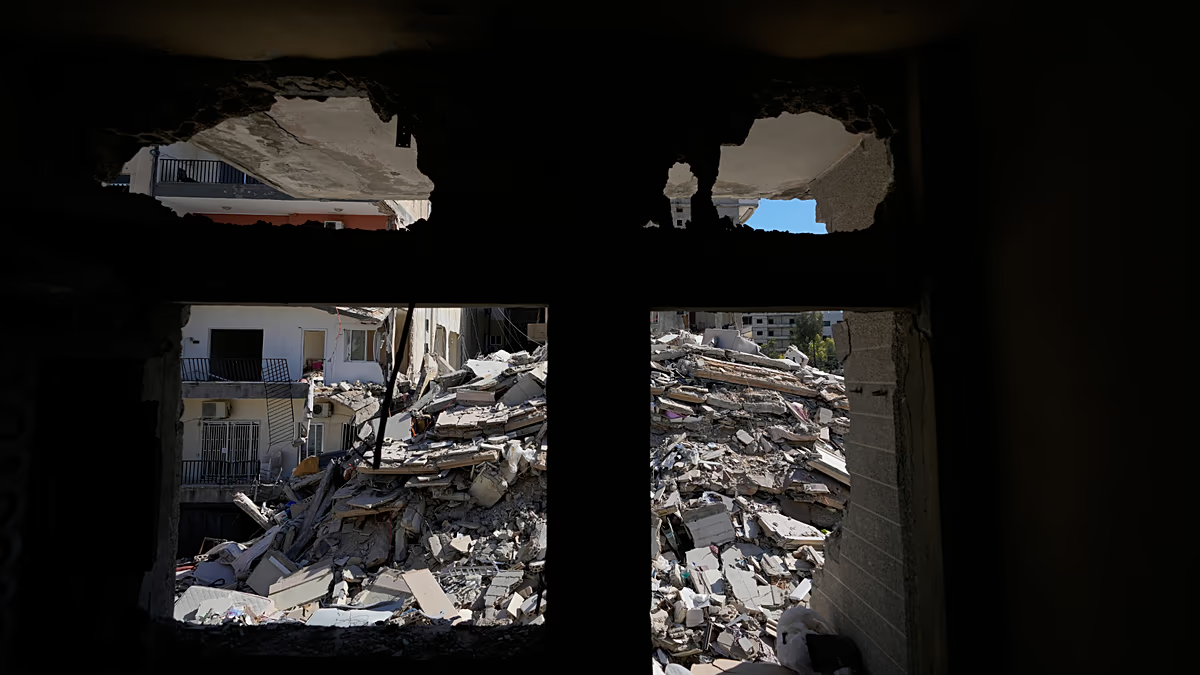
However, this diplomatic machinery operates within a reality that is immediately and violently contradictory. The ceasefire, which had already been extended once and was due to expire on Sunday, exists in a state of contested definition. The United States, Israel, and Lebanon all officially consider the truce to remain in effect, yet this stance was declared even as Israel carried out further strikes in Lebanon during the very talks that secured the extension. This presents a jarring dissonance: the act of negotiating for more time for peace coincided with the act of waging war. It reveals a core tension in Israel’s position—a commitment to the ceasefire framework as a diplomatic channel, alongside an unwavering commitment to its own security operations as it defines them.
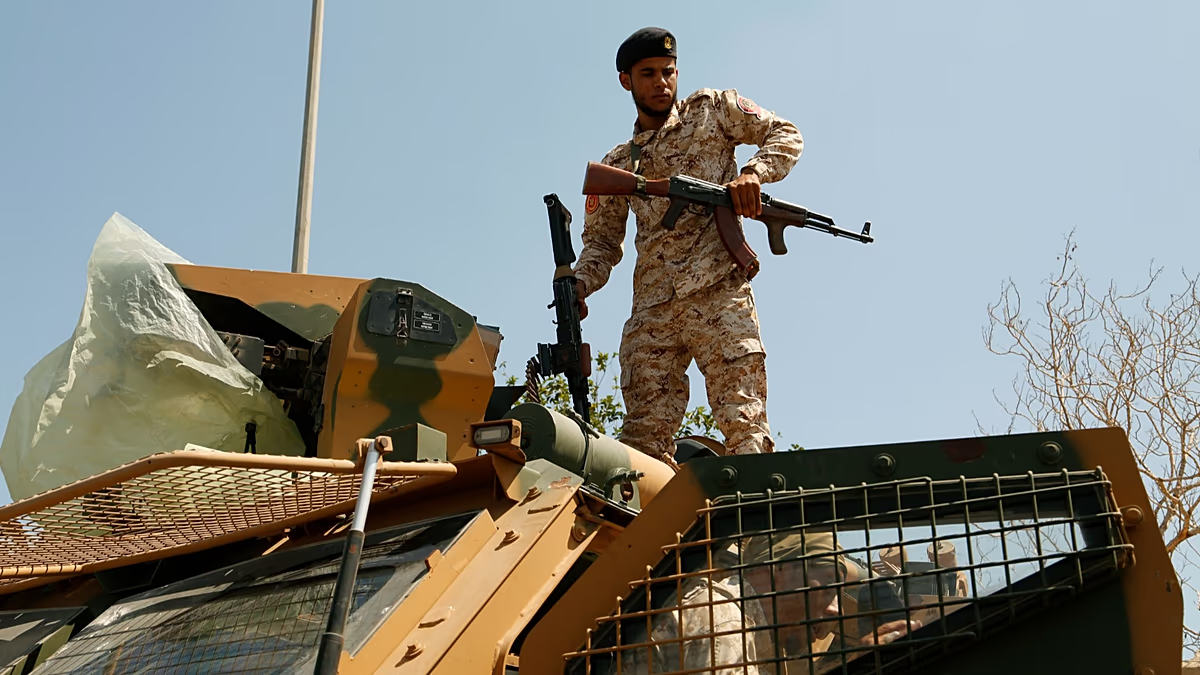
The central actor in this tension is Hezbollah, the Shia militant and political group. Israel explicitly states that it will continue targeting Hezbollah, which it views as a persistent threat. Hezbollah’s initial attacks into Israel, undertaken in solidarity with Iran, were the triggering catalyst for this recent phase of cross-border conflict. Crucially, Hezbollah is not a participant in the Washington talks. This absence creates a critical fissure in the process: the agreement is being brokered between state actors, while a powerful non-state actor, deeply embedded in Lebanese society and a primary driver of violence, operates outside the diplomatic room. This means the ceasefire, in practice, is between the governments of Lebanon and Israel, but not necessarily with one of the key forces on the ground. It is akin to building a roof while one of the walls is still actively being shaken.
Therefore, the extended ceasefire exists in a nebulous space. It is a formal state-level agreement that provides a structure and a timeline for dialogue, offering a respite from full-scale conflict and a pathway for addressing profound bilateral issues. Yet, on the ground, it is a partial and porous truce. The violence that erupted even as the extension was agreed upon signals that the terms of “cessation of hostilities” are interpreted differently by the parties involved. For Israel, it may preclude certain types of large-scale engagement but allow for defensive or retaliatory strikes against Hezbollah. For Hezbollah, which is not bound by the US-mediated terms, the calculus of action remains separate. This creates a perilous environment where the broader peace process can be undermined at any moment by actions outside its direct control.
In conclusion, the 45-day extension is a diplomatic maneuver of both hope and stark realism. It is an attempt to carve out time from the relentless cycle of violence to address root causes—sovereignty, borders, recognition—through scheduled political and military talks. Yet, it is an attempt made while acknowledging that the violence has not, and may not fully, stop. The process is haunted by the shadow of a key absentee, Hezbollah, whose actions can destabilize the talks at any moment. The coming weeks will thus be a tense test of whether a negotiated framework between states can exert enough pressure to contain non-state aggression and create momentum for a larger peace, or whether the persistent flames of conflict will once again consume the fragile, time-limited peace that diplomacy has painstakingly arranged.