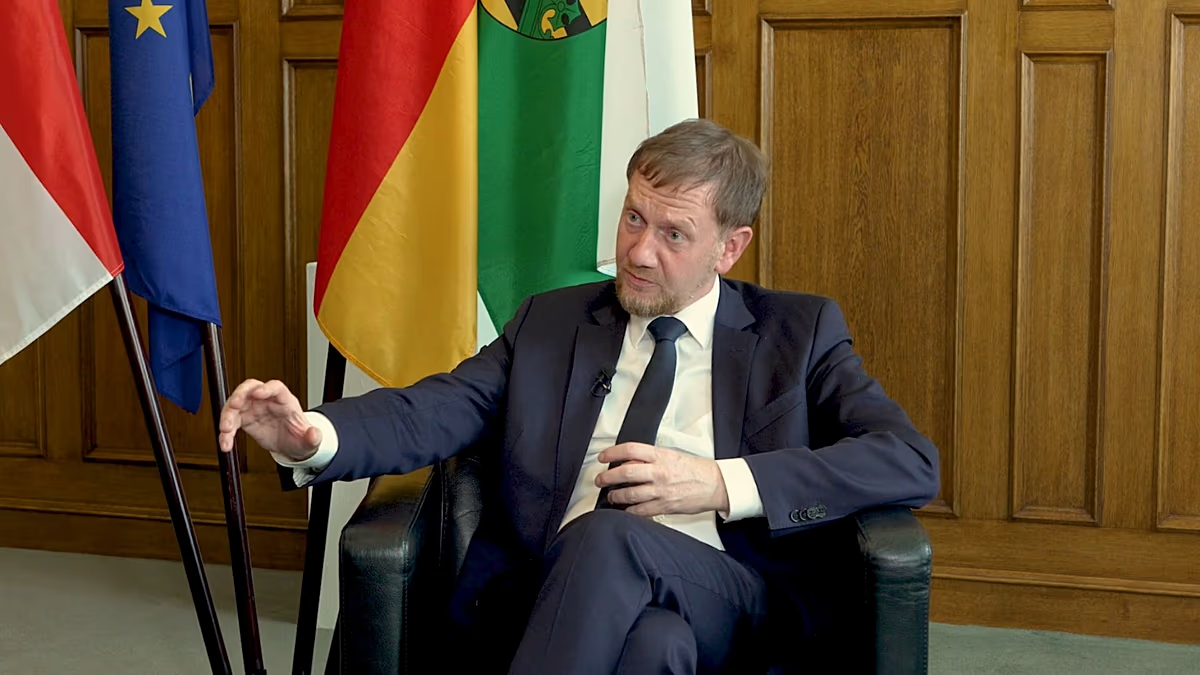


In a recent interview with Euronews, Michael Kretschmer, the Minister-President of Germany’s Saxony region and a leading figure in the Christian Democratic Union (CDU), presented a detailed and often contentious perspective on Germany’s approach to the war in Ukraine. His comments, delivered at Saxony’s state representation in Berlin, weave together a cautionary narrative that prioritizes Germany’s long-term economic stability and diplomatic pragmatism over unconditional support for Ukraine, even suggesting a future return to Russian energy imports. Kretschmer’s stance highlights a significant, though controversial, vein of thought within German politics that seeks a recalibration of current policy.
Central to Kretschmer’s argument is the belief that diplomacy, not just military aid, must pave the path to peace. He expressed a clear openness to eventually resuming economic relations with Russia, including gas supplies, once hostilities cease. “Once there is peace, we can, should, and must talk about such matters,” he stated, emphasizing his hope for a swift ceasefire to end the daily loss of life. This position is rooted in his consistent advocacy for negotiations with Moscow, arguing that the conflict cannot be resolved through arms alone. He extended this logic to his firm opposition to delivering German Taurus cruise missiles to Ukraine, warning, “In my view, Germany must not become a party to the war, and from my perspective it has already gone far too far.” He lamented that domestic critics of military aid are often unfairly maligned, calling such accusations “morally completely over the top.”
Kretschmer applies a similar principle of calculated pragmatism to the issue of economic sanctions against Russia. While he unequivocally condemns the invasion as an act that “cannot be allowed to go unpunished,” he insists any response must be “smart.” For him, this means sanctions must not fundamentally undermine Germany’s own economic vitality. He warned that measures designed without this foresight could jeopardize Europe’s ability to fund its own defense, including crucial systems like a continental missile defense shield. His philosophy is that the goal of compelling an aggressor to negotiate must be pursued rationally, without self-inflicted wounds that could damage Germany’s “legitimate interests” and, by extension, its strategic staying power.
Beyond foreign policy, Kretschmer directed sharp criticism at the federal government’s domestic handling of the refugee crisis. He labelled the decision to grant newly arrived Ukrainians access to Germany’s citizens’ allowance, a basic social welfare benefit, as “a big mistake.” He argued that this policy, in contrast to those in nations like Poland or the Czech Republic, has disincentivized work, resulting in far lower employment rates among refugees in Germany. While praising the EU’s Temporary Protection Directive for initially providing swift, unbureaucratic aid, he signaled support for its eventual expiration, noting that large parts of Ukraine are now safe. He suggested the focus should shift toward supporting reconstruction within Ukraine itself, as the capacity for long-term support in Germany and elsewhere is limited.
This focus on domestic capacity directly ties to another of Kretschmer’s major concerns: securing federal funding for German municipalities. He revealed that during coalition negotiations, he and several other state leaders pushed for a €100 billion municipal support fund as a condition for their agreement. Their reasoning was that Germany cannot divert resources to arm Ukraine while its own critical infrastructure—hospitals, schools, and fire stations—falls into disrepair. For Kretschmer, this was a necessary stand to safeguard local democracy and community integrity, responsibilities he believes the federal government has neglected through underfunded mandates.
Ultimately, Kretschmer’s interview outlines a worldview where national interest and pragmatic statecraft are paramount. It is a perspective that advocates for strong support for Ukraine in principle but insists on clear boundaries to prevent Germany’s direct involvement in the conflict and to protect its economic foundation. While his views on welfare for refugees and future energy deals with Russia are politically charged, they stem from a consistent doctrine: that a successful foreign policy and a resilient democracy depend first and foremost on a prosperous and functionally sound homeland. His comments serve as a reminder of the complex and often difficult balancing act facing European nations as they navigate a prolonged period of crisis.