


In the swirling, glitter-strewn world of international pop music, few events command the global stage like the Eurovision Song Contest. It is a spectacle built on a promise of harmless, kitschy fun, a celebration of music that ostensibly transcends politics. Yet, as the 70th anniversary contest in Vienna approaches in May 2026, that foundational promise is being challenged with unprecedented force. A growing coalition of artists and activists is demanding that the event’s organisers grapple with a stark contradiction, one that they argue transforms the stage from a platform of unity into a tool of complicity. At the heart of this escalating controversy is Israel’s continued participation, which campaigners directly contrast with the ongoing exclusion of Russia, creating a crisis of consistency for the European Broadcasting Union (EBU).
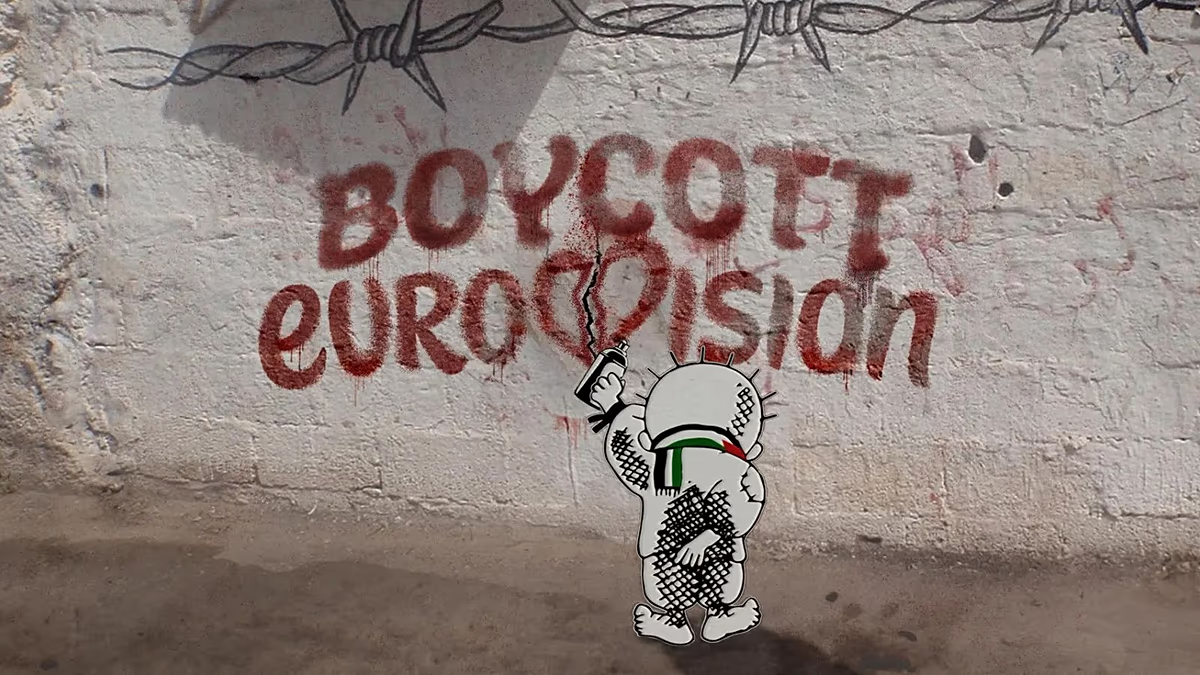
This movement has crystallized around an open letter, a document that moves beyond diplomatic language to voice raw moral outrage. Spearheaded by groups like No Music For Genocide and the Palestinian Campaign for the Academic & Cultural Boycott of Israel, the letter has been signed by over 1,000 artists, including iconic figures such as Brian Eno, Massive Attack, Sigur Rós, and Mogwai. Their central demand is for the EBU to ban KAN, Israel’s public broadcaster. The letter frames the issue with searing clarity: “For the third consecutive year,” Israel will be “celebrated onstage despite its ongoing genocide in Gaza, while Russia remains banned for its illegal invasion of Ukraine.” This perceived double standard is the bedrock of the boycott call, framing the EBU’s stance not as neutrality, but as a deliberate political choice with profound consequences.
The artists’ protest seeks to shatter the bubble of escapism that often surrounds Eurovision, forcing a connection between the glittering performance and a distant reality of devastation. Their language is visceral and specific, meant to haunt the imagination: “When all that’s left of nearly every stage, studio, bookshop and university in Gaza is piles of rubble, under which slaughtered bodies still await recovery and proper burial.” They speak of Palestinian children in Israeli prisons “enduring beatings for humming a tune,” drawing a direct line from the suppression of basic human expression to the very stage where freedom of expression is celebrated. This is not, they insist, an abstract political debate; it is about aligning a global cultural juggernaut with what a UN inquiry in September 2025 concluded is a genocidal campaign, a finding Israel consistently denies.
The strategic power of the boycott, as articulated by the campaigners, lies in the conscious act of refusal. They applaud the five countries—Spain, Ireland, Slovenia, the Netherlands, and Iceland—that have already withdrawn from the 2026 contest, seeing each withdrawal as a crack in the façade of normalcy. “We recognise our collective agency – and the power of refusal,” their statement reads. “We refuse to be silent. We refuse to be complicit.” This philosophy extends a long tradition of cultural boycotts, arguing that participation is not a neutral act but an endorsement. They cite Israeli leaders themselves who have “spoken openly about the contest’s geopolitical value,” suggesting that Israel views its Eurovision presence as a vital tool for softening its international image and projecting normalcy amidst war.
In response, the EBU finds itself in an increasingly untenable position, steadfastly repeating a defense that now rings hollow to millions. The organization maintains that its member broadcasters, including KAN, are judged on their ability to meet technical and broadcast criteria, not the actions of their governments. It insists Eurovision is a “non-political” event. However, this defense was fundamentally compromised in 2022 when it took the unequivocally political decision to ban Russian broadcasters following the invasion of Ukraine, a ban that remains firmly in place. As Irish band Kneecap bluntly stated, “Russia was banned from Eurovision in 2022. For the third year running, [Israel is] welcomed back onto the stage. That’s not neutrality. That’s a choice.” This inconsistency has become the EBU’s greatest vulnerability, making its claims of apolitical management appear selective, if not hypocritical.
As the final in Vienna draws near, the stage is set for a profound clash of narratives. On one side is the EBU, clinging to a technocratic rulebook and the traditional spectacle of Eurovision, an event that last year captivated 166 million viewers. On the other is a formidable and growing segment of the global artistic community, asserting that in a world of stark moral crises, there is no such thing as a neutral song contest. They are leveraging their cultural power to insist that true solidarity means refusing to provide a soundtrack to suffering. The outcome of this confrontation will resonate far beyond a single night of television. It will signal whether one of the world’s most-watched cultural events can truly exist in a political vacuum, or if, in the face of alleged genocide, the music must—for some—stop.