


Paragraph 1: A Sudden Shift in Leadership
In a surprising turn of events on Sunday, June 14, 2026, Romanian political stability was again upended. President Nicusor Dan announced via social media that Eugen Tomac, his nominee for Prime Minister, had abruptly resigned from consideration. Without missing a beat, the President put forward a new candidate: Adrian Vestea. Dan’s statement sought to frame the rapid change not as political gamesmanship but as a necessary pivot, asserting, “Neither Mr. Tomac nor I have been playing at governing.” He explained the move followed consultations with various political factions, concluding that a fresh political solution was now the clear and required path forward for the nation.
Paragraph 2: The Roots of the Current Crisis
This latest nomination is merely the most recent chapter in a political saga that has gripped Romania for over a month. The nation’s government effectively collapsed in May following a successful no-confidence vote against the then-Prime Minister, Ilie Bolojan. This parliamentary revolt was triggered when the left-leaning Social Democratic Party (PSD)—a key member of the governing coalition—dramatically withdrew its support in late April. In a significant and controversial maneuver, the PSD aligned itself with far-right groups to bring down the government. Their justification was a deep-seated frustration with Bolojan’s tenure, accusing him of a failure to deliver “any genuine reform” and calling for a leader better skilled in the art of collaboration.
Paragraph 3: Introducing the New Hope
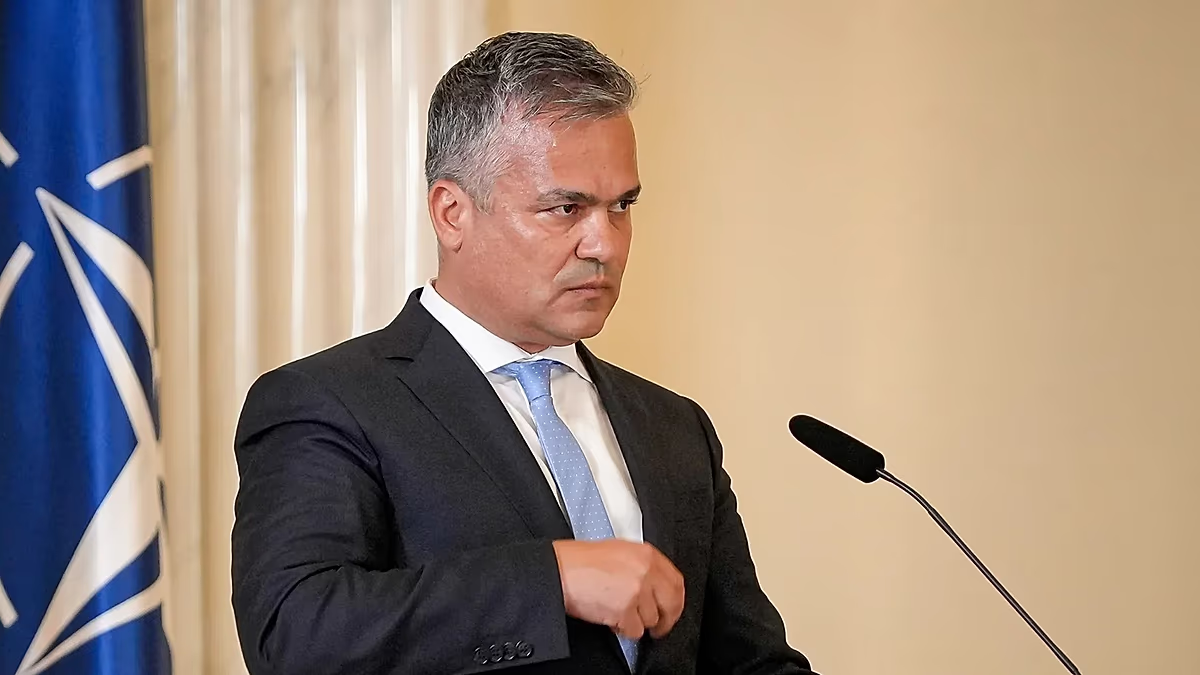
Faced with this vacuum, President Dan is now placing his confidence in Adrian Vestea, presenting him to the public as the figure who can bridge Romania’s deep political divides. Dan’s endorsement was emphatic and strategically crafted. He lauded Vestea, a member of the National Liberal Party, as a “pro-Western” leader and a “man of dialogue, with strong values.” Perhaps most critically, given Romania’s economic challenges, the President highlighted Vestea’s “extensive experience working with budgets.” This qualification was not mentioned casually; it speaks directly to one of the most pressing issues at the heart of both the political stalemate and the country’s future within the European community.
Paragraph 4: The Stakes: Romania’s Economic Reality
The emphasis on budgetary expertise underscores the monumental task awaiting any new government. Romania, while a proud member of the European Union since 2007, struggles with one of the bloc’s most severe government deficits. This fiscal gap, a measure of how much more the government spends than it collects, stood at a worrying 9.3% of the country’s Gross Domestic Product in 2024. Although there was a modest improvement to 7.9% in 2025, the figure remains alarmingly high, far exceeding EU norms and threatening long-term economic stability. This deficit is more than a statistic; it represents a constraint on public services, a concern for international investors, and a point of tension with EU partners who advocate for fiscal responsibility.
Paragraph 5: Navigating a Path Forward
Therefore, Vestea’s nomination is about more than just filling a vacant office; it is an attempt to install a leader perceived as capable of navigating a treacherous dual mandate. The next Prime Minister must be a unifier, able to negotiate a working majority in a fractured parliament where the recent coalition between social democrats and the far-right has redrawn battle lines. Simultaneously, he must be a competent manager, tasked with crafting credible policies to rein in public spending and steer the Romanian economy toward a more sustainable future. The success or failure of this attempt will determine whether Romania can exit a cycle of crisis and embark on a period of coherent governance.
Paragraph 6: A Nation Awaits
As President Dan’s announcement circulates, the nation now watches and waits. The coming days will reveal whether Adrian Vestea can secure the necessary parliamentary support to form a government or if this nomination will meet further resistance, prolonging the uncertainty. The core questions remain unanswered: Can a “man of dialogue” indeed foster cooperation in a polarized political landscape? Can his proclaimed budgetary skills translate into effective policies that address the deficit without stifling growth? For Romanians, the hope is for a resolution that brings not just a new prime minister, but a renewed sense of direction and stability after a period of disruptive political turmoil. The journey to answer these questions begins with this new nomination, setting the stage for the next critical phase in Romania’s democratic process.