

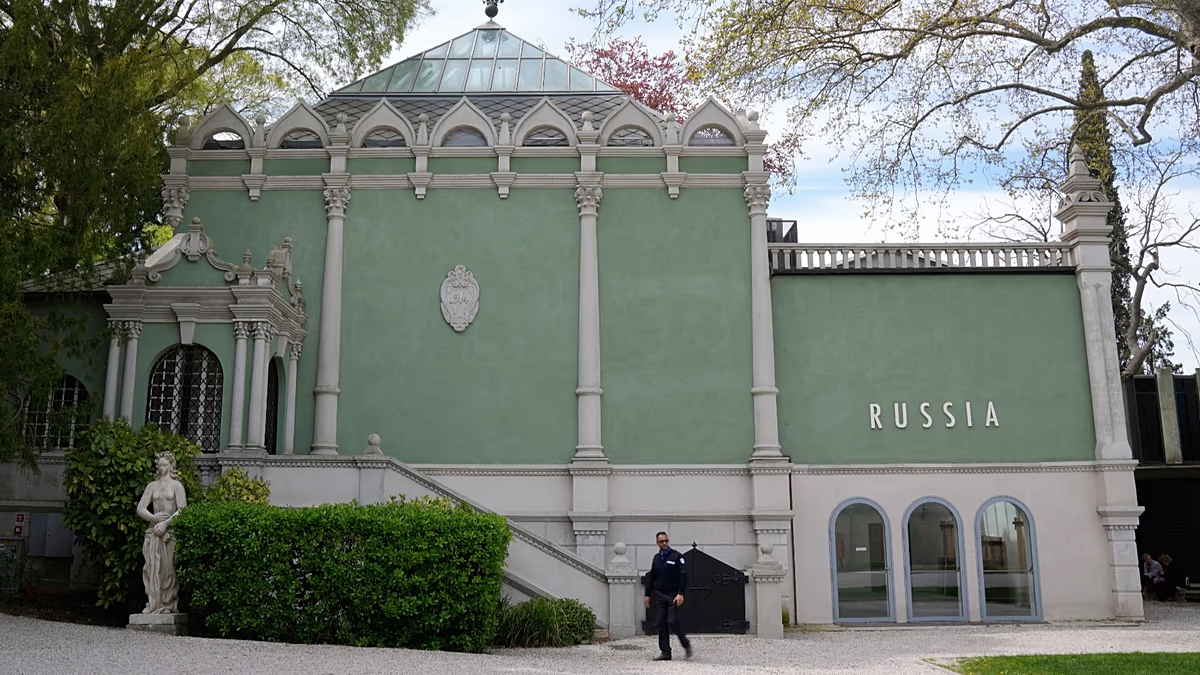
The controversy surrounding Russia’s planned participation in the 2026 Venice Biennale has escalated into a significant diplomatic and cultural clash, exposing deep fissures within the Italian government and creating a standoff with European Union institutions. At the heart of the dispute is the decision by the Biennale’s management to reopen the Russian pavilion, which has been closed since the 2022 invasion of Ukraine. This move has been met with fierce condemnation from the European Commission, which views it as a violation of sanctions related to the war. In a formal note, EU Commission Executive Vice-President Henna Virkkunen and EU Commissioner for Culture Glenn Micallef strongly criticized the Biennale’s leadership, initiating a procedure that could see the prestigious cultural institution stripped of €2 million in EU funding allocated through 2028. The Commission has given the Biennale a 30-day ultimatum to reverse its position, framing the issue not merely as an artistic choice but as a matter of geopolitical principle and solidarity with Ukraine.
The pressure from Brussels has ignited a fierce internal debate in Italy, revealing a stark division within Prime Minister Giorgia Meloni’s coalition government. Italian Minister of Culture Alessandro Giuli has expressed clear disapproval, symbolically choosing to visit the war-battered Ukrainian city of Lviv instead of attending the restoration of the Biennale’s Central Pavilion. However, his stance is directly opposed by that of Deputy Prime Minister Matteo Salvini, who has launched a blistering attack on the EU’s position. Salvini decried the threat to withdraw funding as “vulgar blackmail” and “madness,” arguing that in a troubled world, Brussels should not be threatening one of the globe’s most important cultural forums over the invitation of Russian artists. This split highlights the difficult balance the Italian government must strike between adhering to EU foreign policy consensus and defending national cultural autonomy.
Adding a powerful regional voice to the dissent against Brussels, the president of the Veneto region, Alberto Stefani, has declared the EU’s stance “unacceptable.” He argues passionately that art must serve as a bridge for dialogue, especially when official diplomatic channels have broken down. In an appeal that frames the issue as one of fundamental liberty, Stefani contends that “peace is not built through censorship and freedom is not defended by restricting it,” urging Italian MEPs to defend the Biennale as a vital space for confrontation and exchange. This perspective, shared by Salvini and others, positions the Biennale not as a platform for state propaganda but as a neutral ground where culture can transcend politics, a concept now under direct threat from what they see as punitive bureaucratic overreach.
The controversy has grown more complex with allegations of double standards from within the European Parliament itself. Angelo Bonelli, a Green MP, has pointedly criticized the European Commission for what he calls its hypocrisy, noting its forceful stance against Russia while remaining silent on Israel’s participation in the Biennale amidst the war in Gaza. He references a letter from 187 cultural stakeholders calling for Israel’s exclusion and argues that “a variable geometry policy is no longer acceptable.” Bonelli posits that if the Biennale’s autonomy is to be respected, it should decide freely; but if external pressure is applied to exclude one nation based on its government’s actions, then consistency demands it be applied to all. This argument broadens the dispute from a specific Russia-EU issue into a wider debate about the politicization of cultural institutions and selective application of ethical principles.
Parallel to the institutional wrangling, the Ukrainian government has taken direct action. President Volodymyr Zelenskyy signed a decree sanctioning five Russian cultural figures involved with the Venice pavilion, accusing them of justifying aggression and spreading propaganda. Those targeted include the pavilion’s commissioner, Anastasia Karneeva, and Mikhail Shvydkoy, a special representative for cultural cooperation accused of using the event to break Russia’s cultural isolation. The sanctions, which include asset freezes and travel bans, underscore Kyiv’s view that the pavilion is not an apolitical artistic endeavor but an instrument of state soft power. This move translates the abstract cultural debate into concrete personal consequences, illustrating the high stakes for individuals caught between art and a stark geopolitical conflict.
As the 30-day deadline for the Biennale to respond to the EU looms, the institution finds itself in an immensely difficult position, caught in a crossfire between supranational political mandates, national political divisions, and the foundational ideal of artistic freedom. The outcome will set a powerful precedent for how cultural platforms navigate the pressures of geopolitical conflict. Will the Biennale capitulate to financial pressure from Brussels, potentially affirming the use of cultural funding as a tool for foreign policy? Or will it defy the EU, backed by factions within the Italian government, to uphold a principle of open artistic dialogue, even at the cost of millions in support and accusations of enabling propaganda? The resolution of this clash will reverberate far beyond the canals of Venice, defining the contested boundaries between art, politics, and diplomacy in an increasingly fractured world.