

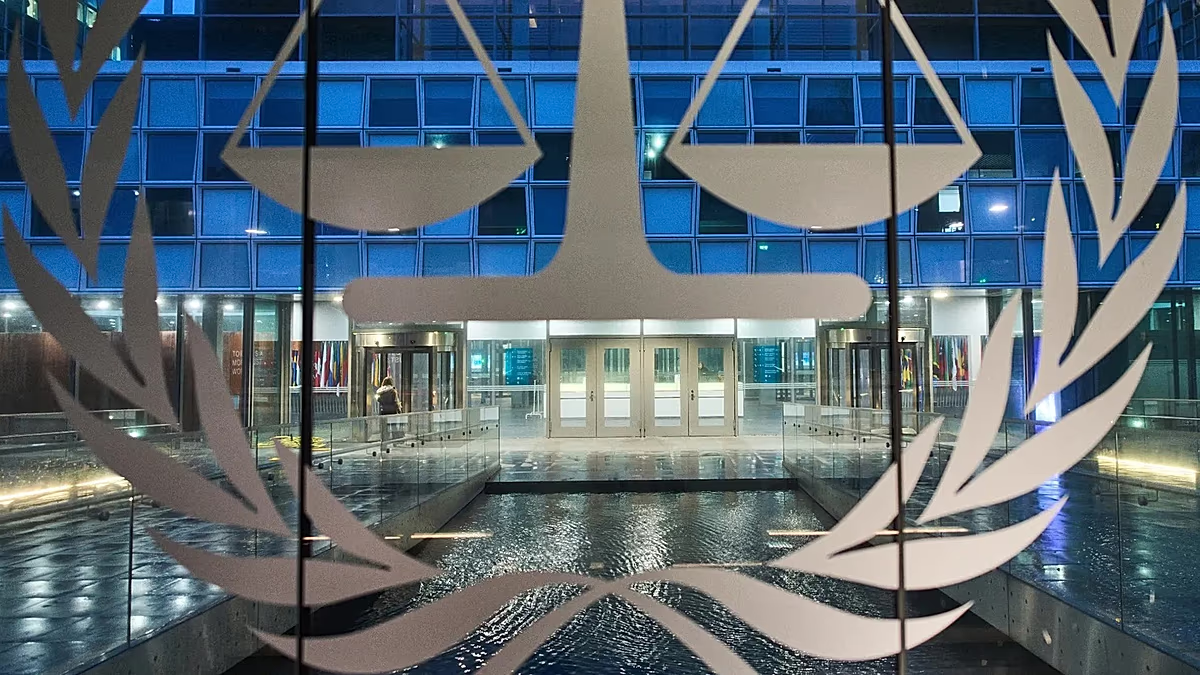
A watershed moment in international justice is set to begin on November 30, as the International Criminal Court in The Hague prepares to try former Philippine President Rodrigo Duterte for crimes against humanity. Presiding Judge Joanna Korner confirmed the trial date, marking a historic first: Duterte, now 81, will be the first former Asian head of state to stand before the ICC, the court of last resort for the world’s most grievous crimes. The prosecution’s case centers on his brutal “war on drugs,” alleging his direct involvement in at least 76 murders between 2013 and 2018. This legal proceeding represents not just a reckoning for one man, but a profound test for a global institution tasked with holding even the most powerful leaders to account.
The path to the courtroom, however, is paved with significant procedural hurdles, primarily concerning Duterte’s health and fitness to stand trial. His defence team, now led by British barrister Peter Haynes, vigorously opposed setting a date, arguing that a full assessment of his declining condition is an absolute prerequisite. While Duterte was previously cleared fit for earlier hearings, his lawyers contend his mental state has deteriorated; he has not appeared in person, joining only once via a video link where he appeared confused and frail. Judge Korner, while acceding to the prosecution’s requested start date, has ordered a fresh medical evaluation, ensuring the trial’s commencement hinges on this critical determination. It remains unlikely that the aging former leader will ever physically set foot in the courtroom.
The charges themselves paint a harrowing picture of state-sanctioned violence. During pre-trial hearings, prosecutors outlined a decades-long campaign of murder that began long before Duterte’s presidency. They alleged he founded and operated a “death squad” during his tenure as mayor of Davao City, a pattern of extrajudicial killing he then scaled to a national policy upon becoming president. Lead prosecutor Julian Nicholls stated bluntly, “He ran a death squad in Davao… His promise was to kill thousands and he did.” The official charge sheet lists 76 specific murders, but the true toll of the drug war is believed to be in the thousands, with human rights groups documenting a staggering loss of life that left deep scars on countless Filipino families.
Duterte’s defence maintains a posture of absolute defiance, framing the ICC’s pursuit as a politically motivated witch hunt. His former lawyer, Nicolas Kaufman, told the court his client “absolutely” maintains his innocence, dismissing the evidence as “wholly insufficient.” The defence strategy acknowledges Duterte’s notoriously fiery rhetoric—the “bluster and hyperbole” in which he encouraged killing drug suspects—but insists he simultaneously gave official orders for law enforcement to only use force in self-defence. This argument seeks to create a divide between provocative speech and criminal responsibility, a central tension the trial must unravel. Furthermore, the defence leans on the controversial fact that the Philippines, under Duterte’s own orders, withdrew from the ICC’s founding treaty in 2019, challenging the court’s very right to judge him.
This trial unfolds against a backdrop of intense geopolitical pressure and complex domestic sentiment. The ICC itself is operating under strain, having faced two rounds of US sanctions since mid-2025, highlighting the contentious nature of international justice. The court has asserted its jurisdiction over crimes alleged to have occurred while the Philippines was still a member state, between 2011 and 2019, setting a crucial precedent. At home, Duterte retains a formidable base of popular support, with many citizens viewing his brutal methods as a necessary evil in the fight against crime and drug addiction. This domestic popularity underscores the profound divide between local perception and the international legal standards the ICC seeks to uphold.
As the November date approaches, the world watches a legal drama with far-reaching implications. For the victims’ families, it offers a long-awaited, though distant, arena for acknowledgment and justice, potentially encouraging more witnesses to come forward. For the Philippines, it forces a national conversation about legacy, sovereignty, and accountability. And for the international community, it is a stark test of whether the mechanisms designed to end impunity can withstand political headwinds and finally deliver a verdict for one of the most controversial and bloody chapters in recent Asian history. The gavel is poised to fall on a case that will be remembered as much for its legal arguments as for its confrontation with a culture of violence that was, for a time, official policy.