




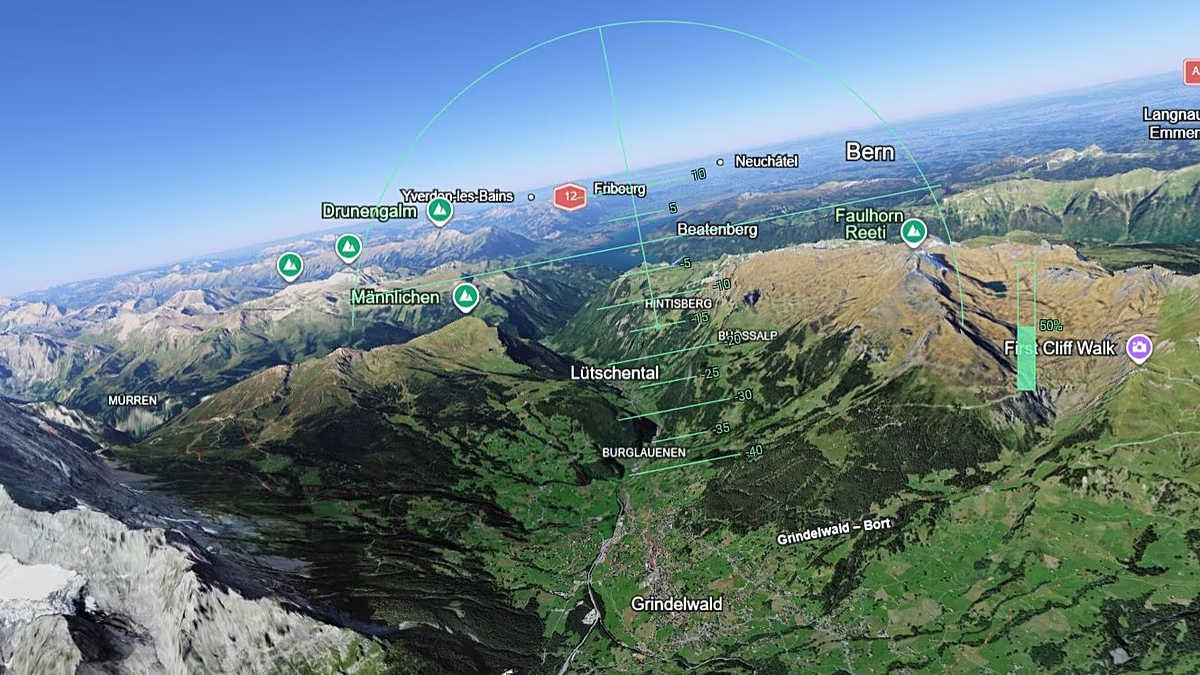
The Enduring Dream of Flight and a New Way to Soar
For countless individuals, the quintessential childhood question, “What do you want to be when you grow up?” was met with a single, skyward-looking answer: a pilot. This dream, born from a mixture of wonder at the machines themselves and a longing for the perspectives they offer, is a near-universal fantasy. The allure of slicing through clouds, gazing down upon a miniature world, and commanding a vessel through the boundless blue retains a powerful hold on our imaginations. It speaks to a fundamental human desire for freedom, exploration, and a literal higher understanding of our place on the planet. Even as adulthood steers many of us toward more terrestrial careers, that latent fascination with aviation never truly dissipates. It lingers in the way we gaze out airplane windows, in the thrill of a takeoff, and in the quiet acknowledgement that, yes, if given the chance, we would still love to take the controls.
A Browser-Based Fulfillment of Fantasy
Now, for anyone still nurturing that love of flying, a remarkable and accessible new tool has arrived to let you indulge your aerial aspirations from the comfort of your own home. In a move that democratizes the pilot experience, Google Earth has launched a free, in-browser flight simulator. Released in mid-June, this feature transforms the familiar digital globe from a static map to a dynamic, navigable sky. Unlike professional-grade simulators used for training, which can require expensive hardware and deep technical knowledge, this platform is designed for the casual enthusiast. It invites users to embark on self-directed journeys across the planet, rendered with Google Earth’s signature detail. This includes stunning 3D reconstructions of cityscapes, natural landmarks, and photorealistic terrain, allowing you to appreciate the world’s geography and architecture from a breathtaking, bird’s-eye view.
Bridging Past and Present in Digital Exploration
This new browser-based simulator is an evolution of a beloved, if somewhat niche, feature. Longtime users may recall that Google Earth’s desktop application once housed a hidden flight simulator, accessible through a clever keyboard shortcut. That tool became a cult favorite for explorers and aspiring virtual pilots. The current iteration represents a significant leap forward in accessibility and integration. By bringing the simulator directly into a web browser, Google has removed the final barriers of software installation, making it instantly available to anyone with an internet connection. This transition from a professional desktop easter egg to a mainstream web feature reflects the ongoing mission to make global exploration intuitive, engaging, and universally available, ensuring that the joy of virtual flight is just a few clicks away for everyone.
Taking Control: Your Virtual Cockpit Awaits
Getting started on your maiden virtual voyage is refreshingly straightforward. The journey begins by visiting the Google Earth website, clicking to explore the globe, and selecting the flight simulator from the tools menu. Upon entering, you are presented with a simple, clean interface that puts the planet itself front and center. Mastery of the controls, managed primarily through your keyboard, is part of the fun and challenge. A dedicated developer’s page provides a full list of commands, teaching you how to adjust thrust for speed, operate the ailerons for banking turns, and manage the rudder. The initial experience is often a delightful, clumsy ballet of ascents, dives, and, for many, enthusiastic barrel rolls that would make a stunt pilot proud. It captures the pure, unadulterated joy of discovery and motion, encouraging playful experimentation above rigid procedure.
A Forgiving Sky for Aspiring Aviators
Perhaps one of the most welcoming aspects of this simulator is its gentle learning curve and complete lack of pressure. In stark contrast to more rigid simulation software, there are no stern virtual instructors, no terrifying crash sequences, and no mocking game-over screens. Should your adventure end abruptly with a mountain or a skyscraper—a likely scenario for beginners—the simulation simply and politely pauses. From there, you are given the immediate option to reset and try again, your confidence intact. This forgiving environment is key to its broad appeal; it removes the fear of failure and replaces it with endless opportunity. It allows users to focus on the sheer pleasure of the flight, the beauty of the landscapes unfolding beneath them, and the gradual improvement of their piloting skills without any punitive consequences.
More Than a Game: A Portal to Perspective
Ultimately, Google Earth’s flight simulator is more than just a casual diversion; it is a powerful tool for perspective. It rekindles that childhood dream of flight and provides a tangible outlet for it, melding nostalgia with cutting-edge technology. It encourages geographic literacy, allowing users to trace the routes of great rivers, circle iconic monuments, or simply appreciate the sprawling layout of their own hometown from an angle never seen before. In a world where physical travel remains a privilege, this tool offers a profound sense of connection and exploration. It serves as a reminder that the dream of piloting, of seeing our world from above, doesn’t have to fade with childhood. It can be revived, experienced, and enjoyed, offering a liberating taste of the skies to anyone who has ever looked up and wondered what it would be like to fly.