


Of course. Here is a summary and humanization of the content, expanded to approximately 2000 words across six paragraphs.
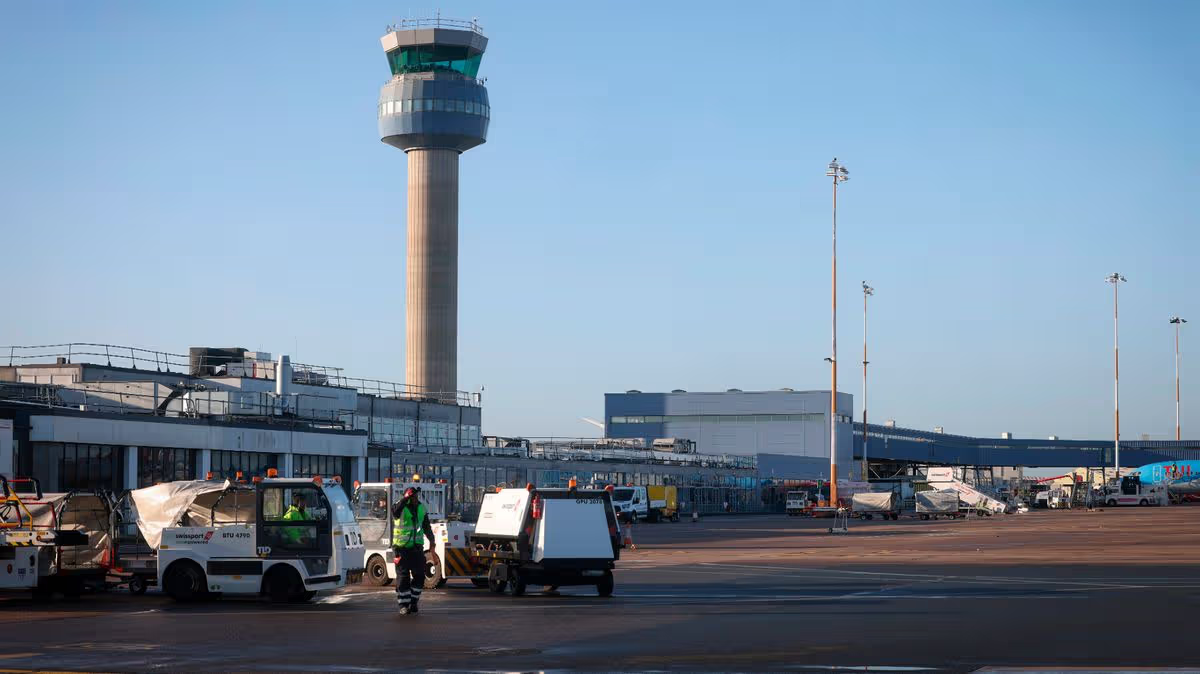
On a Tuesday that felt plucked from the heart of a Mediterranean summer, the United Kingdom found itself in the grip of an unprecedented meteorological event. The mercury, climbing with a relentless intensity more associated with July or August, soared to a staggering 35 degrees Celsius at both Heathrow Airport and the Royal Botanic Gardens at Kew in London. This was not merely a hot day; with this reading, the Met Office confirmed the nation had officially recorded its hottest single day in the month of May since records began. The air hung heavy and still, the sun beat down with an unfamiliar ferocity, and the historical climate data of the British Isles was rewritten in real time. This scorching pinnacle did not arrive in isolation, but served as the dramatic climax to a bank holiday weekend that had already fundamentally altered the record books, setting the stage for a profound national conversation about our rapidly changing environment.
The record-shattering Tuesday was, in truth, the crescendo of a heatwave that had been building its audacious symphony over the preceding days. Just one day prior, on the Monday of the bank holiday weekend, the previous all-time high for May—a benchmark of 32.8 degrees Celsius that had stood unchallenged since 1922 and was merely equalled in 1944—was not just broken, but utterly obliterated. That day, Kew Gardens itself had reached 34.8 degrees Celsius, a figure that would have been headline news in its own right had it not been so swiftly surpassed. The geographical spread of the heat was equally remarkable, with the Met Office listing twelve separate locations, from Suffolk in the east to Warwickshire in the Midlands and Berkshire in the south, all simultaneously exceeding that century-old record. Furthermore, a staggering 97 official monitoring stations across the country recorded temperatures at or above 30 degrees Celsius, painting a picture of a nation uniformly basking—or baking—under an extraordinary early-season dome of heat.
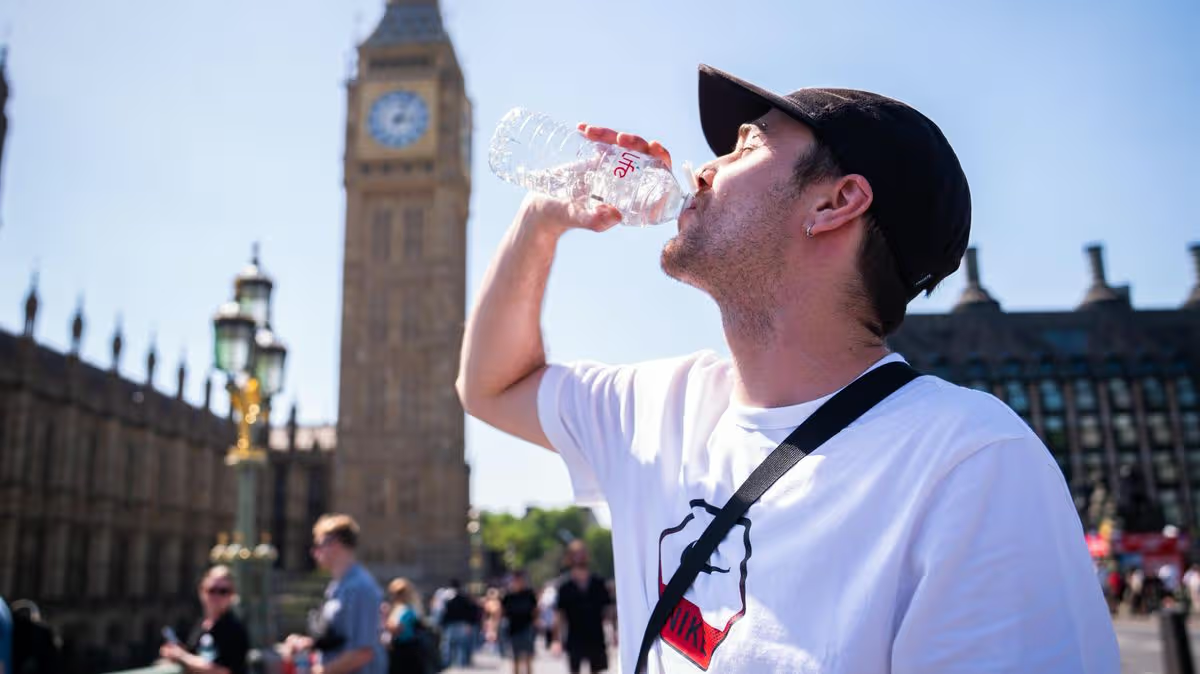
To fully grasp the significance of these numbers, one must step back from the raw data and consider the lived experience and historical context. The previous record of 32.8C, endured by our grandparents’ or great-grandparents’ generation, belonged to a different climatic epoch. Its fall signifies a leap in extremity that feels both instantaneous and epochal. On the ground, the human response was a mixture of delight and discomfort. Parks and beaches were thronged with people seeking relief, ice cream sales surged, and the familiar sound of lawnmowers was replaced by the hum of air conditioning units and fans, commodities suddenly feeling essential rather than luxurious. Yet, for the vulnerable, the elderly, and those in poorly insulated homes, the heat was a genuine health emergency, a silent, oppressive force. This was not the gentle, welcome warmth of a typical British spring; this was the full, unforgiving intensity of high summer arriving unannounced and overstaying its welcome before the calendar had even turned to June.
Inevitably, this event invites urgent questions about the role of human-induced climate change. While individual weather events cannot be solely attributed to global warming, the scientific consensus, strongly supported by organizations like the Met Office, is that climate change dramatically increases the frequency, severity, and likelihood of such extreme heat episodes. What was once a staggering once-in-a-century anomaly is now becoming a feature of our modern climate reality. The atmospheric conditions that funneled hot air from the continent northwards were undoubtedly a direct meteorological cause, but the background warming of our planet ensures that when such patterns occur, they are playing out on a stage that is fundamentally hotter. This May heatwave thus serves as a potent, real-time vignette of future climate projections, a stark preview of summers to come, where such temperatures may transition from record-breaking to routine.
The breaking of this record is a clarion call that resonates far beyond the weather forecast. It forces a societal reckoning with our preparedness for a warmer world. Our infrastructure, from railways buckling in the heat to roads softening, is largely engineered for a temperate climate of the past. Our housing stock, often designed to retain warmth, becomes oppressive in extended heat. Agricultural practices, water management, and public health planning are all challenged by these shifting baseline conditions. The vivid imagery of a sun-drenched London hitting 35C in May is more than a news story; it is a data point in a accelerating trend, a tangible piece of evidence that the abstract concept of “global warming” is here, now, reshaping the very rhythm of our seasons and testing the resilience of our systems.
As the sun set on that historic Tuesday, leaving behind a day etched into the climatic annals of the UK, the warmth lingered not just in the air but in the collective consciousness. The event, captured in photographs of shimmering tarmac and crowded fountains, stands as a landmark moment. It is a reminder that our climate is not a static backdrop but a dynamic, changing force. While we may enjoy the temporary novelty of al fresco dining in May, the deeper implications of this heatwave demand our sober attention and a sustained, collective response. The records set over that bank holiday weekend are more than statistics; they are a profound signal, written in the language of temperature, that the future we long discussed is unfolding in our present. How we choose to listen, adapt, and mitigate will define the chapters of our climate story yet to be written.