



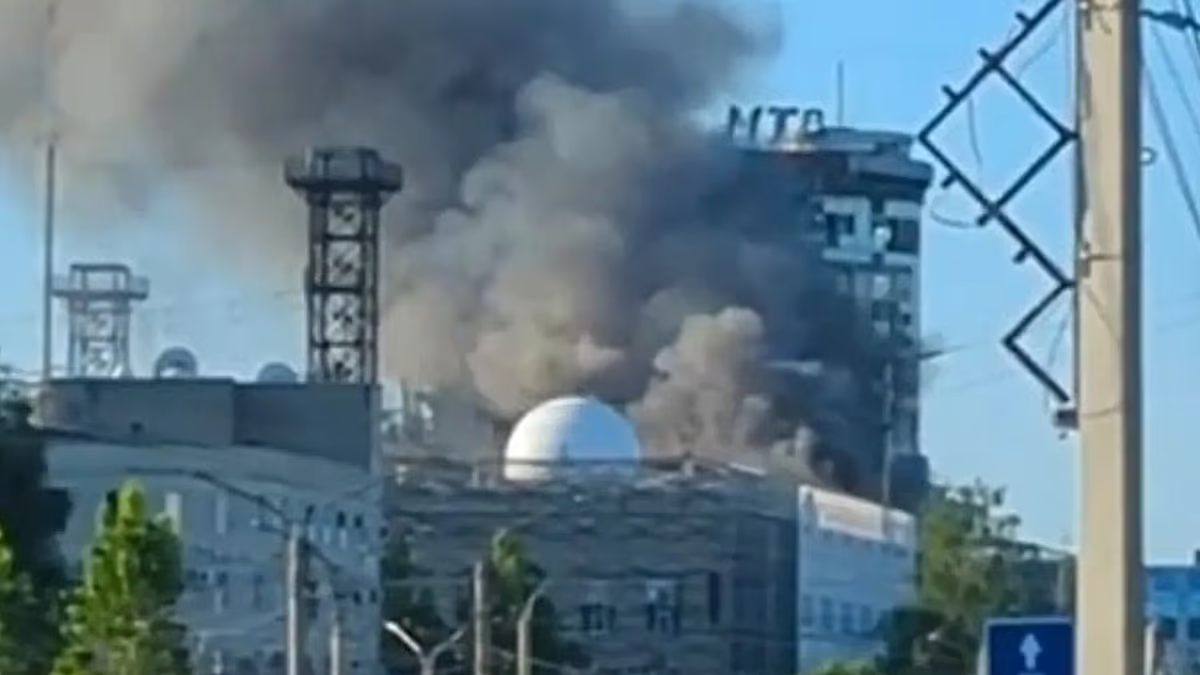
In a significant demonstration of its evolving military capabilities, Ukrainian forces successfully struck a critical Russian military facility deep inside Russian territory. President Volodymyr Zelenskyy confirmed on Wednesday that Ukrainian-made Flamingo missiles were used to hit a plant in the city of Cheboksary, located roughly 1,000 kilometres from the Ukrainian border. This facility, known as the VNIIR-Progress plant, is a vital cog in Russia’s war machine, supplying components for drones and missiles such as the Shahed attack drones and Kalibr cruise missiles. The strike, which regional governor Oleg Nikolayev acknowledged, underscores Ukraine’s stated strategy of applying “long-range sanctions” — a term Zelenskyy used on social media — to disrupt the logistical and industrial backbone supporting Russian forces on the front lines.
The attack on Cheboksary was not an isolated event but part of a coordinated long-range assault targeting Russia’s military-industrial complex. On the same night, Ukrainian forces also struck the Kuibyshev oil refinery in the Samara region, over 900 kilometres away, and two oil infrastructure sites in the Vladimir region, about 700 kilometres from the border. The Kuibyshev refinery, processing millions of tonnes of oil annually, is a key supplier of fuel for Russia’s military. By targeting both component manufacturing and energy infrastructure, Ukraine aims to constrict the flow of essential materials and fuel needed to sustain Russia’s drone and missile campaigns, as well as its ground operations, thereby challenging the sense of security long enjoyed by Russian territory far from the frontline.
The weapon enabling these strikes marks a pivotal development in the conflict: the domestically produced FP-5 Flamingo cruise missile. First unveiled in August 2025, the Flamingo is reported to have an impressive strike range of up to 3,000 kilometres and can carry a substantial warhead. Its deployment in these deep-strike missions signals a growing degree of self-reliance in Ukraine’s defence industry, reducing dependency on Western-supplied long-range munitions. The mere existence of such a weapon extends the battlefield, forcing Russia to disperse and defend assets across a vast geographical area, which strains its air defence resources and complicates military planning.
Beyond its offensive capabilities, the company behind the Flamingo, Fire Point, is ambitiously looking to the future of integrated air defence. The company has announced the test flight of an interceptor variant, the FP7.X, designed to form the foundation of a new missile defence system. This project aims to create a comprehensive system capable of countering ballistic missiles, with the ultimate goal of establishing a unified pan-European air and missile defence network. As co-owner Denys Shtilierman indicated, discussions are already underway with European partners to develop a cost-effective alternative to systems like the US Patriot, potentially reshaping continental security architecture.
For Ukraine, the strategic implications are profound. The ability to manufacture and deploy long-range precision weapons like the Flamingo provides a sustainable means to retaliate against and degrade Russian military production. It represents a tangible shift from a posture of pure defence to one of active, strategic disruption. Each successful strike on a facility like VNIIR-Progress not only damages physical infrastructure but also carries a psychological weight, demonstrating to both the Russian leadership and the Ukrainian public that Ukraine can reach into the heart of Russia’s military-industrial complex.
This evolution underscores a longer-term trajectory for Ukraine’s role in European security. By developing advanced weapons systems for both strike and defence, Ukraine is transitioning from a recipient of military aid to a potential partner and innovator in defence technology. The vision articulated by Fire Point for a collaborative European air defence system suggests a future where Ukraine’s hard-won expertise and industrial capability contribute directly to regional stability. While the immediate context remains the brutal reality of war, these technological strides point toward a future where a resilient Ukraine stands not only as a defender of its own sovereignty but as a contributor to a more secure Europe.