



Of course. Here is a humanized and expanded summary of the event, structured into six paragraphs.
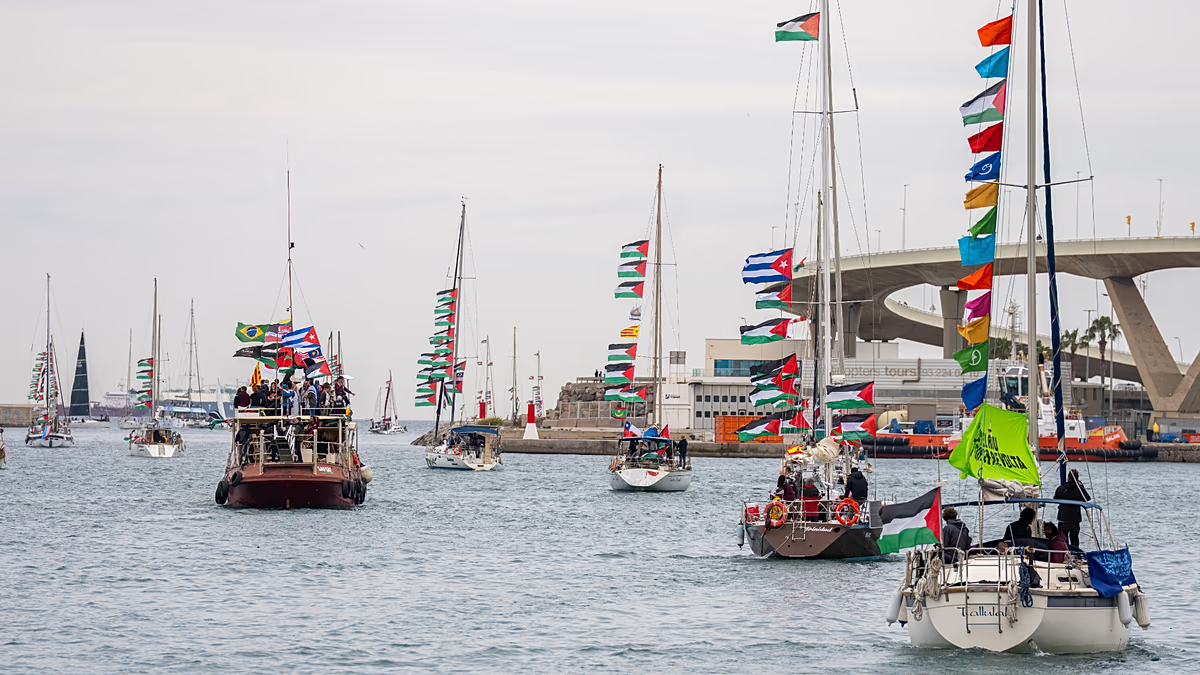
In a scene that unfolded far from the shores of Gaza, the intended destination, dozens of activists from the “Global Sumud Flotilla” disembarked on Friday on the Greek island of Crete. They arrived not on their own terms, but escorted by Greek coast guards after a dramatic interception by Israeli forces in international waters near Crete the previous day. The activists, numbering between 175 and 211 according to conflicting reports, were transferred from their flotilla vessels to an Israeli ship before being brought to Greek soil. Authorities, opting for discretion, moved them in four buses to an undisclosed town on Crete, with plans to subsequently fly them to Athens for final repatriation through their respective embassies. This quiet logistical conclusion on a Greek beach marked the end of a journey that began with much louder political ambitions.
The flotilla’s mission was declaredly humanitarian and defiantly political. Initially consisting of more than 50 boats, organizers aimed to “break the blockade” of Gaza and deliver aid directly to the Palestinian territory. This action was framed as a necessary challenge, highlighting that despite a fragile ceasefire since October, access to Gaza remains severely restricted. The organizers sought to physically and symbolically pierce this isolation, casting their voyage as a direct lifeline to a population in enduring need. However, this objective clashed fundamentally with Israel’s long-standing security policy, which views such maritime approaches as a threat that could allow materials or personnel supportive of Hamas to enter the coastal strip.
The interception itself triggered an immediate and sharp international reaction, revealing deep fissures in diplomatic perspectives. Several European governments, whose nationals were among the detained activists, strongly condemned Israel’s action. They described the seizure of vessels in international waters as a “flagrant contravention of international law” and called for the immediate release of the participants. This stance was encapsulated by the Greek Foreign Ministry, which, while facilitating the disembarkation, issued a statement calling for “restraint and universal respect for international law, including international law of the sea.” This position contrasted starkly with that of Israel’s closest ally.
The United States provided unequivocal backing to Israel, framing the flotilla not as a humanitarian mission but as a provocative “political stunt.” A U.S. State Department spokesman explicitly urged all allies to deny port access, docking, and refueling to the flotilla vessels, endorsing a strategy of preemptive obstruction. Israeli Foreign Minister Gideon Sa’ar publicly thanked Greece for its cooperation in receiving the activists, confirming the operation was conducted “in coordination with the Greek government.” This alignment showcased a coordinated effort between Israel, the U.S., and Greece to neutralize the flotilla’s progress before it could reach nearer to Gaza, treating it primarily as a security and political challenge rather than a humanitarian convoy.
The event resurrected the potent symbolism and painful memories of previous flotilla confrontations, most notably the 2010 Mavi Marmara incident, which resulted in lethal violence and a profound international crisis. While this latest interception ended without reported physical injuries, the underlying narrative conflict remained identical: a clash between the principle of free maritime passage and humanitarian access on one side, and a state’s assertion of its right to enforce a defensive blockade, even in international waters, on the other. The activists embodied the “Sumud” (steadfastness) they named themselves after, attempting a act of solidarity. Israel’s response embodied its unwavering stance on controlling all avenues of approach to Gaza, citing security imperatives rooted in the conflict with Hamas.
Ultimately, the flotilla’s tangible outcome was a redirected journey for the activists and an uncertain fate for the humanitarian aid they carried. Their boats were intercepted, their course altered, and their personnel repatriated through a coordinated diplomatic and logistical process. The aid itself did not reach Gaza via the sea. The event, however, succeeded in its symbolic political outcome: it forcefully reignited the debate over Gaza’s blockade on the international stage. It prompted governments to articulate their positions on maritime law and humanitarian principles, and it highlighted the enduring, stark dichotomy in viewpoints—where one side sees a lawful security measure and a meaningless stunt, the other sees a unlawful violation and a meaningful act of defiance aimed at alleviating human suffering. The waters off Crete thus became not a corridor for aid, but an arena for this unresolved and profound contention.