


The human need for sanctuary and safety remains one of the most pressing challenges of our time. In a stark report released in June 2026, the United Nations Refugee Agency (UNHCR) laid out a daunting figure: nearly 2.4 million refugees across the globe will require resettlement in the coming year. These individuals, hailing from 43 different countries and currently living in 76 nations of asylum, find themselves in a perilous limbo. They cannot safely return to their homelands, yet they also face significant dangers or untenable conditions in their countries of first refuge. The UNHCR’s warning underscores a growing crisis—a dire and widening gap between the sheer number of people in desperate need of a fresh start and the world’s willingness to provide it.
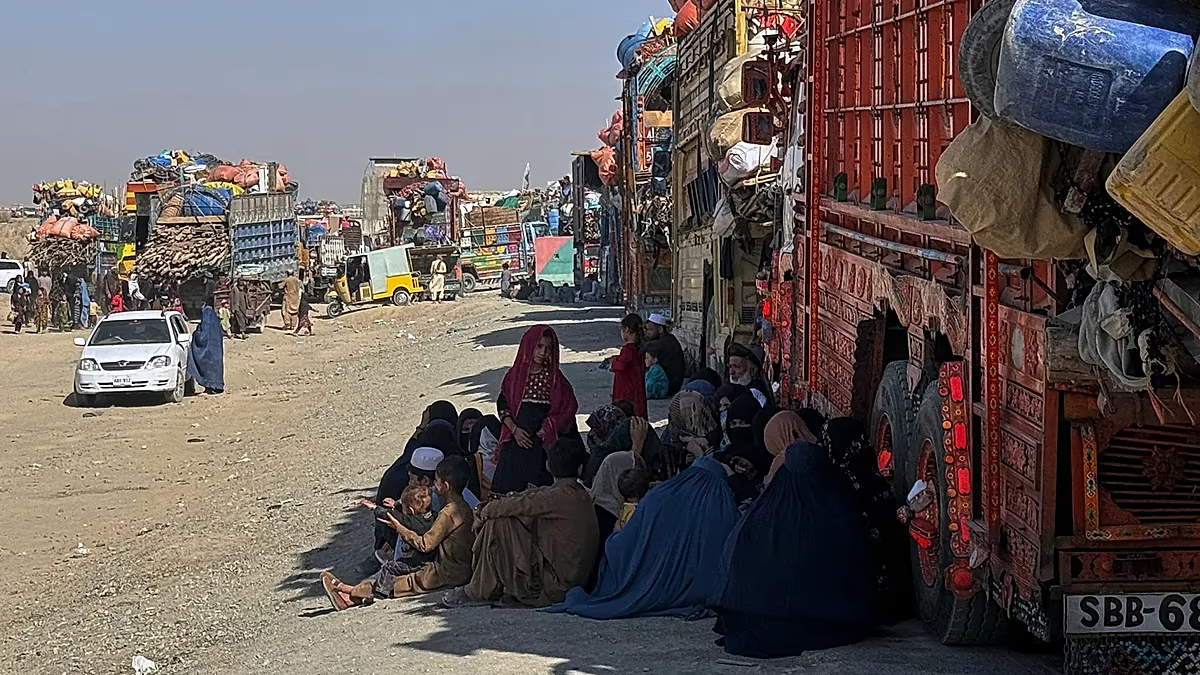
The profiles of these millions tell a story of protracted conflicts and enduring instability. The largest group in need remains refugees from Afghanistan, a testament to a crisis spanning decades. They are followed by people fleeing the brutal conflicts in South Sudan and Sudan, those escaping the long-standing civil war in Syria, and Rohingya refugees from Myanmar, hundreds of thousands of whom continue to live in sprawling, precarious camps in Bangladesh. While the 2.4 million figure represents a slight 6% decrease from the previous year, this is not a simple sign of improvement. UNHCR officials explained this drop is partially due to Afghans returning from Iran and Pakistan under “adverse circumstances”—often a euphemism for coercion, destitution, or fear—and a slight increase in voluntary returns to Syria following a major political shift there. These are not truly free or safe choices, but rather reflections of deteriorating conditions in host countries or fragile hopes in unstable homelands.
Against this backdrop of immense need, the actual machinery of global resettlement has nearly ground to a halt. In a devastating statistic, UNHCR reported that only about 37,000 refugees were resettled to a new country with its assistance in 2025. This number represents a catastrophic drop from 116,000 just the year before. To put this in perspective, the system is now meeting less than 2% of the identified need. This means that for every refugee who boards a plane to a new life, dozens more are left behind in camps, urban shelters, and uncertain legal status, their hopes deferred indefinitely. This collapse in resettlement is not a natural phenomenon but a direct result of political decisions made in the world’s wealthiest nations.
A significant driver of this decline is the dramatic shift in policy from the United States, historically the world’s largest recipient of resettled refugees. Shortly after the return of President Donald Trump to the White House in 2025, the U.S. slashed its refugee admissions cap to a fraction of its historical levels. This sent a chilling signal across the globe and placed an impossible strain on an already fragile international system. However, as UNHCR’s Jackie Keegan emphasized, this is “not just the US.” Other traditional resettlement countries, including several in Europe and the Anglosphere, have either drastically reduced their own quotas or suspended their programs altogether. In a time of rising inward-looking politics and economic anxiety, the principle of shared responsibility for protecting the world’s most vulnerable has been severely weakened.
In response to this mounting emergency, UNHCR officials are issuing a clear and urgent call to action. “Expanding resettlement is urgent and achievable,” stated Jackie Keegan, who leads the agency’s durable solutions team. The blueprint she outlined is straightforward but requires political will: existing resettlement countries must increase their annual quotas, new nations must be brought on board to share the responsibility, and bureaucratic processing must be accelerated to offer hope more swiftly. “Increased quotas, bringing more countries on board, and accelerating processing will ensure this life-saving tool reaches more of those in need,” Keegan told journalists in Geneva. At its core, this is an appeal to rebuild a lifeline that has been systematically dismantled.
Ultimately, the resettlement deficit is more than a statistic; it is a profound failure of global solidarity. Each of the 2.4 million individuals identified by UNHCR is someone whose life remains on hold, whose safety is not guaranteed, and whose future is uncertain. Resettlement is not the solution for all refugees, but for those in the most vulnerable categories—survivors of torture, unaccompanied children, women at extreme risk—it is often the only path to safety and stability. As Keegan concluded, “Recommitting to protection and solutions is more critical than ever.” The world stands at a crossroads: it can continue to retreat behind walls and lowered quotas, or it can choose to revitalize one of the most concrete expressions of humanitarian compassion—offering a permanent home to those who have lost everything. The choice will define our collective character for years to come.